
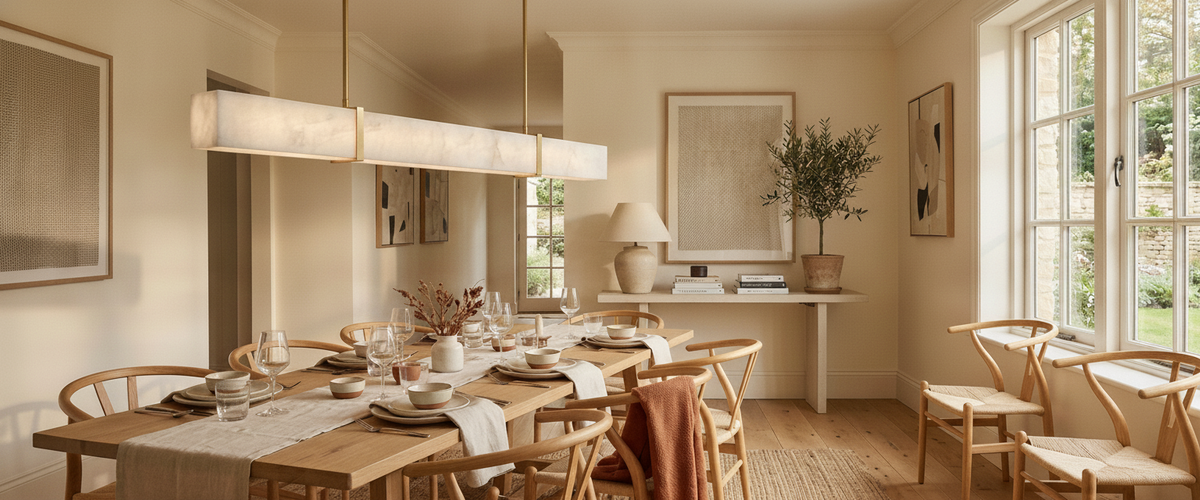

The real test of any chandeliers for dining room use happens the moment the light lands on a full table: white plates, wine glasses catching the source, and the faces of the people you sat down to enjoy. Get that wrong and the most expensive fixture in the house works against you. Cutlery flares, stemware throws hard little pinpricks of glare, and half the table sits in a shadow no one wants to mention. Choosing among dining room chandeliers is less about the piece looking good empty and more about what it does once the room is in use.
Niori works in alabaster and natural stone, so we look at chandeliers for dining room use from the light quality first. A stone shade softens and spreads the source in a way bare bulbs and cut crystal never will, and over a dining table that difference is the whole game.

Key Takeaways Before You Buy
Size to the table, not the room. A chandelier should read as roughly half to two-thirds the width of the table beneath it.
Hang it low. Around 30 to 34 inches (76 to 86 cm) above the tabletop for a standard 8-foot ceiling, raised a little for higher rooms.
Match the shape. Round table, round or compact fixture. Long table, a linear chandelier.
Kill the glare. Diffused sources like alabaster flatter food and skin; exposed bulbs and hard crystal reflect off glass and cutlery.
Always specify a dimmer. One fixture has to cover prep, dinner and the slow end of the evening.

What You Are Actually Lighting
People forget the dining table is a reflective surface. Polished porcelain, glassware, silver, a lacquered tabletop; every one of them bounces light back up. A raw source directly overhead turns that reflection into glare, so guests squint slightly without knowing why. The job of a good dining room chandelier is to put warm, even light onto the food and the faces around it while keeping the source itself easy on the eye.
This is where material matters more than shape. Alabaster is naturally translucent, so light passes through the stone and comes out softened and warm, with the fine veining giving it a gentle unevenness that reads as candlelight rather than a bulb. Translucent materials scatter light instead of transmitting it in a hard beam, and that scattering is exactly what you want above a table (the US Department of Energy notes that diffusers spread light and cut glare). Browse the alabaster lighting range and you will see how much calmer a stone-shaded piece looks against a crystal one. It is the reason our chandeliers for dining room settings lean on stone rather than cut glass.

Round Table, Linear Fixture and Other Mismatches
A common and costly error: a long linear chandelier dropped over a round or square table. The fixture overshoots the ends and leaves the sides dim, and the geometry never settles. The fix is simple once you name it.
Round or square table: a round chandelier or a compact cluster centred over the middle.
Rectangular or oval table: a linear chandelier that runs along the length, ideally two-thirds of the tabletop length so the ends are still lit.
Very long refectory-style table: two matching pendants or a long linear dining room chandelier rather than one heroic centrepiece that only lights the middle.
For the rectangular case, a linear chandelier in the dining room does the heavy lifting. A stone linear bar throws an even wash down the whole run of the table instead of concentrating everything in one spot. Where the table wants soft diffusion rather than sparkle, a piece such as the Oria LED Linear Alabaster Chandelier spreads light along the length without a single hot point, and the horizontal Selvara 3 Light Alabaster Linear Chandelier does the same in a leaner, matt-black frame. Among linear chandeliers for dining room use, these read calmest. If you prefer sparkle, the crystal linear designs deliver more glitter, though they demand more care about glare, which we come back to below.
What Size Chandelier for a Dining Room
Start with the tabletop, not the floor plan. A dining room table chandeliers that reads as roughly half to two-thirds of the table's width sits in proportion; anything much smaller looks lost, and anything much wider crowds the diners at the ends. Sizing chandeliers for dining room tables always begins with the surface below.
A working method: measure your table width in inches, then aim for a fixture diameter (or length, for a linear piece) of around half to two-thirds of that. A 42-inch-wide round table suits a fixture around 24 to 28 inches across. A 96-inch (8-foot, roughly 2.4 m) rectangular table wants a linear piece around 48 to 60 inches long. These are starting points, not laws; ceiling height and the visual weight of the design shift things.
How High to Hang a Dining Room Chandelier
The height question comes up more than any other, so here is the direct answer. Hang the bottom of the fixture around 30 to 34 inches (76 to 86 cm) above the tabletop for a standard 8-foot (2.4 m) ceiling. That range clears sightlines so people can see each other across the table, keeps the source out of direct eye line when seated, and still throws light where the plates are. Most chandeliers for dining room tables read best inside that band.
For every extra foot of ceiling height above 8 feet, raise the fixture by roughly 3 inches (about 7.5 cm). A double-height dining room needs more drop rod, not a fixture stranded near the ceiling. The reference is the seated eye line, and 30 to 34 inches above the surface is the sweet spot however you phrase the question: how high to hang above the table, or how high overall.
One studio note from a project we shipped to a Napa dining room: the client had a 10-foot ceiling and initially wanted the fixture pushed high for drama. We talked them into keeping it at table-reference height with a longer rod. Once the table was set, the difference was obvious; the light actually reached the food, and the room felt intimate rather than cavernous.
Why Glare off Cutlery and Stemware Ruins a Good Chandelier
An exposed filament reflected in a wine glass is a small, sharp point of light that the eye keeps snagging on. Multiply that by ten bulbs and a table full of glassware and you get a fixture that photographs well and dines badly. Cut crystal compounds the problem because it is designed to break light into hard sparkle, which is lovely in a hallway and less kind over a plate of food. This is the trap most chandeliers for dining room shoppers walk into.
Alabaster and marble sidestep this. Because the light emerges already diffused, there is no single hot point to bounce off the stemware. Skin tones look warmer, food looks appetising rather than clinical, and no one at the table is fighting a glare spot. If you love the glamour of crystal, pair it with a strong dimmer and lower-output warm bulbs so the reflections stay soft. Where you want that glamour but still need it to sit comfortably over a large table, a broad piece such as the Wisteria 16 Light Crystal Linear Chandelier in French gold shows how much length a crystal run can carry before the sparkle becomes glare. You can compare the crystal and stone approaches across the wider lighting collection.
Dimming Through the Courses
One dining room chandelier has to do several jobs across an evening. Laying the table and clearing plates wants brightness. Dinner itself wants something warmer and lower. The long tail of the evening, wine and conversation, wants almost candlelight. A dimmer is not optional on a dining fixture; it is the control that turns one piece into three moods, and it is what makes chandeliers for dining room use earn their keep.
Specify warm-dimming or good-quality dimmable LED sources around 2700K for a domestic table. Confirm the dimmer module suits the driver in your chosen fixture, and if you are unsure, have a qualified electrician confirm compatibility before installation. Cheap dimmers on LED drivers are the usual cause of flicker and buzz. Alabaster's diffusion works beautifully at low levels because the stone keeps a gentle glow even when the output drops, rather than collapsing to a dull spot.
The Dark-Corner Problem
A single fixture centred over the table lights the table and very little else. Diners with their backs to the room can end up under-lit, and the corners of the dining room fall away into gloom that makes the whole space feel smaller. This is a layering issue, not a chandelier fault.
Add a pair of alabaster wall lights on the flanking walls, or a stone table lamp on a sideboard, to fill the perimeter. The chandelier handles the table; the secondary layer lifts faces and stops the shadow effect. In a modern dining room chandelier scheme this layering is what separates a considered room from a showroom photo. Even one warm point of light at eye level on a side wall changes how the whole room reads, and it lets your chandelier for the dining room stay focused on the food.
A Quick Buyer's Checklist
Measure the tabletop and choose a fixture around half to two-thirds of its width or length.
Match the shape: round to round, linear to rectangular.
Plan a 30 to 34 inch drop above the table, adjusted up for tall ceilings.
Favour a diffused source, alabaster or marble, over exposed bulbs above a reflective table.
Confirm a compatible dimmer and warm bulbs, checked with an electrician if needed.
Add wall or sideboard lighting so no diner sits in shadow.
Get those six things right and the fixture earns its place every night, not just in the estate-agent photo. That is the standard we hold every piece to, and the way we think chandeliers for dining room tables should behave, from a compact stone cluster over a breakfast round to a long linear chandelier down a dining table built for twelve.