
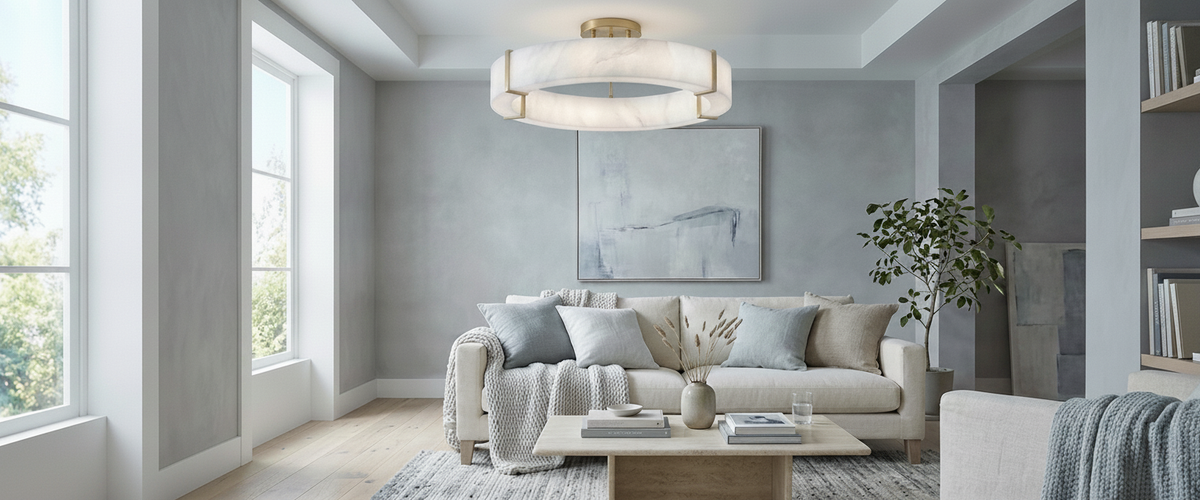

The first thing that goes wrong with ceiling lights in a living room is scale, and it happens long before anyone touches a dimmer. A fitting looks generous on a screen, arrives, and then hangs there like an afterthought because nobody did the maths on ceiling height and room proportion first. A good maker runs those sums before drawing a single line, which is why the best ceiling lights living room owners end up loving are chosen with intent rather than guesswork.
Niori works in alabaster and natural stone, so the way light moves through material sits at the centre of every decision we make. That gives us a slightly opinionated view of what ceiling lights living room buyers should look for: warm the room from above without glare, hold their own as objects when switched off, and never fight the daylight. Below is how the thinking actually goes.

Key Takeaways Before You Choose
Size to the room, not the ceiling rose. Room dimensions and ceiling height decide the fitting's diameter and drop, not habit or a showroom photo.
Stone selection sets the glow. Veining and thickness change how alabaster carries light, so no two ceiling lights living room shoppers see will read the same overhead.
One ceiling light is rarely enough. Layer it with table and floor lamps so the room isn't flatly lit.
Ask about the wiring and the block. The honest questions to raise with any maker are about materials, engineering and lead time, not just finish.
Budget depends on scale, stone, complexity and installation. Ask for a tailored quote rather than trusting a flat figure.

The Ceiling-Height and Room-Size Sums We Run First
Choosing living room lights starts with two measurements: the floor area and the height from floor to ceiling. A useful rule for a central pendant or flush fixture is to add the room's length and width in feet, then read that total in inches as a rough guide to fixture diameter. A 16 by 14 foot room (about 4.9 by 4.3 m) lands near 30 inches (76 cm) of visual presence, whether that comes from a single piece or a cluster. This is where most ceiling lights living room projects either succeed or fall flat.
Ceiling height then decides whether you hang or hug. Standard ceilings around 8 to 9 feet (2.4 to 2.7 m) usually call for a flush or semi-flush fixture so nobody walks into it and the room keeps its air. In a room of that 16 by 14 foot order, a broad flush piece such as the Gemini Flush Ceiling Light 81cm holds the centre without any drop into the space, while a smaller sitting room is better served by the 42.5cm version so the fitting reads in proportion rather than dominating. Taller ceilings, the kind you find in a converted warehouse or a double-height sitting room, can take a hanging alabaster piece with real drop. As a working figure we leave at least 7 feet (2.1 m) of clearance under any suspended fitting in a walk-through zone, more over seating where the sightline matters. Those numbers shape ceiling lights living room designs before aesthetics get a vote.

Craft Decisions That Quietly Move Both the Look and the Price
Two living room lights fixtures can look near identical in a photo and cost very different sums to make. The difference sits in choices you cannot always see. Solid carved alabaster behaves differently from thin cut panels: the carved piece diffuses light with more depth but weighs more, which means a sturdier mount and heavier engineering above the ceiling. Brass detailing that is machined and hand-finished reads warmer than a plated substitute, and it ages better. Where a room already leans warm and you want the metalwork to echo it rather than recede, a finish like the Gemini Flush Ceiling Light in Brushed Brass carries that warmth in the rim itself.
The mount itself is a quiet cost too. A flush ceiling light that carries a stone shade needs a backplate rated for the load, wired to sit tight against the ceiling. Buyers comparing ceiling lights living room options rarely see this part, which is exactly why it is worth asking about. If you want to see the range of forms these decisions produce, our full lighting collection is a good place to compare pendants, flush fittings and lamps side by side.
Why Stone Selection and Veining Decide How the Fitting Glows Overhead
Alabaster is not a uniform material, and that is the point. Each block carries its own veining, translucency and colour in the stone itself, so light pushed through it comes out warm and slightly uneven in the way candlelight is uneven. The Metropolitan Museum of Art notes that alabaster has been prized since antiquity precisely because it transmits light while staying opaque enough to hold form (metmuseum.org). That is the quality we are selecting for when we choose which part of a block becomes a ceiling shade.
Thickness matters as much as pattern. A thicker section glows softly and hides the light source; a thinner cut lets more brightness and more veining read through. For ceiling lights living room use we usually favour a section that softens the source, because you are looking up at it more often than you would a table lamp. When you browse our alabaster lighting, the variation you see between pieces is not a flaw to be ironed out. It is the reason natural stone lights never look mass-produced overhead.
From Raw Block to Wired Fixture: The Workshop Sequence
A living room with light this considered starts as a rough block of stone. The sequence runs roughly like this: the block is inspected and cut to reveal its veining, the shade is shaped and hollowed, then the surface is worked back until the wall thickness carries light the way we want. Only then does the metalwork get fitted, the wiring routed, and the whole piece tested lit before it leaves. That is the making side of ceiling lights living room owners never watch, but it decides everything.
The lesson we learned early, and it still catches people out, is that stone does not forgive a rushed mount. We once remade a flush fixture for a client with a plaster ceiling that could not take the original backplate load. The fix was a wider mounting plate spreading the weight, not a heavier bracket. Small engineering detail, big difference to whether the fitting sits flat for years. Ask any maker how they handle the ceiling side of the job, not just the visible side.
Layering So the Living Room Isn't Flatly Lit
A single ceiling light, however good, flattens a room if it works alone. The living room lighting ideas that actually feel warm always use at least three sources at different heights. Think of the ceiling fixture as the general wash, then add a table lamp for reading beside the sofa and a floor lamp to throw light into a dark corner. Alabaster works beautifully across all three because the material speaks to itself: a stone table lamp echoes the ceiling piece without matching it exactly. Good ceiling lights living room schemes never carry the whole load alone.
Recessed downlights, the can lights people ask about, have a place in this layering too, mostly for even background fill. A sensible can light layout in a living room spaces fittings roughly 4 to 6 feet (1.2 to 1.8 m) apart and keeps them off the walls to avoid harsh scallops. On can light placement in a living room, aim them at what you want seen, artwork, a fireplace, a bookshelf, rather than dotting the ceiling on a grid. Then let the alabaster ceiling fixture and the lamps carry the mood. The recessed layer is support, not the star.
What Wattage and Bulbs to Use
For lights for a living room, warmth beats raw output. We recommend LEDs in the 2700K range for a relaxed evening feel; push to around 3000K only if the room doubles as a workspace. On brightness, aim for roughly 10 to 20 lumens per square foot as a starting point across all your living room lights combined, weighted toward lamps rather than a single bright ceiling source. In old wattage terms that is usually equivalent to a 40 to 60 watt bulb per fitting, but read the lumens, not the watts, since LEDs deliver far more light per watt. The same logic applies to ceiling lights living room buyers pairing a stone shade with the right bulb.
Dimming is not optional in a living room. Fit dimmable LEDs on a compatible dimmer and check the pairing before you commit, because a mismatched driver flickers at low levels. The Chartered Institution of Building Services Engineers publishes solid guidance on lighting levels and comfort if you want to go deeper (cibse.org). And always have living room ceiling lights wired by a qualified electrician; stone fittings carry weight and the mount needs doing properly.
Red Flags to Raise Before You Pay a Deposit
No answer on stone origin or thickness. A maker who cannot tell you how the alabaster is cut probably buys shades in.
Vague on the mount. Ask what backplate the flush fitting uses and how it handles a plaster or lath ceiling. Silence is a warning.
One size fits all. If nobody asks your ceiling height and room dimensions, the sizing on your ceiling lights living room order is a guess.
A flat price with no detail. Cost should reflect scale, stone, complexity and finishing. Ask for a tailored quote and an itemised breakdown.
No lit test before dispatch. Stone should be checked lit, since veining only truly reads with light behind it.
Get those answers and the rest of the decision becomes about taste, which is the enjoyable part. Start from the room's measurements, choose stone that glows the way you want overhead, and layer your ceiling lights living room scheme with lamps so nothing feels flat. That is how a living room ends up lit like it was designed, not decorated as an afterthought. To see the forms and finishes together, the Niori homepage is the easiest way in.