

One bright fitting in the middle of the ceiling turns a bedroom into a waiting room. Everything gets lit at once, shadows go flat, and the last thing you see before bed is a hard downlight staring back at you. The room does its job, technically, but it never feels like somewhere you want to slow down. Good bedroom lights fixtures work the opposite way; they give you pools of soft light where you need them and let the rest of the room fall away. That is what the best bedroom light fixtures do.
Getting there is less about spending more and more about choosing the right pieces for the right heights and switching them properly. At Niori we make alabaster and natural-stone lighting, and the bedroom is where that material earns its keep, because stone diffuses light instead of throwing it. The right bedroom light fixtures lean on that quality.
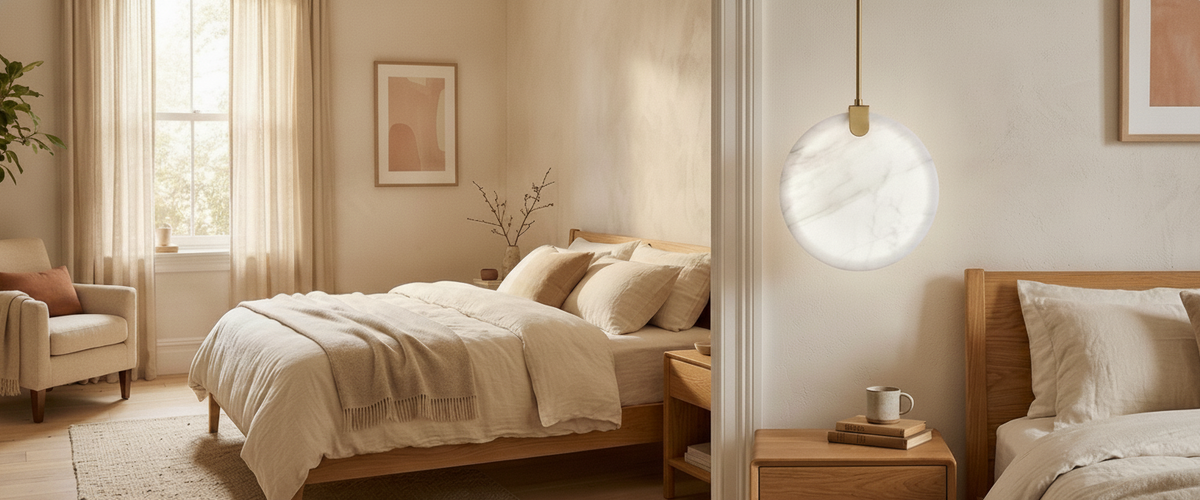
A layered scheme of alabaster fittings at ceiling, bedside and wall height.

Key Takeaways for Bedroom Lighting
Use at least three layers: an overhead source, bedside light, and one accent or wall light.
Warm colour temperature (around 2200K to 2700K) reads as restful; cooler light keeps you alert.
Put every fixture on a dimmer you trust, especially for the last hour awake.
Aim light so it never catches you flat in the eye when you are lying down.
Alabaster and stone shades soften glare that a bare bulb or thin glass cannot.

Why One Ceiling Fitting Is Never Enough
A lone ceiling light gives you a single flat wash from above. It is fine for finding a lost sock and useless for everything else. There is no light at pillow height for reading, nothing to soften the corners, and no way to drop the level gently as the evening winds down. You end up with two states, full glare or total dark, and nothing in between. One fitting cannot do the work that layered bedroom light fixtures do together.
The fix is layering. Think of your bedroom light fixtures as three jobs rather than one fitting: general light to move around safely, task light for reading and dressing, and accent light that sets the mood. Once you separate those jobs, you can control each one on its own, and the room finally behaves after dark. You can see how these roles play out across pendants, wall lights and lamps in the wider lighting collection.

The Three Layers That Make a Bedroom Restful
Layer One: The Overhead Source
Your ceiling layer sets the base level. Bedroom ceiling lights do not have to be dramatic, but they should be soft. A flush or semi-flush alabaster fitting spreads a diffused glow rather than a spotlight, which matters in a room where you often look up from the bed. If you have the ceiling height, a compact chandelier or pendant adds presence without needing to be the only fitting you ever switch on. This is the first of the bedroom light fixtures you should plan.
Whatever you choose for lights on the ceiling of a bedroom, put it on its own dimmer. The overhead layer should almost never run at full after sunset; it is there for the first few minutes when you walk in, then it comes down.
Layer Two: Bedside Light
This is the layer people get wrong most often. Bedside light needs to land on your book or phone without shining across the bed into your partner's eyes. A pair of table lamps with stone shades handles this well, because the shade glows evenly and the spill stays close to the surface. Wall-mounted reading lights work even better in a tight room, since they free up the nightstand and let you aim the beam. Among bedroom light fixtures, these are the ones you reach for nightly.
Layer Three: Wall and Accent Light
The third layer is where a room stops feeling functional and starts feeling considered. A sconce light fixture in the bedroom throws light up or down a wall and creates the soft vertical glow that makes a space feel calm. Wall lights for the bedroom are also the discreet choice for small rooms, awkward alcoves, or either side of a headboard where a lamp would crowd the surface.
Alabaster sconces flanking a headboard keep glare off the pillow.
Ceiling, Bedside, Wall: What Each Fitting Does to the Mood
Each fixture type has a quiet personality, and good bedroom light fixtures play their part. Ceiling fittings set the overall level and are the least flattering when run bright, so they suit low, warm settings. Bedroom lights at bedside height create intimacy and are the ones you will actually reach for last thing at night. Wall lights shape the vertical planes of the room, and because they sit at or below eye level, they are the gentlest on tired eyes.
Matching material across the three helps them read as a set rather than a collection of solo purchases. A run of alabaster pieces, ceiling to bedside to wall, gives the same honeyed light at every height. You can browse pieces built for exactly this kind of layering in the alabaster lighting range.
Warm Tones and a Dim You Can Trust
Colour temperature is the single biggest lever for how a bedroom feels. Cool white light (4000K and above) keeps the brain alert, which is the last thing you want at eleven at night. Warm light in the 2200K to 2700K band mimics the glow of a low sun and signals wind-down. There is real science behind this; exposure to bright, blue-rich light in the evening suppresses melatonin and pushes your body clock later, as the Sleep Foundation sets out in its guidance on light and sleep. It is worth checking the bulbs inside your bedroom light fixtures land in that warm band.
Dimming matters just as much as colour. LED lights for the bedroom are the sensible default now for efficiency and lamp life, but not every LED dims cleanly. Look for bulbs rated as fully dimmable and pair them with a compatible trailing-edge dimmer, or you will get flicker and buzz at low levels. Some LEDs also warm as they dim, dropping toward candlelight tones at the bottom of the range, which is exactly the behaviour you want for the last hour awake.
What Wattage Should a Bedroom Bulb Be?
Think in lumens and colour temperature, not old watt numbers. For a bedside lamp, a bulb producing roughly 400 to 600 lumens is plenty for reading; for an overhead fitting in an average room, 800 to 1000 lumens gives you a soft general level with room to dim down. In LED terms that is usually a bulb between 6 and 10 watts. Keep every bulb across your bedroom light fixtures in the same warm colour temperature so the layers blend instead of clashing.
Placing Fixtures So Light Never Catches You Flat in the Eye
The hard-won lesson from years of shipping bedroom lighting is that mounting height decides everything. A beautiful fixture at the wrong height becomes a glare bomb the moment you lie down. Even the best bedroom light fixtures fail if they sit at the wrong level.
Bedside wall lights: mount so the bottom of the fitting sits roughly 24 to 30 inches (60 to 75 cm) above the mattress. High enough to clear your head sitting up, low enough to pool light on the page.
Overhead fittings: centre them over the foot or middle of the bed, not directly above where your face lands on the pillow. You never want to look straight up into a bulb.
Table lamps: the shade should sit near eye level when you are seated in bed, so light spreads sideways onto the book rather than up into your eyes.
Sconces beside a mirror or dressing area: mount in pairs at around eye level to light the face evenly and kill shadows.
One client fitting out a low-ceilinged coastal bedroom swapped a single central pendant for a pair of alabaster wall lights flanking the headboard plus a small flush ceiling fitting. Same footprint, completely different room. The glare was gone and the space finally felt like somewhere to unwind. Careful placement is what separates thoughtful bedroom light fixtures from a fitting that simply fills a socket.
How a Stone Shade Takes the Edge Off the Harshest Corner
This is where alabaster and natural stone do something a fabric or glass shade cannot, and it is why they suit bedroom light fixtures so well. Alabaster is naturally translucent, so light passes through the body of the stone and comes out softened and slightly warm, carrying the faint veining of the material with it. Instead of a hotspot, you get an even, low-glare glow that suits a room where eyes are tired and pupils are wide.
Stone also holds its character at every dimmer setting. As you drop the level, an alabaster shade keeps that gentle marbled warmth rather than turning murky. It is a forgiving material in the one room where forgiving light matters most. For care, treat it kindly: dust with a dry, soft cloth, avoid soaking it or using harsh cleaners, and let a qualified electrician handle any hardwired fitting or new wall light rather than tackling the mains yourself.
A Quick Buyer's Checklist
Plan three layers before you buy a single fixture: ceiling, bedside, accent.
Put each layer on its own switch or dimmer.
Choose warm bulbs, 2200K to 2700K, and check they are fully dimmable.
Confirm mounting heights against your mattress and headboard.
Match materials across fittings so the room reads as one scheme.
Budget honestly. Cost depends on material, scale, engineering, and installation, so request a tailored quote rather than guessing.
Get the layers and the colour temperature right and your bedroom light fixtures do the rest. Browse the full Niori range to see how alabaster and stone handle the softest light in the house.