

The bedroom ceiling light is the one fitting in your home you actually stare at, flat on your back, last thing at night and first thing in the morning. Most of them fail that test. A bright disc of LEDs or a cluster of bare crystal points straight into your eyes the moment you lie down, and no amount of styling fixes that angle. Choosing bedroom ceiling lights well is mostly about controlling where the light goes once you are horizontal, not about how the piece looks switched off in a showroom.
At Niori we make alabaster and natural-stone lighting, and the bedroom is where the material earns its keep. Stone shades soften and scatter the source so you get a glow rather than a glare. Below is how we steer clients through height, fixture type, warmth and dimming so your bedroom ceiling lights read as calm rather than clinical.
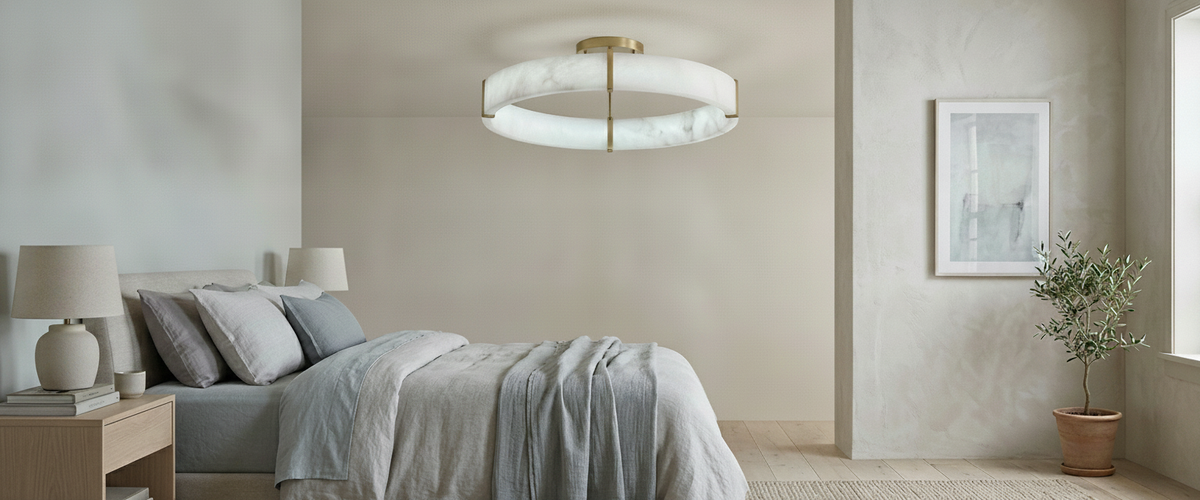
An alabaster flush fitting diffuses the source so the glow stays soft from the pillow.

Key Takeaways Before You Buy
Glare is the enemy. Pick a shade that hides the source from a lying-down eyeline, which is exactly what a diffusing alabaster or stone shade does.
Ceiling height decides format. Under about 8 feet (2.4 m), flush or semi-flush. Above that you have room for a low pendant.
Warm and dimmable, always. Aim for 2700K and a fitting that dims smoothly to a low ember.
Centre on the bed where it counts. Symmetry over the bed often reads better than dead-centre to the room.
Overhead supports, it does not replace. Pair your bedroom ceiling lights with bedside lamps rather than asking one fixture to do everything.

Why Ceiling Glare Ruins a Bedroom Faster Than Anything
Every other room you light for people who are standing or sitting. The bedroom is the exception. Your eyeline spends hours pointed almost straight up, so bedroom ceiling lights that look discreet from the doorway can be punishing from the pillow. Exposed lamps, clear glass and unshaded crystal all throw a hard point source right into your field of view.
This is the single biggest reason we favour stone in the bedroom. Alabaster is translucent enough to pass light but dense enough to blur the source behind it, so you see a warm lit surface instead of a filament. The Natural Stone Institute describes alabaster as a fine-grained gypsum prized for exactly this quality of light transmission, which is why it has been carved into windows and lamps for centuries (naturalstoneinstitute.org). In a bedroom that translates to a fixture you can look at without flinching.
Flush, Semi-Flush or Pendant: What Your Ceiling Height Allows
Start with a tape measure, not a wishlist. The format that works is the one your ceiling can carry without crowding the room or smacking anyone tall in the head.
The argument for flush bedroom ceiling lights starts at the ceiling itself. Carved thin and backlit, alabaster glows like a lit window rather than a fixture, which is exactly the effect you want when the source sits in your eyeline from the pillow. The stone's veining catches the light unevenly, so the surface reads as warm and alive rather than a flat plastic disc. Flush fittings shine when you have 8 feet (2.4 m) or less to work with, or a sloped loft section where a drop would crowd the bed. A piece like the Aleron LED Extra Small Round Alabaster Flush Ceiling Light spreads an even, soft pool and all but vanishes against the plaster when it is off. Less hardware, more light, no glare.
Semi-flush drops a few inches from the ceiling, which lets light wash slightly upward as well as down. That little gap softens the edges of the light and adds shadow play on the ceiling. Choose semi-flush when you have roughly 8 to 9 feet (2.4 to 2.7 m) and want a touch more presence than a pure flush gives. Where you want adjustable warmth without sacrificing that low profile, a fitting such as the Nur Dimmable LED Semi-Flush Ceiling Light handles the upward wash while still dimming to a settled level.
Flush sits tight to the plaster; semi-flush drops a few inches for an upward wash.
Pendants and low chandeliers need height and, usually, a bed they can sit over rather than a walkway. With ceilings above 9 feet (2.7 m) a stone pendant becomes a genuine option, hung so the lowest point stays well clear of standing head height. Browse the full lighting range to compare drops before you commit, then weigh them against the flush bedroom ceiling lights if the height is tight.
Centring on the Bed Versus the Room
Designers split on this, and the honest answer is that it depends on what your eye reads as the centre of the space. In a bedroom, the bed is almost always the visual anchor, so bedroom ceiling lights centred over the room but offset from the bed can look subtly wrong even when the maths is correct.
We shipped an alabaster semi-flush to a client in a converted barn whose architect had positioned the ceiling rose dead-centre to the four walls. The bed sat against one end, which left the light hanging awkwardly over the middle of the floor. The wiring could not be moved easily, so the fix was a wider, softer flush fitting that read as ambient room light, with the real bedside work handled by lamps. The lesson: if you can choose the position, centre it on the bed. If you cannot, choose a broad, diffuse fitting that does not demand to be the focal point.
Warm Output and Dimming Turn a Ceiling Light Into a Wind-Down Light
Colour temperature does most of the heavy lifting. For a bedroom you want warm light around 2700K, sometimes a hair lower. Cool white above 4000K belongs in a kitchen or a bathroom mirror, not over your bed, where it suppresses the wind-down cue your body is waiting for. The Chartered Institution of Building Services Engineers covers how colour temperature and illuminance shape the feel of a space in its lighting guidance (cibse.org).
Dimming matters just as much, and it is where good bedroom ceiling lights separate from cheap ones. An overhead fitting that only does full brightness is half a fixture. You want it to drop to a low, candle-like level for reading or settling without flicker. Two things make that reliable: a fitting built to dim, and a dimmer matched to its driver. If your light uses an integrated LED, check it is genuinely dimmable and that your wall control is compatible, because a mismatched dimmer is the usual culprit behind buzz and flicker. Where you want the colour temperature itself to shift through the evening, a remote-controlled fitting such as the Virgin CCT LED Flush Ceiling Light lets you move from a brighter daytime setting to a warmer wind-down tone without rewiring. When the wiring is involved, have a qualified electrician make the connection.
How a Soft Overhead Works With Bedside Lamps
The best bedroom lighting is layered, and the overhead is only one layer. Ask a single ceiling fitting to light the whole room and you end up with something too bright to relax under and too flat to read by. Let your bedroom ceiling lights handle gentle ambient fill, then put the task light where you need it, beside the bed.
Matching materials across the layers keeps the scheme calm. A pair of alabaster table lamps on the bedside tables echoes the glow of a stone flush fitting overhead, so the whole room shares one quality of light rather than fighting between warm and cool sources. You can see how the stone reads across fixture types in the alabaster lighting collection. The point is restraint: the overhead sets the mood, the lamps do the work.
The Fittings We Steer Clients Away From in Low Bedrooms
Some bedroom ceiling lights simply fight a bedroom, especially a low one. A short checklist of what we tend to talk people out of:
Multi-arm chandeliers with exposed lamps. Lovely from across a high-ceilinged hall, brutal from a pillow 7 feet (2.1 m) below.
Clear glass or unshaded crystal flush fittings. The crystal looks the part off, but switched on it scatters bright points across your eyeline. If you love the sparkle, save it for a hallway.
Anything with a deep drop in a low room. A pendant that hangs into head height over a dressing area is an accident waiting to happen.
Cool-white integrated panels. Efficient, yes, but the colour is wrong for sleep and rarely dims convincingly.
None of these are bad fittings. They are simply in the wrong room. For low ceilings, diffusing stone bedroom flush ceiling lights are almost always the safer, softer choice, and they age better than a trend-led fitting you tire of in two years.
A Quick Buyer's Checklist
Measure your ceiling height and decide flush, semi-flush or pendant before you shortlist.
Lie on the bed and imagine the fitting overhead. Would the source be visible? Choose a shade that hides it.
Confirm 2700K warm output and genuine dimmability across the bedroom ceiling lights on your list.
Centre on the bed where the wiring allows; choose a broad diffuse fitting where it does not.
Plan bedside lamps as part of the same scheme, ideally in a matching material.
Have a qualified electrician handle installation and dimmer matching.
Budget for a stone fitting depends on the material, the scale, the engineering inside it and the finishing, so it is worth requesting a tailored quote rather than guessing from a category price. Start at the Niori homepage to see how alabaster and natural stone behave across pendants, flush fittings and lamps, then narrow down by room from there. Chosen carefully, bedroom ceiling lights become part of how you wind down rather than something you tolerate.