
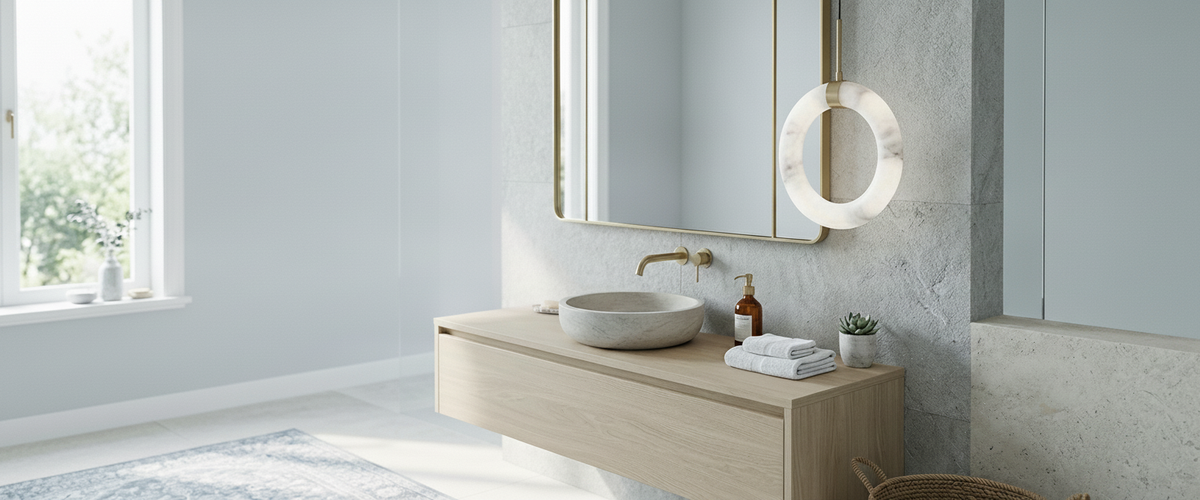

Stand at your basin at 7am and the mirror rarely lies about the light; it lies about you. That greenish, hollowed look most people blame on bad sleep is usually a lighting problem. Skin tones read as muddy, shadows pool under the eyes, and whatever you apply looks wrong the moment you step into daylight. The culprit is almost always position: a lone downlight in the ceiling, dropping hard light straight onto the top of the head instead of across the face. A bathroom mirror with lights corrects the geometry. It puts a source at the height your eyes, cheeks and jaw actually sit, so shaving, skincare and makeup happen in light that shows you what is really there.

Quick Answer: What Makes a Lighted Bathroom Mirror Work
Light from the sides beats light from above. Flanking or front-lit sources fill in shadows; top-down fittings create them.
Aim for colour around 2700K to 3000K for a warm, natural bathroom, with a high colour rendering index (CRI 90+) so skin tones read true.
Height matters. A bathroom mirror with lights above the glass generally sits around 75 to 80 inches (190 to 200 cm) from the floor, or roughly 6 to 12 inches (15 to 30 cm) above the mirror's top edge.
IP rating is not optional. Anything near a basin needs the right ingress protection for its zone under UK wiring rules.
Dimming saves your 6am face from a cold, full-brightness blast.

Why Top-Down Fittings Carve Shadows
Point light straight down onto a face and every raised feature casts a shadow below it. Brows shade the eyes, the nose shades the top lip, the chin drops a dark band across the throat. It is the same effect that makes overhead office lighting so unloved. For grooming this is worse than unflattering; it hides the detail you are trying to see. A recessed downlight over the basin can stay for general wash, but it should never be the only source behind a bathroom mirror with lights.
The better approach is to bring light closer to eye level and let it hit the face front-on. That is why the phrase bathroom lights over mirror is slightly misleading. A single strip above the glass helps, but it works best paired with light coming from the front or sides.
Front-Lit, Backlit and Edge-Lit: What Each Does to Your Reflection
A lighted bathroom mirror usually comes in one of three formats, and each has a job.
Front-lit mirrors carry an illuminated band or panel on the face of the glass, throwing light forward onto you. This is the most reliable format for a bathroom mirror with lights aimed at makeup and shaving, because the light lands where you need it. Look for a wide, even panel rather than a thin ring, which can leave the lower face underlit.
Backlit mirrors glow from behind the glass, casting a soft halo onto the wall. The effect is calm and architectural, and it flatters the room, but the light reaches your face indirectly. Good as ambient layering, weak as a working light on its own.
Edge-lit designs run illumination around the perimeter. They sit between the two: more face light than a pure backlit piece, softer than a full front-lit panel. If you want one bathroom mirror with lights to do everything, combine a front-lit or edge-lit face with a separate warm source elsewhere in the room.
Flanking Lights Versus Integrated Strips
The most honest face light in any bathroom comes from a matched pair either side of the mirror at roughly eye level, around 60 to 66 inches (150 to 168 cm) from the floor. Vanity theatres and film makeup rooms have used this arrangement for decades because side light fills shadows evenly on both sides of the face. If your layout allows a pair of bathroom lights above mirror plus flanking wall lights, you have the ideal setup: sides for the face, top for a gentle wash. For a flanking pair that reads as a soft diffused glow rather than a hard point of light, a frosted globe fitting such as the Globe Bathroom Wall Light IP44 in Matt Black sits close to the right design language.
Integrated strips built into a lighted bathroom mirror are tidier and easier to fit into small rooms. They give even light and no separate wiring to plan. The trade-off is flexibility; you cannot move or upgrade the light without changing the mirror. In a compact ensuite where wall space is tight, integrated wins. In a larger bathroom with room to breathe, flanking fittings look richer and light better. Where a top wash is the priority and you want it aimed rather than fixed, an adjustable bar such as the Globe 3 Light Bathroom Bar Spotlight in Polished Chrome lets you angle the glow onto the face instead of straight down the wall.
Colour Temperature and CRI: The Numbers That Keep Skin True
Two numbers decide whether your reflection looks like you. Colour temperature, measured in kelvin, sets the warmth. Around 2700K to 3000K gives a soft, homely light that suits most UK bathrooms and flatters skin. Push toward 4000K and you get a crisper, more clinical feel that some people prefer for detailed grooming; go much cooler and it starts to feel like a hospital. Match this to your bathroom mirror with lights and the reflection stays honest.
The number people forget is CRI, the colour rendering index. It measures how faithfully a light shows colour against daylight, on a scale to 100. For a mirror, aim for CRI 90 or above so foundation, concealer and skin tones read accurately rather than muddy. Higher colour rendering means better colour judgement, which is precisely the task you are doing at a mirror. A low-CRI bulb is the reason makeup applied at home can look wrong in daylight.
IP Ratings and Basin Zones: What Is Legal Above a UK Sink
Bathrooms are split into zones based on how close a fitting sits to water, and each zone sets a minimum IP (ingress protection) rating. Any fitting within the splash reach of a basin needs to be suitably rated, commonly IP44 or better. A bathroom mirror with lights directly over a sink is firmly in territory where a standard living-room fitting is not allowed.
This is where you should stop and involve a professional. Bathroom electrics must follow the UK wiring regulations, and any new circuit or fitting near water should be installed by a qualified electrician who can confirm the correct zone, IP rating and RCD protection. Guidance from Electrical Safety First is a sensible starting point before you buy, so you choose a fitting that is legal for its position rather than one you fall in love with and cannot use.
Where a Stone Wall Light Belongs Alongside a Lit Mirror
A mirror handles the working light. The atmosphere comes from everything else. This is where alabaster earns its place. Alabaster is a translucent stone that softens and warms whatever passes through it, giving a glow closer to candlelight than to a bare LED. A pair of alabaster or natural-stone wall lights flanking the mirror, or a single one on an adjacent wall, adds a layer of warm, diffused light that a lighted bathroom mirror alone cannot produce.
The look works because the veining in the stone catches the light and reads as texture rather than a lit box on the wall. In a stone or marble bathroom the material conversation feels intentional. You can see how alabaster behaves across our alabaster lighting range, and the broader lighting collection covers wall fittings and pendants that pair with a bathroom mirror with lights. Bear in mind that any stone fitting used in a splash zone needs the correct IP rating; many decorative pieces are best placed on a dry wall away from the basin and used alongside a properly rated mirror light.
Dimming and Switching: Killing the Cold 6am Glare
Full brightness at dawn is a shock nobody asked for. A dimmable bathroom mirror with lights lets you drop to a gentle level for a bath or a late-night visit and bring it up for shaving or makeup. If you fit dimming, check the driver or transformer is rated for it; the wrong pairing causes flicker and buzz, and LED dimming in particular needs compatible components.
Some lit mirrors offer switchable colour temperature, letting you flip between warm relaxation light and a cooler task setting. It is a genuinely useful feature if the same mirror serves both a soak and a morning routine. Wire the mirror and any ambient wall lights to separate switches so you can run soft mood light without the bright working layer.
A Short Buyer's Checklist
Choose front-lit or edge-lit for the truest face light; treat backlit as ambient.
Add flanking wall lights at eye level where space allows.
Target 2700K to 3000K and CRI 90+ for accurate skin tones.
Confirm the IP rating suits the zone above your basin.
Set a bathroom mirror with lights around 75 to 80 inches (190 to 200 cm) from the floor if it sits above the glass.
Specify dimming with compatible drivers, on a separate switch from ambient fittings.
Have all bathroom electrics checked and installed by a qualified electrician.
Get the direction, colour and height right and a bathroom mirror with lights stops fighting your face. Layer an alabaster wall light beside it and the room stops feeling like a showroom and starts feeling like part of the home.