
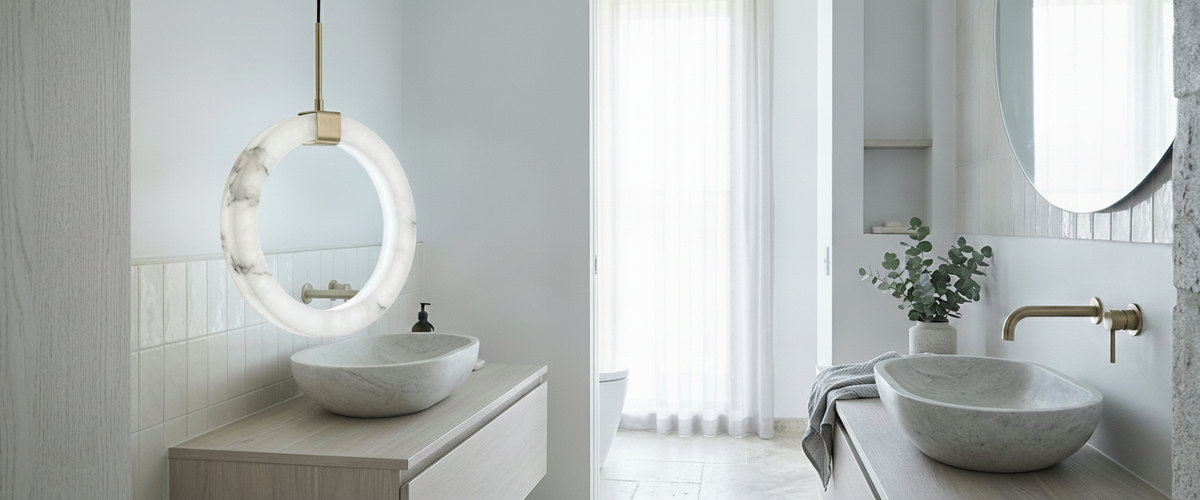

Stand under a single ceiling downlight, look in the mirror, and watch your face turn ten years older. The light drops straight down, pools in your eye sockets, and throws every line into shadow. That one mistake is behind half the complaints people have about their own bathrooms. The most useful bathroom lights fixtures ideas start by moving light off the ceiling and onto the wall, where it actually does your reflection a favour.
The good news: you do not need a bigger room or a structural rebuild. The best bathroom light fixtures ideas come down to the right fittings in the right places, the right glass or stone in front of the bulb, and a dimmer that lets you drop the room to a low warm wash at night.
Wall lights either side of the mirror fill in shadow more evenly than a single top fitting.

Key Takeaways
Light beside the mirror at eye level beats a single fitting above it for an even, flattering face.
Low or sloped ceilings call for flush mounts or slim alabaster fittings rather than a hanging pendant.
IP rating decides what survives near the shower; always confirm the install with a qualified electrician.
Even a small bathroom wants three light layers: ambient, task and a touch of accent.
Warm colour temperature plus dimming keeps the room calm at night and crisp in the morning.

Why a Single Ceiling Fixture Ages Your Face
Overhead light is brilliant for floors and terrible for faces. When the only source sits directly above the mirror, it skims down the brow and casts hard shadow under the eyes, nose and chin. You end up leaning in, tilting, and second-guessing your own grooming. This is the most common fault we see when clients send us photos of a room they want to rework, and it is why most bathroom light fixtures ideas should start at the mirror.
The fix is to think about where the light meets your face, not where the fitting looks tidy on the ceiling plan. Ceiling fixtures still earn a place for general fill, and well-chosen bathroom ceiling lights ideas matter for circulation and safety. They just should not be the only thing doing the work at the mirror.
Vanity Lighting Ideas: Flank the Mirror, Don't Crown It
For the cleanest result, put light on both sides of the mirror at roughly eye height, around 60 to 66 inches (1.5 to 1.7 m) from the floor. Two vertical sources fill in shadow from the left and right, which is exactly what a single top light cannot do. This is the single most effective of all bathroom vanity lighting ideas, and it is how theatre and studio mirrors are arranged for a reason.
Wall lights with a softening diffuser do the heavy lifting in most bathroom light fixtures ideas. Opal glass and ribbed glass spread the output so you do not get a hot spot in your peripheral vision. Where you want that diffusion in a warmer key, a ribbed-glass fitting such as the Cora 1 Light Bathroom Wall Light breaks up the source without dulling it, mounted as a pair either side of the glass. Where the room can take it, a slim alabaster wall light gives the same flattering wash with more warmth in the material itself; the stone glows rather than glares. Browse the wider range of wall and vanity formats in the lighting collection to see how diffuser styles compare side by side.
If the mirror is wide and you genuinely cannot flank it, a long fitting mounted above the glass is the next best option, ideally one that pushes light forward and down rather than straight onto your hairline. For that wider span, a continuous fitting like the Sisley Large Bathroom LED Wall Light spreads an even line of light across the top edge rather than concentrating it in one spot. Keep it close to the mirror's top edge so the beam reaches your face, not the back of your head.
Low and Sloped Ceilings: Where a Flush Fitting Earns Its Keep
Loft conversions, cottage bathrooms and box rooms rarely have the headroom for a pendant. Hang one and someone will catch it with a towel. Among the smartest bathroom light fixtures ideas for tight rooms, a flush or semi-flush mount sits tight to the ceiling and keeps the sightline clean. Under a slope, mount the fitting on the highest flat section you have, or use wall lights to sidestep the angle entirely.
A flush alabaster fitting reads as a soft panel of light, ideal where headroom is tight.
Alabaster comes into its own here. A flush alabaster ceiling fitting reads as a single soft panel of light rather than a bright bulb, so a low ceiling feels calmer instead of crowded. The natural veining catches the glow and gives a small room something to look at overhead. For more ceiling bathroom lighting ideas in tight rooms, think in terms of one quiet central wash plus task light at the mirror, rather than a grid of bright spots that flatten the whole space.
IP Zones in Plain English
Bathrooms are split into zones based on how much water a fixture is likely to meet, and each zone has a minimum IP (Ingress Protection) rating. Any bathroom light fixtures ideas you like still have to clear the right zone. In short: Zone 0 is inside the bath or shower tray, Zone 1 is directly above it, and Zone 2 covers the area just beyond, including around the basin. The further from water, the more freedom you have. The UK guidance on bathroom zones and the relevant wiring regulations is summarised clearly by Electrical Safety First.
As a working rule, a fixture near the shower needs a higher IP rating (IP65 is common for Zone 1), while a vanity wall light set well back from splashing often sits in Zone 2 or outside the zones, where IP44 is typically acceptable. For those Zone 2 positions around the basin, an IP44-rated chrome fitting such as the Shelly 1 Light Bathroom Wall Light is rated for the job. Natural alabaster and marble pieces tend to live happily in the drier parts of the room, away from direct spray. Always confirm the exact fixture and zone with a qualified electrician before you buy or install. Do not treat bathroom wiring as a weekend DIY job.
Three Layers in a Small Footprint
Layering does not need a large room. The best bathroom light fixtures ideas for a compact space share three jobs across three different sources, and you rarely need a spare wall to make it happen.
Ambient: a flush ceiling fitting or a couple of well-placed downlights for overall fill.
Task: wall lights flanking the mirror, aimed at your face for grooming and make-up.
Accent: a low glow that does the mood work, such as a small alabaster wall light, a recessed niche light in the shower, or a strip tucked under a floating vanity.
That third layer is where most small bathroom lighting ideas fall down. People light the room brightly and call it finished, then wonder why it never feels relaxing. A single dimmable accent source changes the character of the whole space after dark. We shipped a pair of slim alabaster wall lights to a client reworking a narrow ensuite in a period terrace; the brief was simply "make it feel less like a clinic." Two stone fittings either side of the mirror, on a dimmer, did exactly that without losing any practical brightness in the morning.
Keep It Calm, Not Clinical
Colour temperature decides whether a bathroom feels like a spa or a surgery, so factor it into your bathroom light fixtures ideas early. For a softer, warmer result, aim around 2700K to 3000K. Cooler 4000K output is crisp and accurate, which some people prefer for make-up and shaving, so match it to how you use the room. If in doubt, lean warm for the ambient layer and keep the task light a touch crisper.
Dimming is the other half of the equation. A dimmable circuit lets you run bright for the morning routine and drop to a low warm wash for a late bath. Confirm your bulbs and driver are genuinely dimmable, because not every LED is, and a mismatched dimmer causes flicker. Alabaster rewards this approach: at low output the stone holds a candle-like warmth that flat glass simply cannot match. You can see how that warmth reads across different fittings in the alabaster lighting collection.
A Quick Buyer's Checklist
Decide the mirror strategy first: flank it if you possibly can.
Measure your ceiling height before you fall for a pendant.
Map your IP zones and have an electrician confirm the fixture choice.
Plan three layers, even in a small room, on at least two switches.
Choose warm-leaning colour temperature and confirm dimmable bulbs and driver.
For alabaster or marble pieces, keep them out of direct spray and in the drier zones.
Colour and Mood: Working With Blue and Green Schemes
Tile colour changes how your light reads, so let it steer your bathroom light fixtures ideas too. A light blue bathroom scheme can drift cold under cool white light, so warm fittings pull it back toward calm rather than clinical. Soft greens behave similarly; a warm wash keeps them looking natural instead of grey. Alabaster's honeyed glow flatters both palettes because it adds the warmth cool tiles lack. If you are choosing soft furnishings to sit alongside a light green scheme, a putty, off-white, or natural-linen shower curtain tends to settle the room better than a competing bright colour.
Niori specialises in alabaster and natural-stone lighting, so our bias is honest: stone gives a bathroom a warmth and depth that mass-market glass struggles to reach. Of all the bathroom light fixtures ideas worth your money, stone is the one that earns its keep across the accent and mirror layers. Used with sensible IP-rated fittings near the water and a dimmer across the circuit, it turns a functional room into one you actually want to linger in.