
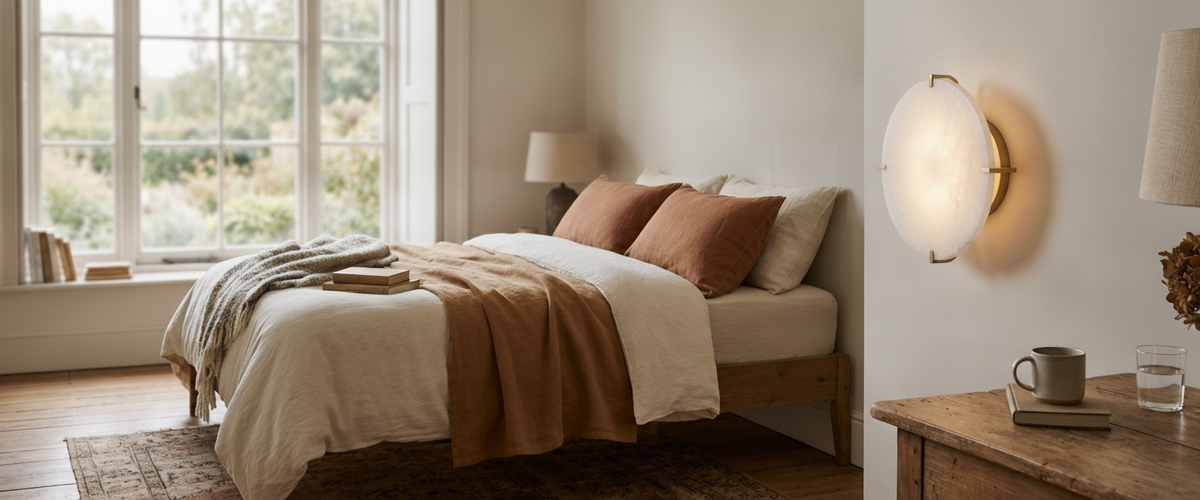

Two identical alabaster sconces can turn one room warm and another cold, and the difference is rarely the stone. Alabaster wall sconce lighting lives or dies on which way the light leaves the fixture. Aim it up and a corner softens into ambient wash. Aim it down and you carve out a tight pool for reading. Let the whole stone body glow and the wall reads like a quiet lantern. The alabaster carries the veining and the warmth; beam direction decides whether anyone in the room actually feels it.
We say this because the most common question we field in the studio is not about the alabaster at all. It is people asking why their previous sconces felt harsh. Nine times out of ten the fitting aimed a bare-ish source straight at the eye, and no amount of lovely stone fixes a glare problem baked into the geometry. Good alabaster wall sconce lighting starts by fixing the geometry first.

Key Takeaways Before You Buy
Beam direction sets the mood more than the fixture style does. Decide uplight, downlight or diffuse first.
The wall finish matters. Pale, matt walls flatter alabaster; dark or glossy walls fight it.
Stone thickness and backplate quality are the honest tells of a well-made sconce.
Switching changes the feel. A dimmer on a warm bulb keeps the light calm.
Placement decides everything. A sconce at the wrong height glares; at the right height it disappears into the room.

How Beam Direction Changes the Whole Mood of a Wall
Alabaster is a natural diffuser. Light does not just bounce off it; it travels a short way into the stone and comes back softened, carrying the veining with it. That means the way you aim an alabaster wall lights decides how much of that character you actually see, and it is why alabaster wall sconce lighting rewards planning the beam before you pick a frame.
Uplight throws a broad, soft wash toward the ceiling. It is the gentlest option, good for hallways and living rooms where you want ambient glow rather than task light. Downlight concentrates the beam below the fitting, which suits bedside reading or a spot beside a mirror. Fully diffuse sconces, where the whole stone body glows, give an even lantern effect that reads calm from every angle. Most rooms want a mix, but each wall should have one clear job.
A quick studio example. We shipped a pair of diffuse alabaster wall sconce lighting fittings to a Cotswolds bedroom where the client had originally asked for downlighters. Once we mocked up the wall, the downward beam pooled on the bedside table and left the sleeper's eyeline in shadow. The diffuse version glowed evenly, softer to wake up to, and the veining became the thing you noticed rather than the bulb. Direction first, always.

Uplight for a Soft Wash, Downlight for Reading, Diffuse for Calm
Match the beam to the task and the sconce stops being decoration and starts earning its place. Use uplight in circulation spaces: stairs, landings, entrance halls. The wash reads generous and the light never hits you head-on. This is where alabaster wall sconce lighting earns its keep.
Downlight belongs where someone needs to see something specific. A downward alabaster wall light beside a bed lets one person read while the other sleeps, provided you fit it high enough that the glow clears the pillow. Diffuse works best where you want the fixture to look lit from within, which is why alabaster suits it so well. The stone becomes a soft block of color on the wall rather than a bright dot.
If you want to see the range of forms these ideas suit, the alabaster lighting collection is a good place to compare uplight, downlight and diffuse bodies side by side before you commit to alabaster wall sconce lighting in a room.
Why the Wall Behind the Sconce Decides How the Stone Reads
People obsess over the fixture and forget the surface it sits on. The wall is half the result. A pale, matt plaster or limewash wall reflects the sconce's glow gently and lets the alabaster's warm tone spread. A dark or high-gloss wall absorbs or mirrors the light, so the stone looks isolated and the effect turns spotty. No amount of good alabaster wall sconce lighting survives a wall that fights it.
Texture counts too. A slightly rough lime plaster catches an uplight wash beautifully and gives the whole wall a soft grain. A flat vinyl paint can look clinical under the same fitting. Before you order, hold a warm torch against your chosen wall at roughly the sconce's height and see how the surface takes the light. It is a two-minute test that saves a lot of regret.
Color temperature interacts with the wall too. Warm white around 2700K keeps alabaster's honey undertones alive on a cream wall. Push toward cool white and the stone can look gray and lifeless, which defeats the point of buying natural stone in the first place. Get the temperature right and the alabaster wall sconce lighting reads warm rather than clinical.
Backplate and Stone Thickness: The Tells That Separate Real Quality From Cheap
Turn a wall sconce over and the backplate tells you most of what you need to know. Quality alabaster wall sconce lighting has a solid, well-cast plate that sits flush to the wall, hides the junction box cleanly and carries the weight of the stone without flexing. Thin pressed metal, visible gaps or a plate that rattles are signs the maker cut corners you will feel later.
Stone thickness is the other honest signal. Alabaster that is too thin transmits light unevenly and can show a hot spot where the bulb sits close to the surface. Alabaster is a form of gypsum, softer and more translucent than marble, which is exactly why it glows; the Encyclopaedia Britannica notes its long use in decorative carving for that fine, light-passing quality. A properly specified sconce uses a stone panel thick enough to spread the light evenly, with the veining reading as movement rather than a blotch.
Because alabaster is a natural material, no two panels match. That is a feature, not a flaw, but it means quality makers of alabaster wall sconce lighting hand-select and orient the stone so the grain sits well on the wall. Ask how the stone is chosen. A vague answer usually means it is not.
Modern, Transitional, or Traditional: Matching the Frame to the Glow
The metalwork around the stone sets the register. An alabaster modern wall light tends toward clean geometry: a slim brass or blackened frame, sharp edges, minimal hardware, letting the stone read as a plain glowing plane. It suits new-build interiors and pared-back rooms where the architecture is doing the talking.
An alabaster contemporary wall light softens that a touch, often with a sculptural stone form or a curved backplate, still restrained but warmer in feel. A transitional piece bridges old and new, pairing aged brass with a simple stone body so it works in a period home that has been updated inside. Where the room has period detailing and you want alabaster wall sconce lighting that reads at home beside brass and cut glass, something like the Aegean 1 Light Wall Light sits closer to that transitional register than a bare stone plane would. An alabaster traditional wall light leans further into detail: fluted stone, decorative castings, a heavier frame that reads at home beside paneling and cornice.
Match the frame to the room's bones, not to a trend. A modern frame on a heavily corniced wall can look like it wandered in from another house. If you are weighing styles across a whole project, browsing the broader lighting range helps you keep your alabaster wall sconce lighting, pendants and table lamps in one visual language.
Switching That Keeps the Light Calm: Rocker, Rotary, or Dimmer
How you turn a sconce on shapes how it feels every evening. A basic rocker switch on the wall is fine for circulation lights where you just want on or off. A rotary switch built into the fitting, or a rotary dimmer on the wall, gives you the control that alabaster deserves.
Alabaster looks its best dimmed. At full output the stone can look flat; brought down to sixty or seventy per cent, the veining deepens and the glow turns intimate. Fit a good-quality dimmable LED and a compatible trailing-edge dimmer so the light drops smoothly without flicker or buzz. The Chartered Institution of Building Services Engineers publishes guidance on lighting levels and dimming that is worth a look if you are planning a whole scheme around alabaster wall sconce lighting. Whatever the switching, hard wiring should go to a qualified electrician; wall sconces sit on a live circuit and this is not the place to improvise.
Where a Sconce Feels Intentional and Where It Just Glares Back
Height is the single biggest placement mistake with alabaster wall sconce lighting. Fit a sconce too low and the glow catches you at eye level; too high and it lights the ceiling and nothing useful. As a working rule, general wall sconces sit around 60 to 66 inches (152 to 168 cm) from the floor to the center of the fitting, with bedside and reading sconces adjusted to the person using them.
Flanking a mirror, run a pair at eye height so light lands on the face rather than the top of the head; that is how you avoid the shadow-under-the-brow effect. In a hallway, space uplight sconces evenly so the washes overlap gently rather than leaving dark gaps. Beside a bed, mount high enough that the beam clears the pillow. On an exterior wall or a covered porch, the same directional thinking applies but the fitting itself has to be rated for the weather; an IP44 piece such as the Outdoor Wall Light in Black is the kind of specification you need where splashes and damp are in play, since alabaster and interior-rated sconces are not built for it. In a bathroom, choose a fitting rated for the zone and keep it well clear of splashes.
A sconce feels intentional when its light does a job you can name. It glares back when it is fighting a dark wall, sitting at the wrong height, or aiming a bright source straight at the room. Get the direction, the wall and the height right, and your alabaster wall sconce lighting does the rest.
Quick Buyer's Checklist
Decide the beam job first: uplight wash, downlight task, or diffuse glow.
Test the wall finish with a warm torch before ordering.
Check the backplate is solid and flush, and ask how thick the stone is.
Choose the frame style to suit the room's architecture, not a trend.
Specify a warm dimmable LED and a compatible trailing-edge dimmer.
Set mounting height to the task, and use a qualified electrician for wiring.