
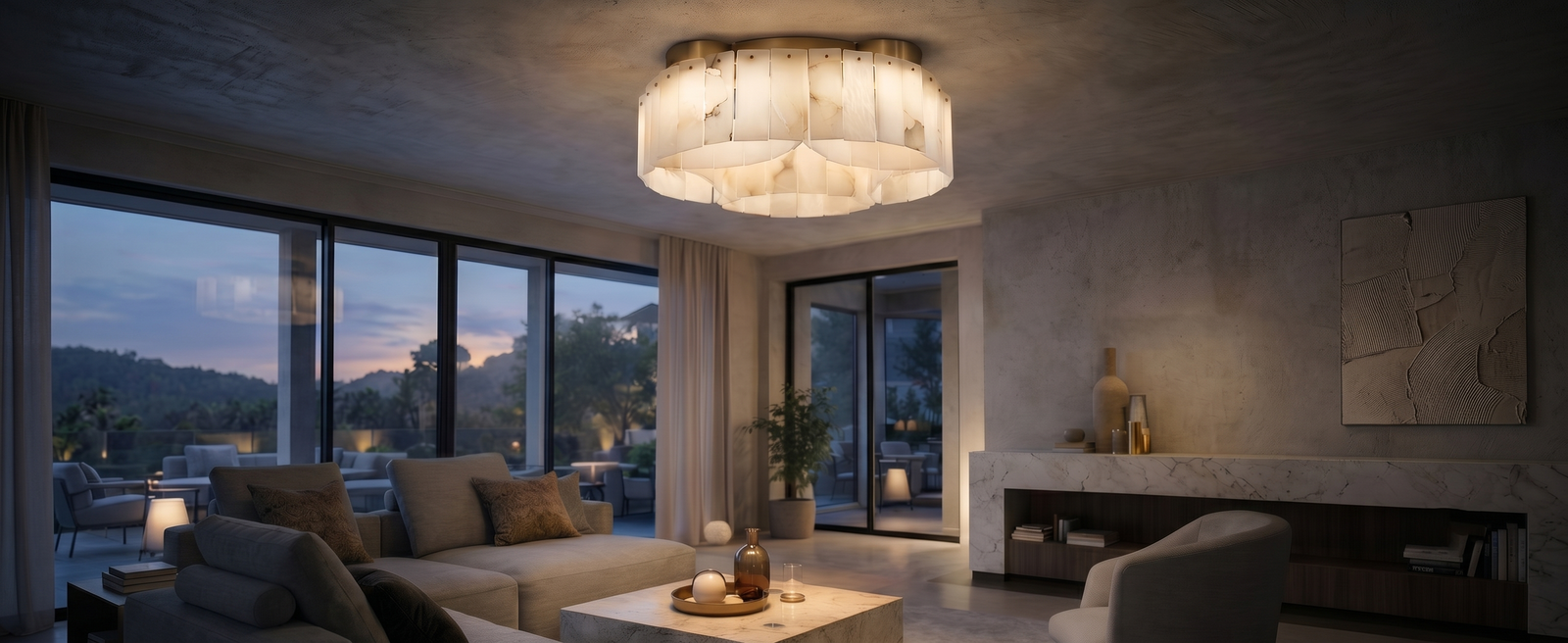

Look up in three different homes and the same alabaster light fixture ceiling mount can tell three completely different stories. In one it hangs like a carved relic, heavy with history. In another it floats flat against the plaster like a slice of frozen stone. The stone is the same material in each; the mount does the talking. Get that match wrong and even a beautiful alabaster light fixture ceiling piece looks stranded on the wrong ceiling.
Alabaster is a soft, translucent gypsum stone that has been carved for light and ornament since antiquity, prized because it glows rather than glares when lit from within. That translucency is the whole point of putting an alabaster light fixture ceiling piece overhead, and it is also the thing most buyers underestimate when they order from a single product photo.

Key Takeaways Before You Choose
Style tells a story: an antique alabaster ceiling light reads heavy and grounded, a contemporary one reads light and floating, and a transitional piece sits between the two.
Match the mount to your ceiling height, not to how the fixture looks in a studio shot.
Flush discs wash the ceiling plane; deep bowls pool light downward and cast a warmer core.
Bulb colour temperature and a proper dimmer decide whether the veining stays warm and honey-toned or turns flat and grey.
Confirm real specifications with the maker before any alabaster light fixture ceiling mount reaches your ceiling: weight, drop, canopy size and dimming compatibility.

Antique, Transitional, Contemporary: Three Mounts, Three Stories
An antique alabaster ceiling lights leans on ornament. Think fluted bowls, chain suspensions, bronze or aged-brass fittings and stone carved to show its hand-worked edges. It reads as an object with weight and provenance, and it wants a room that can hold that gravity: a period hallway, a panelled dining room, a home with tall skirting and deep cornices.
An alabaster contemporary ceiling light does the opposite. It strips the metalwork back, favours clean geometry, and lets a single slab or disc of stone become the whole event. Lit well, it barely looks attached to anything; the stone appears to hover. That floating quality is exactly why this kind of alabaster light fixture ceiling mount suits pared-back interiors where the architecture is quiet and the light is meant to be the feature.
Between them sits the alabaster transitional ceiling light, and it is the one most people actually need. It keeps enough shape and warmth to feel considered, without the fuss of full period detailing. Where a room mixes old bones with newer pieces, a fixture such as the Cintura LED Alabaster Ring Chandelier, with its warm copper and leather detailing, plays diplomat between both sides.

Why Period Fixtures Read Heavy and Modern Ones Read Like Floating Stone
The weight you perceive has little to do with actual pounds and everything to do with visual mass. An antique alabaster ceiling light surrounds the stone with visible structure: chains, canopies, decorative collars. Your eye reads all of that as ballast, so the alabaster light fixture ceiling mount feels anchored to the ceiling.
An alabaster modern ceiling light hides its hardware. The suspension is often a slim rod or a near-invisible cable, and the canopy is kept small and flush. With the metalwork out of the way, the translucent stone catches the light and appears to detach from the plane above it. That is the trick behind a contemporary flush mount that looks like a single lit tile of alabaster rather than a lamp.
Neither approach is better. A period drawing room in a Cotswold house will swallow a minimalist disc and make it look like a smoke alarm; a clean-lined new-build flat will feel oppressed by a heavy carved bowl on chains. Read your architecture first, then choose the visual mass to match. Our full range across the alabaster lighting collection spans both ends of that scale, which makes it easier to see the contrast side by side.
The Transitional Bowl That Bridges a Fussy Room and a Bare One
The single most useful alabaster light fixture ceiling shape in this category is the transitional bowl. It is a shallow-to-medium alabaster dish, usually suspended on three slim stems or a discreet frame, with restrained brass or bronze detailing at the fittings.
It works because it borrows a little from each side. The bowl shape nods to traditional pendant forms, so it does not fight period cornicing. The clean stone face and slim hardware keep it current, so it does not date a newer room. In a converted barn with original oak beams on one side and a sharp modern kitchen island on the other, a horizontal linear piece such as the Selvara 3 Light Horizontal Alabaster Linear Chandelier is the kind of form that reads correctly from both rooms at once.
Flush Disc Versus Deep Bowl: How Each Spills Light
The profile of the fixture changes how light behaves across your ceiling plane, and this matters more in a room with a lower ceiling. The right alabaster light fixture ceiling profile can make a low room feel taller or a large one feel grouped.
A flush disc sits close to the plaster and throws light outward and upward as much as down. That wash across the ceiling makes a room feel taller and softer, which is why flush alabaster discs suit bedrooms, landings and hallways where you want ambient glow rather than a focused pool.
A deep bowl holds more of its light inside the stone and directs a warmer, more concentrated core downward. It gives a room a defined centre, so it earns its place over a dining table or a coffee-table grouping where you want the light to gather people rather than flatten the whole space. The deeper the bowl, the more dramatic the veining looks, because more stone sits between you and the bulb.
Match the Mount to Your Ceiling Height, Not the Product Photo
Studio photography flatters every fixture equally, which is exactly the problem. A drop that looks elegant in a shot taken at three metres can hang in your face at standard ceiling height, and that is the fastest way an alabaster light fixture ceiling choice goes wrong.
Standard ceilings (around 2.4m): favour flush or semi-flush alabaster mounts, or a shallow bowl with a short drop. Keep the lowest point well clear of head height in circulation areas.
Tall or period ceilings (3m and above): this is where a suspended antique or transitional bowl earns its keep. A generous drop fills the vertical space instead of leaving the stone marooned near the plaster.
Over a dining table: hang the base of the fixture roughly 30 to 34 inches (about 75 to 85cm) above the table surface, adjusting up for very large rooms. For a long table that needs an even run of light rather than a single focal point, a linear form like the Oria LED Linear Alabaster Chandelier spreads the glow along the surface.
Stairwells and double-height voids: a linear or tiered alabaster chandelier reads best because it occupies the drop rather than sitting at the top of it.
If you are still weighing pendant against flush mount for a specific room, it is worth browsing the wider lighting range to compare drops and profiles before committing to an alabaster light fixture ceiling piece.
The Bulb and Dimmer Pairing That Keeps Veining Warm
This is where a good alabaster light fixture ceiling mount gets ruined by the wrong bulb. Alabaster's veining glows honey and amber under warm light and turns dull and greyish under cool white. Reach for a warm colour temperature, around 2700K, so the natural minerals in the stone read warm rather than clinical. A high colour rendering index, ideally 90 CRI or above, keeps those tones honest; the CIBSE lighting guidance is a useful reference on why colour rendering matters for how materials appear.
Pair that bulb with a dimmer, and confirm the dimmer is compatible with the driver in an LED fixture. Alabaster rewards low light: dropped to 20 or 30 percent, a bowl stops being a light source and becomes a glowing stone object, and the veining comes forward. A qualified electrician should confirm the dimmer and driver are matched, both for performance and to avoid flicker. Never treat mains wiring as a casual DIY job.
What to Confirm With a Maker Before It Reaches Your Ceiling
Because every piece of alabaster is a unique cut of stone, the specification of your alabaster light fixture ceiling mount matters more than with mass-produced glass. Run through this before you order.
Actual weight and fixing: confirm the fixture weight and whether your ceiling needs additional support. Heavier bowls and chandeliers may need a joist or a mounting plate.
Real drop and canopy size: ask for the exact overall drop, not the stone dimension alone, and the canopy diameter so it covers your existing back box.
Dimming and driver compatibility: confirm the recommended dimmer type and colour temperature so you are not guessing later.
Stone variation: ask whether the veining is representative or whether your piece will differ. With natural stone, some variation is expected and desirable, per guidance from the Natural Stone Institute.
Care instructions: alabaster is porous and soft, so confirm how to clean it. A dry or barely damp cloth is usually right; harsh cleaners and standing moisture are not.
Get those five answers and the alabaster light fixture ceiling mount that arrives will match the one in your head. Whether you land on an antique alabaster ceiling light or something far more minimal, Niori works only in alabaster and natural stone, so every alabaster light fixture ceiling piece is chosen for how it handles light rather than how it photographs, and that is the difference you feel once it is glowing above you.