
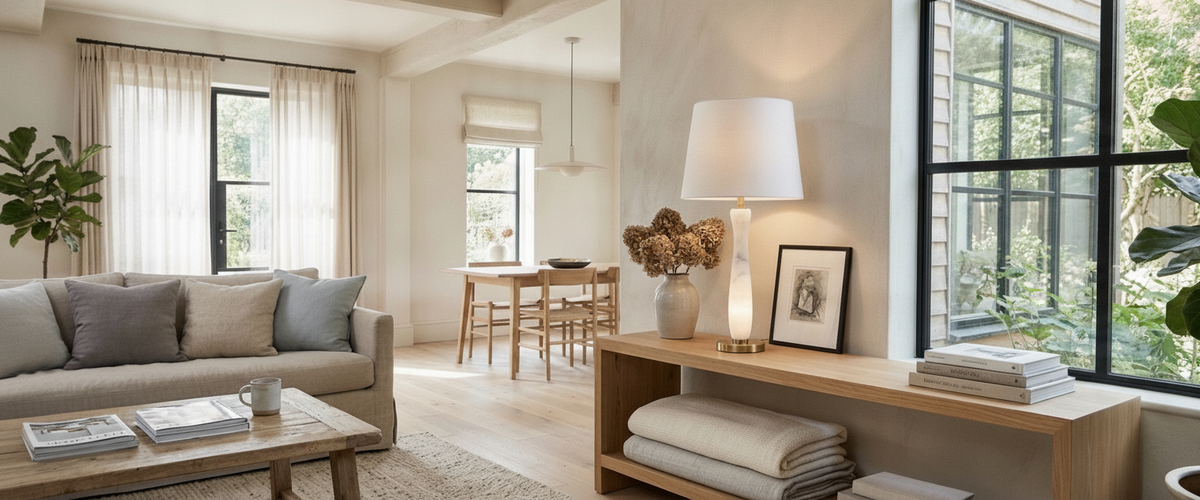

A genuine vintage alabaster table lamps gives itself away in the first ten seconds of handling it. The stone feels cooler and denser than you expect, the veining runs in one continuous logic rather than a printed pattern, and the base carries small marks that no factory would deliberately add. Reproductions try to fake all three, and they usually overreach. If you know where to look, you can tell an antique alabaster table lamp from a distressed newcomer without ever asking the seller a question.
We handle a lot of stone at Niori, both new pieces and older lamps that clients bring to us for advice before a rewire. The same questions come up every time about a vintage alabaster table lamp: is this the real thing, is it safe, and how do I make it glow the way it should. Here is how we answer them.
Backlit stone reveals veining that passes through the block, not a surface print.

Key Takeaways
Real vintage stone shows uneven, logical veining and honest wear; reproductions overdo the distressing in tidy, repeating patterns.
Patina and fine hairline veining usually add value; open cracks that run through the wall of the lamp cost you.
Old UK wiring is the deal-breaker. Assume a rewire by a qualified electrician unless there is recent proof otherwise.
A warm, low-wattage LED at around 2700K revives a tired-looking alabaster shade.
Cordless conversions suit display pieces; leave a well-wired mains lamp alone.

How Genuine Vintage Stone Tells Its Age
Alabaster is a soft mineral, close to gypsum, and it rates around 2 on the Mohs scale, so it wears in ways that are hard to fake. Over decades the high points of a carved vintage alabaster table lamp lose their crispness, edges soften, and the surface picks up a faint sheen from handling. That sheen is uneven. It sits on the parts a hand naturally touches and skips the recesses, which is exactly what a reproduction gets wrong when it sprays a uniform aged finish across the whole body.
Look at the veining next. Real alabaster carries mineral streaks that pass through the stone in three dimensions, so the pattern on the outside relates to what you can see when light passes through it. Printed or cast imitations show veining that stops at the surface and repeats. Hold the lamp up to a window and the difference is obvious. The Natural Stone Institute is a useful reference if you want to read more on how genuine stone behaves and why no two blocks match.
Where reproductions overdo it is the distressing. A maker chasing an aged look will add chips in symmetrical spots, rub the same amount of "wear" onto every edge, and sometimes stain the whole piece an even tea colour. Genuine age on a vintage alabaster table lamp is messier and more specific. One corner takes the knocks because that is the corner that faced the room.

Patina and Veining That Add Value, and the Cracks That Cost You
Not every mark is a problem. A soft, warm patina is part of why people want an antique alabaster table lamps in the first place, and fine hairline veining inside the stone often reads as beautiful when the lamp is lit. These are the features that make a vintage alabaster table lamp feel collected.
The distinction that matters is between veining and cracking. A vein is a mineral feature that runs consistently and does not compromise the wall of the lamp. A crack is a fracture that catches your fingernail, opens under light, or runs to an edge. Structural cracks near the neck or base are the ones to walk away from, because alabaster is porous and repairs rarely hold under the small heat cycles a lamp goes through.
Run your thumbnail gently across any suspect line. If it snags and the line has a slightly different colour on each side, you are likely looking at a real crack rather than a vein. Chips on a foot are cosmetic and often add character to a vintage alabaster table lamp. A fracture through the shade is not something to buy your way past.
What the Base and Wiring Reveal
The base often hides cloth flex and unearthed fittings that need replacing.
Turn the lamp over. The base tells you more about an old carved piece than the seller usually will. Antique examples often have a felt pad hiding a threaded rod, a heavy weight, and wiring that has not been touched in decades. Cloth-covered flex, brittle rubber insulation, brass switches with worn contacts, and two-core cable with no earth are all signs you are dealing with original wiring that belongs to another era. A lamp made before the mid-1960s will almost never carry a modern three-core earthed flex.
In a UK home this is non-negotiable: assume a full rewire by a qualified electrician before the vintage alabaster table lamp goes into daily use. Perished insulation and unearthed metal fittings are a genuine fire and shock risk, and no amount of surface charm changes that. Electrical Safety First publishes clear guidance on why aged flex and old fittings need replacing rather than nursing along.
A rewire is straightforward for a competent electrician and it does not harm value. Keep the original brass fittings if they are sound and simply reuse them with new internal cable, a modern lampholder, and a fresh earthed flex. That way the lamp keeps its face and gains safe internals. If a seller tells you the piece was "recently rewired," ask when and by whom, and check the flex looks modern rather than nostalgic.
How Decades of Use Shift the Glow
Alabaster does not stay the same colour under light. Years of warm incandescent bulbs and household dust can leave an older shade looking dull, slightly yellowed, or flat. People often assume the stone is spent. Usually it is not; it is the light source and the surface film.
Clean first, gently. A soft dry brush and a barely-damp microfibre cloth lift most surface dust. Avoid soaking alabaster, because it is porous and water can mark it. Once the surface is clean, the bulb does the rest. A warm LED at roughly 2700K, dimmable, with a wide beam, revives a tired alabaster table lamp and shows the veining without the heat and yellowing of an old filament bulb. Keep the bulb modest, around 6 to 8 watts of LED; the stone glows best when it is lit from within by a soft source, not blasted.
If you are building a room around several stone pieces, our wider lighting range shows how the same warm, diffused quality carries from table lamps through to pendants and wall lights.
Placing an Old Lamp in a Modern Room
The trick with a vintage piece is to let it look chosen rather than inherited. An antique alabaster table lamp reads as collected when it sits against clean, current surroundings: a plain plaster wall, a modern console, a low sofa in a flat linen. Surround it with other brown-wood antiques and it slips into dated. Give it space and one contemporary neighbour and it becomes a deliberate note.
Scale matters more than era. A heavy carved vintage alabaster table lamp needs a surface that can carry its weight visually, so a slim hallway table under about 12 inches (30 cm) deep will fight it. Where a room wants a crisp modern counterpoint to the warm stone, a defined silhouette such as the Essence Round Table Lamp, Black gives the eye something contemporary to rest against without competing for glow. Pair the warm stone glow with cooler architectural light elsewhere and the lamp becomes the soft centre people gravitate towards in the evening. If you want the same effect with a piece engineered for modern wiring and dimming from the start, the alabaster lighting collection carries that translucent quality in current designs, including clean modern alabaster table lamp shapes.
Cordless Conversions and Retrofits
Cordless alabaster table lamp conversions have become popular, and they genuinely suit certain uses: a lamp on a dining table, a piece that moves between rooms, or a display lamp where a trailing flex would spoil the line. Rechargeable LED units with a warm output drop neatly into many shades and remove the wiring question altogether. A well-chosen vintage alabaster table lamp takes to this treatment easily.
The judgement is when to leave a lamp alone. If an old piece has been safely rewired and lives in one spot, converting it to cordless gains you little and can mean cutting into original components you would rather keep. Reversible conversions are the goal. A battery module that sits inside the shade without altering the base is fine. Drilling a fresh hole through antique stone to hide a charging port is not, because it is permanent and it usually shows.
For a houa alabaster table lamp or any single-block carved piece, treat the stone as the fixed asset and the electrics as replaceable. Modernise the parts that keep you safe and comfortable. Preserve the parts that give a vintage alabaster table lamp its age.
A Quick Buyer's Checklist
Hold it to the light: veining should carry through the stone, not sit on the surface.
Check wear is uneven and specific, not uniformly distressed.
Snag-test any suspect line to separate a harmless vein from a structural crack.
Turn the lamp over and inspect the flex, holder, and earthing.
Budget for a rewire by a qualified electrician on any un-proven vintage alabaster table lamp.
Plan a warm 2700K dimmable LED of around 6 to 8 watts rather than an old filament bulb.
Keep conversions reversible; never drill original stone for convenience.
Buy on the stone and the safety, and a vintage alabaster table lamp will outlast most of the furniture around it. The wiring is renewable. The block of alabaster, chosen well, is not.