
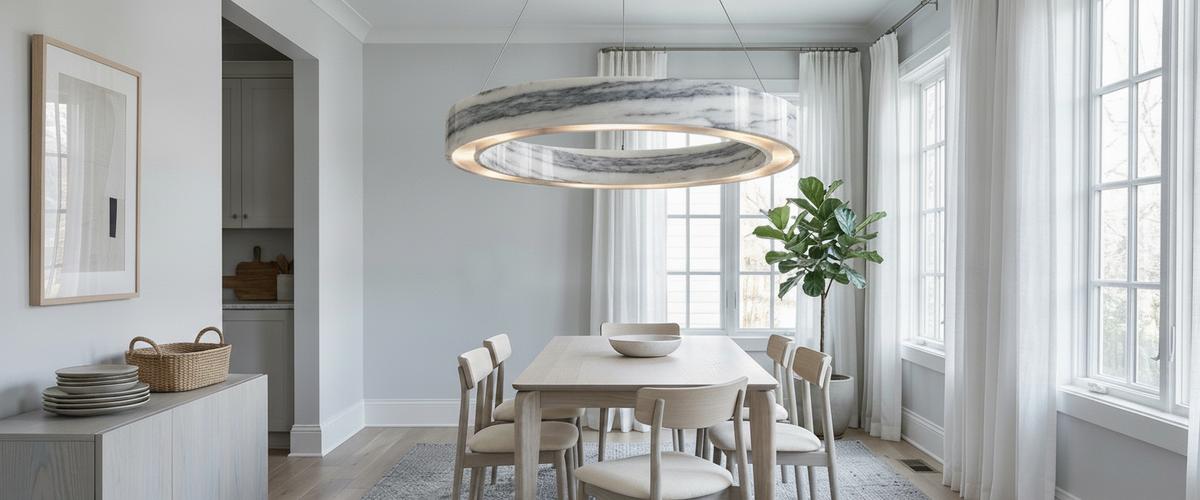

Hold a slab of onyx up to a window and then do the same with a sheet of alabaster. The onyx keeps its secrets; the alabaster gives them up. That single difference is the whole story of a natural stone chandeliers. Dense stone reads heavier than alabaster in both directions: heavier in the hand and on the fixing, and heavier in the light it throws. Get that right and the natural stone chandelier anchors a room. Get it wrong and you have hung a very expensive lump from the ceiling.
Most people shopping for a natural stone chandelier start from a brochure photo and end up surprised by two things: how much the piece weighs and how differently it glows once it is actually switched on above a table. This guide is about closing that gap before you commit.
A stone fixture given the height and air it needs to read as a whole object.

Key Takeaways Before You Commit
Stone glows less than alabaster. Denser stones like slate and heavily veined marble read as mass with light rather than light with mass.
Weight drives everything. A multi-arm natural stone chandelier can run to a serious load, and the ceiling structure, not the ceiling surface, has to carry it.
Room scale matters more than budget. A large fixture in a low, small room reads as a threat, not a centrepiece.
Layer the surrounding light. A stone piece needs support from wall and table lighting or it turns into a dark shape.
Ask about the stone before the styling. Provenance, backing, and fixing method decide whether the piece lasts.

Why Stone Reads Heavier Than Alabaster
Alabaster is prized in lighting because it is translucent. Light passes through it and warms as it goes, which is why an alabaster piece seems to hold a glow inside the material itself. Denser stones behave differently. Marble transmits a little light at thin sections; onyx can be strikingly translucent when it is cut thin and backlit; slate and most granites barely transmit at all and instead read as solid form catching light on their surface.
This changes what a fixture does in a room. An alabaster piece tends to soften the whole space with diffuse warmth. A natural stone chandelier is more sculptural. It behaves like a lit object rather than a light source, throwing definition and shadow rather than an even wash. Neither is better; they solve different problems. If you want the ambient softness that alabaster gives, our alabaster lighting range is built around exactly that quality of diffusion. Where you want a natural stone chandelier to read as carved mass first and light second, denser slate does more of that work, and a piece like the Stone CCT LED Pendant in multicoloured slate shows how a dense material catches light on its surface rather than passing it through.
One studio observation worth repeating: clients almost always underestimate how dark veined marble goes between the lit sections. The veining that looks dramatic in daylight can turn to muddy shadow once the room lights are low. Onyx is the exception. Thinly cut and lit from within, it can carry colour and movement that no alabaster can match, and it makes for a natural stone chandelier with real depth.

Fixing Points and Ceiling Weight the Photos Never Show
Here is what the styled photograph leaves out. A heavy natural stone chandelier puts its weight where you do not expect. Multiple stone shades on a metal frame concentrate load at the ceiling rose and the fixing point above it.
The load has to reach a joist or a purpose-fitted brace, never bare plasterboard.
The ceiling surface is not the structure. Plasterboard holds almost nothing. The load has to reach a joist, a purpose-fitted brace bar between joists, or a structural fixing designed for the weight. For anything approaching 7 to 9 kg (roughly 15 to 20 pounds) and certainly beyond, this is not a job for a toggle bolt and optimism. The Institution of Engineering and Technology sets out the wiring and mounting principles behind safe fixtures in the IET Wiring Regulations, and the practical takeaway is simple: a qualified electrician should confirm both the electrical connection and that the mounting can carry the static and any dynamic load.
Three questions to resolve before delivery day:
What does the complete fixture weigh, assembled? Not the shipping weight, the hung weight.
What is above the ceiling at the fixing point? Joist, void, or a run you can add a brace to.
Is the drop adjustable? A natural stone chandelier over a dining table usually wants the lowest point around 76 to 91 cm (30 to 36 inches) above the tabletop, and you want that set before, not after, the electrician leaves.
Which Stones Carry a Multi-Arm Frame
Not every stone suits a chandelier form. The material has to survive being cut into shades or panels, drilled or slotted for mounting, and then hung for years without cracking along a weak seam. That is what separates a lasting natural stone chandelier from a fragile one.
Marble carries a frame well when it is selected for even structure rather than maximum drama; the most dramatic veining is often the most fragile. Onyx is the show-off, worth the care it demands because backlighting brings out colour that reads as almost lit-from-within. Slate and other dense stones give you graphic, matte mass and work best where you want the natural stone chandelier to read as a dark sculptural object rather than a glowing one. Travertine and limestone sit in between, warm and characterful but softer and more porous, so they need sealing and gentle handling.
The frame metal matters as much as the stone. Brass, bronze, and matte black are the usual pairings because they hold their own without competing. A heavier material wants a frame engineered for it, not a decorative armature borrowed from a glass fixture. A linear form such as the Axis 27 Light Alabaster Linear Chandelier in matte black shows how a dark, restrained frame lets the panels carry the visual weight, while a ringed piece like the Vireon Triple Ring Chandelier in bronze puts the metalwork itself into the composition. If you are comparing forms across materials, the broader lighting collection is a useful way to see how frame and shade balance changes from glass to alabaster to denser stone.
Rooms That Flatter a Stone Chandelier, and Rooms That Swallow It
Scale is where most decisions go wrong. A large natural stone chandelier needs air around it and above it. A double-height entrance hall, a dining room with 3 m (10-foot) ceilings, a stairwell you look up through: these give the fixture the room to be read as a whole object.
Rooms that swallow it whole tend to share one trait: low or busy ceilings. Drop a substantial natural stone chandelier into a standard 2.4 m (8-foot) sitting room and it crowds the sightline the moment you stand up. It stops being a centrepiece and becomes an obstacle. In those spaces, a smaller linear stone or alabaster pendant over a table does far more work than a full multi-arm design ever could.
A note on kitchens and dining. Stone over a kitchen island can be handsome, but cooking throws grease and steam upward, and porous material does not love that. If the fixture sits directly over a hob, factor in more frequent, more careful cleaning, or place it over the seated end of the island instead.
Layering Light So the Fixture Reads as a Centrepiece
A natural stone chandelier switched on alone in a dark room looks flat. Because dense material throws less ambient light than alabaster, the surrounding layers do the heavy lifting.
Give the room two or three other sources at different heights. Wall lights at eye level, a table lamp on a console, maybe a floor lamp in a reading corner. These lift the ambient level so the fixture is not fighting pitch black, and they let the stone read as a lit object against a warm background rather than a bright point in a void. Put your natural stone chandelier on its own dimmer circuit. You want to bring it up as the star at dinner and drop it back when the wall lights carry the room.
Bulb choice is not a small detail here. Warm white in the 2700K range suits most stone and keeps the veining looking natural; push toward cool white and marble can go clinical while onyx loses its warmth. Confirm the fixture is fully dimmable and that the driver or transformer is compatible with your dimmer, because a mismatch shows up as flicker or a hum you will notice every evening.
The Sourcing Questions to Ask Before Commissioning
Because natural stone varies piece to piece, a natural stone chandelier is closer to a commission than an off-the-shelf buy. The right questions protect you.
Where is the stone from, and is it consistent across the shades? Ask whether the panels are cut from the same block so the veining relates.
How is the stone backed or reinforced? Thin translucent stone is often backed with a stabilising layer; ask what happens at the seams.
What is the assembled weight and the recommended fixing? Get this in writing to hand to your electrician.
How is it cleaned and sealed? Porous stones need periodic sealing; ask what product and how often. The V&A's guidance on caring for stone and marble is a sound primer on why gentle, non-acidic cleaning matters.
What is the lead time and the replacement policy for a cracked panel? Stone can chip; know how a single shade is replaced before you need to.
Niori works in alabaster and natural stone precisely because the material rewards this kind of care. A natural stone chandelier is a long-term fixture, not a seasonal swap. Choose the material for how it lives with light, plan the fixing properly, and give it a room with space to breathe. Do that and your natural stone chandelier holds a space for decades.