
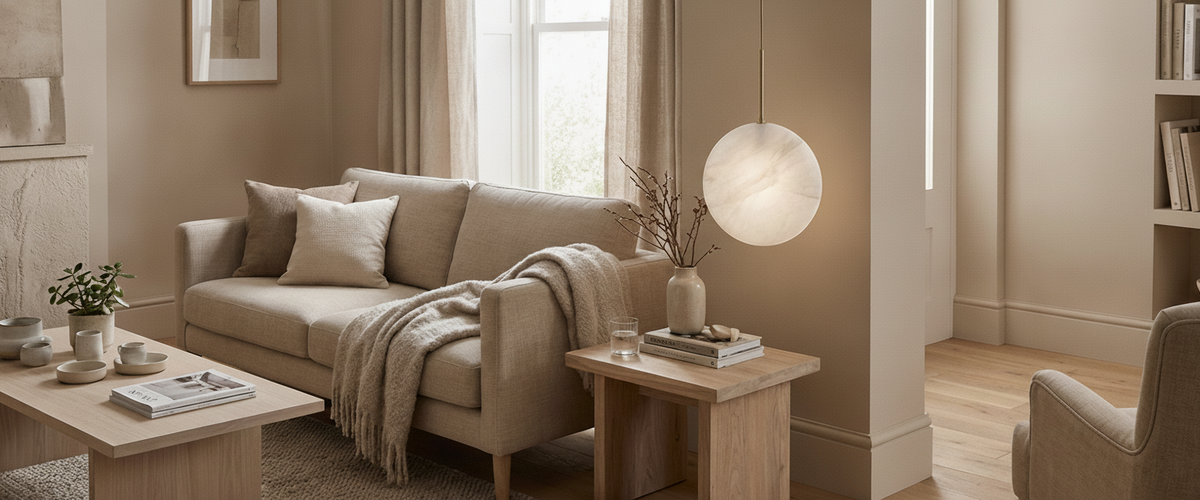

Some of the most beautiful lamps we ship have no switch you can reach without crawling behind a console table. A tall alabaster floor lamp in a Cotswold sitting room, a heavy onyx table lamp wired to a fixed feed, a pendant on a long flex: all lovely, all frustrating at 10pm when you want the room half a stop dimmer. A lamp socket dimmer switch solves exactly that. It puts the control where your hand already is, and it lets warm light do what warm light should do through natural stone.
This piece is about the small components that quietly change how a fixture feels, and how to pick the right lamp socket dimmer switch without turning a smooth dial into a flicker box.

Key Takeaways
A lamp socket dimmer switch (also sold as a lamp dimmer socket switch or light socket dimmer switch) adds dimming to a single fixture, no wall wiring needed.
It suits lamps with fixed feeds, no reachable switch, or rented rooms where you cannot touch the walls.
LED compatibility is the make-or-break factor; the wrong bulb flickers, buzzes, or refuses to dim.
Screw-in socket models and inline cord models solve different problems, and your flex decides which fits.
Any hard-wired work belongs with a qualified electrician.

What an Inline Socket Dimmer Does That a Wall Dimmer Never Can
A wall dimmer controls a whole circuit. Useful for ceiling lights, useless for the one alabaster lamp you actually want to soften while the rest of the room stays bright. A lamp socket dimmer switch works on a single fixture. You dial that lamp down to a low glow and leave everything else where it is.
That matters most with layered lighting, which is how good rooms are lit. Picture a living room with a pendant overhead, wall lights either side of a fireplace, and a stone table lamp on a side table. A wall dimmer flattens the lot. A lamp socket dimmer switch on the table lamp alone lets you drop it to a candle level while the wall lights carry the room. This is the granular control designers build into a scheme, and it is why we get asked about these small fittings almost as often as about the lamps themselves.
There is also the practical case: no electrician, no chasing walls, no lifting floorboards. For a renter, a listed building, or a finished room you would rather not disturb, that is the entire appeal of a lamp socket dimmer switch.

The Lamps That Most Need One
Three situations come up again and again in our order notes, and each points to a lamp socket dimmer switch.
Fixed wiring with no local control. Some lamps are wired straight to a spur or fed from a switched socket across the room. Lovely until you want a subtle change and the only switch is behind the sofa. Where the lamp plugs into a wall point rather than a fixed feed, a switched socket such as the 13A Double Socket DP Switched in Antique Brass at least gives you a positive on-off at the wall, though it will not dim; a lamp socket dimmer switch at the bulb, or an inline dimmer on the cord, gives you control at arm's reach.
No reachable switch. Tall floor lamps and heavy stone table lamps often hide their inline switch low on the flex, or they simply do not have one. An inline cord dimmer sits partway up the flex, typically 12 to 24 inches (30 to 60 cm) from the plug, where you can find it in the dark.
Rented rooms. If you cannot alter the walls, you can still control your own lamps. A plug-and-flex fixture with an inline dimmer travels with you when you move. We ship a lot of alabaster table and floor lamps to tenants for exactly this reason; the lamp is the upgrade, the lamp socket dimmer switch makes it liveable.
LED Compatibility: Why the Wrong Bulb Turns a Smooth Dial Into a Flicker Box
This is where most disappointment starts. A dimmer and an LED bulb have to agree on how power is cut, and plenty of them do not. Fit a non-dimmable LED to any lamp socket dimmer switch and you get flicker, buzz, a narrow dimming band, or a bulb that drops out entirely near the bottom of the dial.
Two rules keep you clear of trouble. First, use a bulb marked dimmable; it says so on the box, and non-dimmable LEDs are never worth the gamble. Second, match the dimmer type to the load. Older units were built for high-wattage incandescent lamps and often have a minimum load of 40W or more, far above the 5W to 10W a single LED draws, which is why one modern bulb can flicker on old kit. Trailing-edge models designed for low LED loads behave far better with our fixtures.
The Chartered Institution of Building Services Engineers has published guidance on why low-load LED dimming misbehaves and how driver design affects it; worth a look if you want the technical detail behind the flicker (CIBSE). In practice, our shorthand is simple: dimmable LED, warm colour temperature around 2200K to 2700K, and a lamp socket dimmer switch rated for LED loads. Get those three right and the dial feels smooth from full to low.
How a Slow Fade Warms Alabaster and Stone From Cold to Candlelit
Here is the part a spec sheet never captures. Alabaster and onyx are translucent; light does not just bounce off them, it travels through the stone and picks up the mineral veining on the way. When you dim a warm LED behind that stone, two things shift at once. The output drops, and the colour warms, because a well-behaved dimmable LED shifts slightly amber as it fades, often from 2700K near full down toward 2200K at the low end. The stone goes from a clean daytime glow to something closer to candlelight, with the veins reading darker and richer at the low end.
You lose that effect entirely with a hard on-off switch. A lamp either blasts or sits dark. The reason we push clients toward dimming on stone fixtures is that the material rewards the middle of the range, where the glow is soft and the veining has depth. Our alabaster lighting range is built around that warm, diffused quality, and a lamp socket dimmer switch is what lets you use it across an evening rather than at one fixed brightness.
Screw-In Versus Inline Cord Models, and Which Suits Your Flex
Two common formats, two different jobs, both a kind of lamp socket dimmer switch.
Screw-in socket dimmers sit between the bulb and the lampholder, usually with a small rotary body you turn by hand. They add roughly an inch (about 2.5 cm) of height above the holder, they are neat, and they suit a lamp where you can reach the bulb comfortably. The catch: on a tall alabaster floor lamp with the bulb near the top, reaching up to twist a socket dimmer every evening gets old fast. They work best on lower table lamps where the holder is within easy reach.
Inline cord dimmers live on the flex itself, partway down the cord. You set them at a height your hand finds naturally. These are the answer for floor lamps and for any lamp where the bulb sits out of reach. They also let you dim without touching the shade or the stone, which matters on delicate carved pieces you would rather not handle repeatedly.
Your flex decides part of this. Braided or round flex takes an inline dimmer cleanly; very fine or flat flex may not suit every model. Check the cord rating against the control, and check its minimum and maximum load against your bulb. Where the lamp draws from a floor-level point, a solid switched outlet such as the 13A Double Socket DP Switched in Matt Black keeps the feed neat behind heavier stone pieces, with the dimming handled on the flex above it. If you are choosing lamps and controls together, it is worth browsing the wider lighting collection with the lamp socket dimmer switch question in mind rather than as an afterthought.
Is a Rotary Socket Lamp Switch a Dimmer?
Not always, and this trips people up. A rotary socket switch that clicks on and off with a turn is just a switch; it makes and breaks the circuit and does nothing to brightness. A rotary lamp socket dimmer switch turns smoothly through a range without a click and varies the light. If it clicks, it switches. If it glides, it dims. Read the product description rather than the photo, because the two look nearly identical from the outside.
Fitting One Safely, and the Moment to Hand It to an Electrician
A plug-in lamp with an inline dimmer already on the flex is straightforward: plug in, fit a dimmable bulb, done. A screw-in lamp socket dimmer switch is close behind, since it sits between bulb and holder with the lamp unplugged.
The line to hold: anything that involves opening the fixture, cutting into the flex, or touching fixed wiring is electrical work. In the UK, work on fixed wiring is covered by the wiring regulations and should be done by a qualified electrician, not improvised at the kitchen table (Electrical Safety First). If your lamp is fed from a spur or you want to wire a lamp dimmer socket switch into fixed cabling to control one socket, that is the electrician's job. A component that costs a fraction of the fixture is not worth risking a heavy stone lamp, your home, or yourself.
A Quick Buyer's Checklist
Bulb: confirm it is a dimmable LED, warm colour temperature around 2200K to 2700K.
Dimmer type: choose a lamp socket dimmer switch rated for LED loads, ideally trailing-edge.
Load range: check the bulb wattage sits inside the minimum and maximum.
Format: screw-in for reachable table lamps, inline for floor lamps and out-of-reach bulbs.
Flex: match the inline dimmer to your cord type and rating.
Wiring: plug-in and screw-in are DIY-friendly; fixed wiring goes to an electrician.
Get the small parts right and a single alabaster lamp does far more work: bright when you are reading, low and amber when you want the veining to glow. That is the whole point of pairing good stone with a proper light socket dimmer switch.