
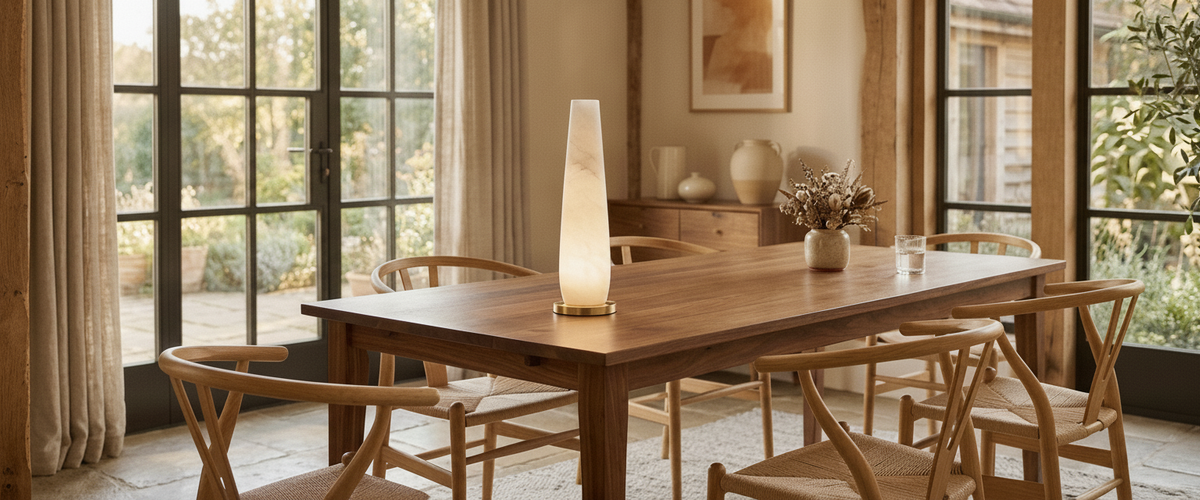

Move a lamp to the middle of a dining table and the whole room shifts. No trailing flex, no hunt for a hidden socket, no extension lead snaking under a rug. That freedom is the entire appeal of a cordless alabaster table lamps, and it is why so many designers now specify one for the spots a plug could never reach. The catch is that alabaster is heavy and rechargeable batteries are not, so a cordless alabaster table lamp is always a negotiation between how good the light looks and how long it lasts.
Alabaster is a gypsum stone that has been carved for lamps and vessels since antiquity, prized because it lets light pass through it in a soft, honey-warm way rather than blocking it. The Metropolitan Museum of Art holds Egyptian alabaster pieces more than 3,000 years old that still show this glow when lit from within. Put an LED inside that stone and cut the cord, and you have a lamp that behaves like candlelight but never gutters.

Key Takeaways Before You Buy
Runtime is the real spec. Expect useful evening light from a cordless alabaster table lamp, not all-night burn. Warmer, dimmer settings last far longer than full brightness.
Weight is a feature, not a fault. A dense stone base keeps the lamp from tipping, but it makes daily carrying less casual.
Charging is a habit. The best results come from topping up on a routine, not running the battery flat.
Placement pays off. A rechargeable stone lamp earns its keep on dinner tables, deep shelves, and mantels where wiring is impossible.
Corded still wins for a lamp that stays put and needs to run for hours every night.

Why Cordless Changed Where an Alabaster Lamp Can Actually Live
A corded lamp is quietly bossy. It dictates position, because it has to sit within a flex length of a socket, and it tends to end up beside a wall or behind a sofa. A cordless alabaster table lamp removes that rule. Suddenly the lamp can go dead center on a walnut dining table, at the far end of a kitchen island, or on a floating shelf that was never wired for anything.
We shipped a pair to a client furnishing a converted barn in the Cotswolds where the original stone walls could not be chased for cabling. Corded fittings would have meant visible trunking across a listed surface. Two battery-powered alabaster lamps solved it in an afternoon, and the owners now carry one out to the garden table on warm evenings. That portability is the point. A cordless alabaster table lamp glows the same whether it is plugged in or not.

Battery Life Versus Glow: The Honest Runtime You Should Expect
Here is where marketing and reality drift apart. A rechargeable lamp quotes its best-case runtime at its lowest brightness, and that number drops sharply as you turn it up. A lamp that claims 20 hours on its dimmest setting can drop to 4 or 5 hours at full output. Alabaster helps, because the stone diffuses even a modest LED into a generous pool of light, so you rarely need full output for the lamp to look good. A warm, low setting can carry you through a long dinner and beyond; full brightness will not.
Think in terms of an evening rather than a full day. Most cordless stone lamps are designed to cover the hours you actually use them, then recharge overnight, and a flat battery typically takes 4 to 6 hours to fill on the supplied charger. If you want a light that runs from dusk until bedtime at full tilt, a cordless alabaster table lamp will frustrate you. If you want warm, atmospheric light for a few hours, it delivers beautifully. Look for a model with genuine dimming rather than a single fixed brightness; being able to drop the output is the single biggest lever you have over runtime.
How Stone Weight and a Rechargeable Base Fight for Balance
Alabaster is dense. A carved stone base gives a lamp presence and a low center of gravity, which is exactly what you want on a table where a cable might otherwise be nudged. A base carved from solid stone can weigh several pounds (2 to 4 kg is common), and adding a rechargeable battery grows it heavier still, since the cell and its housing sit low to keep the lamp stable.
That weight is a genuine trade-off. A cordless alabaster table lamp you plan to carry between rooms should be one you can lift comfortably with one hand; a lamp that lives permanently on a mantel can afford to be heavier and steadier. The shape of the base matters here too: where a rounded silhouette such as the Essence Round Table Lamp reads as soft and self-contained, a squared form like the Essence Square Table Lamp sits more deliberately against the straight edges of a shelf or console. When you compare pieces across our alabaster lighting range, weigh the base against how mobile you actually need the lamp to be. Buyers often overestimate how much they will move it. In practice a portable lamp gets carried far less than people imagine; the freedom is mostly about where it lives, not how often it travels.
One practical note on the stone itself: alabaster is softer than marble or granite and can scratch or stain. On the Mohs hardness scale gypsum alabaster rates about 2, well below marble at 3 to 4, so it marks more easily. The Natural Stone Institute classes gypsum alabaster as porous and sensitive to moisture, so a lamp taken outdoors should come back in before dew settles, and spills should be blotted rather than left to soak.
Placing a Cordless Lamp on Shelves, Mantels and Dinner Tables
The best spots for a cordless alabaster table lamp are the ones a wired fitting cannot reach.
Dinner tables. A low lamp at the center, dimmed warm, replaces candles without the wax or the fire risk. Keep it below eye level, roughly 12 to 15 inches (30 to 38 cm) tall, so it does not block sightlines across the table.
Mantels. A pair flanking a fireplace gives symmetry with no cables running down the chimney breast. Alabaster's glow flatters the stone or plaster around it.
Floating and deep shelves. Shelves are almost never wired. A battery-powered lamp turns a bookshelf recess into a lit vignette and can be lifted out to charge.
Kitchen islands. A cordless alabaster table lamp at the end of an island softens hard task lighting in the evening and moves aside when you need the surface.
Bedsides without sockets. Period bedrooms and guest rooms rarely have a socket exactly where you want a lamp. Cordless fills that gap.
Across a whole scheme you might mix battery-powered pieces with wired pendants and wall lights; the broader lighting collection is worth browsing to see how the same alabaster finish reads in different fixture types, so the portable lamp does not feel like an orphan next to your permanent fittings.
Charging Habits That Keep the Light Consistent Night to Night
A rechargeable lamp lives or dies on your routine. Treat your cordless alabaster table lamp like a phone: top it up regularly rather than running it flat, and it will give you the same warm light every evening. Let it drain to nothing repeatedly and you will find yourself with a dark lamp on the night you most wanted it.
Charge on a schedule, not an emergency. A quick daytime top-up beats a scramble at 8pm.
Use the supplied charger. Mismatched adapters can undercharge or run warm.
Keep the contacts clean. Magnetic or pin charging bases work best when free of dust; a soft dry cloth is enough.
Avoid extreme cold. Batteries lose capacity below about 32°F (0°C) in a chilly conservatory or a garden overnight. Bring the lamp indoors.
Store it charged. If a lamp goes into a spare room for a season, leave it part-charged, around 50 percent, rather than empty.
Any charging cradle or contact base should be wiped only when unplugged, and any concern about the charger or wiring itself is a job for a qualified electrician rather than a guess. Battery and mains safety guidance from Electrical Safety First is worth a read if you are running several rechargeable pieces around the home.
When a Corded Lamp Still Wins, Despite the Tether
Going wireless is not automatically the better choice. A corded alabaster lamp that sits in one fixed spot, next to an armchair or on a hall console, will run all evening at any brightness without a thought, and it never needs charging. If the lamp lives permanently within reach of a socket and you want steady, unlimited light, the cord is barely a compromise.
Corded lamps also tend to offer larger, brighter output because they are not rationing a battery, and they can be wired into a dimmer circuit for whole-room control. For a reading lamp you use for hours, or a lamp meant to carry real illumination rather than mood, corded is the honest answer. Choose a cordless alabaster table lamp when placement freedom matters more than runtime, and corded when runtime matters more than freedom.
Budget and Choosing Well
Price on any alabaster lamp comes down to the stone itself, its size, how it is carved and finished, and the quality of the electrics or battery inside. A hand-selected block with clean veining, a well-engineered dimmer, and a reliable rechargeable cell all add cost, and they are the parts that decide how a cordless alabaster table lamp looks and lasts. Rather than chase a headline figure, tell us the room, the placement, and how you plan to use the lamp, and we can point you to the right piece and a tailored quote. A cordless alabaster table lamp is a small object that changes how a room feels after dark, so it is worth getting the match right.