
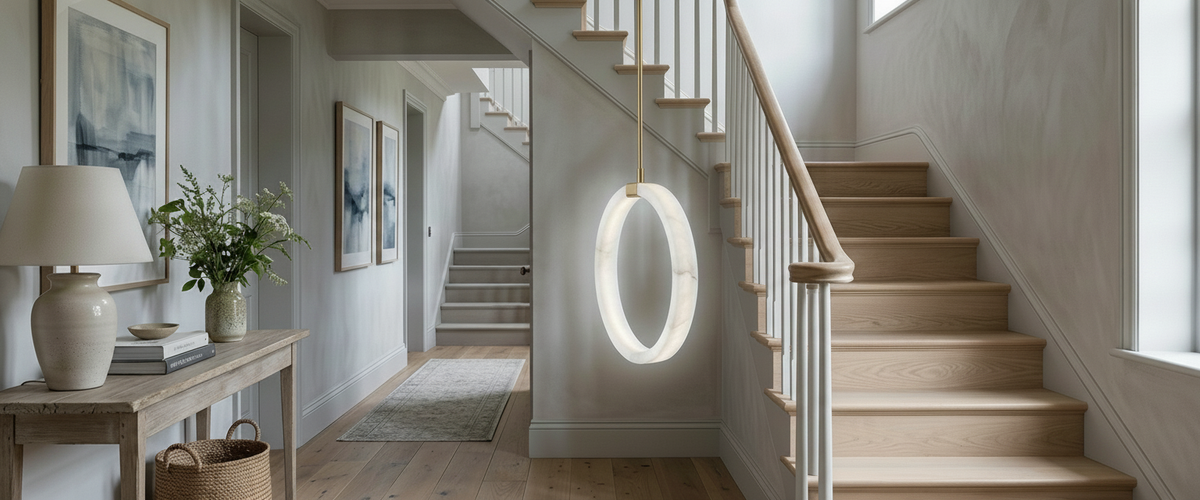

A staircase step light LED setup has exactly one job: show you where the edge of the next tread is when you are half-asleep and the main lights are off. Get that right and the stairs feel safe and quietly handsome. Get it wrong, usually by chasing brightness, and you end up with a strip of fixtures firing straight into your eyes so you see spots instead of steps. Most staircase step lighting problems come down to glare, not lumens.
Under-tread LEDs cast a soft line onto each step without dazzling the eye.
At Niori we are known for alabaster and natural-stone lighting, the pendants, wall lights and lamps that give a warm, diffused glow rather than a hard beam. A staircase step light LED runs on the same principle. The light you notice least is often the light that works best, because it lands on the surface you need to see and stays out of your line of sight.

Key Takeaways for a Staircase Step Light LED Scheme
Glare is the enemy. Aim light down onto the tread, never out at eye level.
Warm is safer at night. A warm white staircase step light LED (around 2700K) reads as calm and does not shock the eye when you are drowsy.
Place before you power. Decide riser or under-tread, then set consistent spacing so no step falls dark.
Dim it. A low night setting is kinder than full output and far more useful at 3am.
Use a qualified electrician for the wiring and driver, especially on a mains-connected run.

The One Job Step Lights Actually Have
Think about how you use a staircase in the dark. You are not reading; you are judging depth. Your eye needs to see the nosing, the front edge of each tread, so your foot knows where to land. A good staircase step light LED puts a soft pool of light on that edge and the step below it.
Glare defeats this completely. A bare diode at ankle or knee height throws light into your pupils, which then contract, which then makes the darker parts of the stair harder to read. You have added illumination and reduced what you can see. The fix is simple in principle: keep the source shielded or recessed, and let the light do its work on the horizontal surface.

Recessed Into the Riser or Under the Tread
These two approaches give very different night effects, and it is worth choosing deliberately.
Recessed into the riser means a small fixture set into the vertical face beneath each tread, casting light downward and slightly forward onto the step below. This gives an even, architectural rhythm. It reads well on straight flights and open-plan stairs where the run is on show. Because the source sits low and points down, glare on this style of staircase step light LED is easy to control. Set the fixture roughly 2 to 4 inches (50 to 100 mm) above the tread it lights so the pool lands on the nosing rather than the wall.
Under-tread lighting tucks a strip beneath the nosing so light spills onto the step underneath. This creates a floating, shadow-line effect where each tread seems to hover. It is the softer, more contemporary look and it hides the source almost completely. Cuttable LED strip is the usual tool here, run in a shielded channel so you see the glow and not the diodes. For a continuous line of light with no visible dots, a dense-emitter option such as the COB LED Strip 10W/m IP65 24V Warm White gives the smooth glow this effect depends on.
Riser-recessed fixtures give a repeated, architectural rhythm up the flight.
Riser lights suit period staircases and anywhere you want a clear, repeated point of light. Under-tread strips suit minimalist joinery, stone stairs, and homes where the staircase is a feature in its own right. Neither is better; they answer different design questions.
Getting the Spacing Right so No Step Falls Into Shadow
Spacing is where most schemes wander off. The instinct is to light every third or fourth step to save money, then wonder why the middle of the flight goes dark. On a night-time stair, the eye reads the pattern; a missing step in the sequence is exactly where a foot hesitates. Even the best staircase step light LED cannot fix a gap the eye keeps tripping on.
For riser fixtures, the cleanest result is one per step, or a strict every-other-step rhythm if the flight is long and the treads are wide enough that the light overlaps. A standard domestic tread runs around 9 to 11 inches (230 to 280 mm) deep, so on an alternating pattern each pool of light has to reach the step in between. If you skip steps, keep the interval identical the whole way up. An irregular pattern looks like a fault, not a design choice.
Under-tread strip solves spacing by default, because it runs continuously; every tread gets its own line of light. That is part of why it looks so calm. If budget or joinery forces you to light alternate treads with a staircase step light LED, plan it before the carpenter starts, not after.
One thing we have learned from projects: measure the actual visible face of each riser before ordering. Winder treads on a turning staircase have very different riser widths, and a strip cut for a straight flight will not sit right on a curved one. Cuttable strip helps, but the channel and end caps still have to fit the real geometry.
Warm Beam Angles That Light the Stair, Not the Whole Hallway
Colour temperature and beam control together decide whether the effect is restful or clinical. For stairs used at night, a warm white staircase step light LED in the region of 2700K is the friendly choice. It suits timber, stone and painted risers, and it does not jolt the eye the way cool white can. Cool or daylight sources have their place in workshops and garages; a home staircase is not one of them. Where the stair sits inside a warm-toned scheme, a warm strip such as the COB LED Strip 10W/m IP65 24V Warm White keeps the glow closer to candlelight than to a cool downlight; the daylight versions of the same strip belong in a garage or utility run rather than a bedroom landing.
Beam angle matters as much as colour. You want the light contained on the stair, not washing the whole hallway wall. A narrow, downward throw keeps the effect purposeful. Shielded fixtures and recessed channels do this naturally by physically blocking the sideways spill.
This is the same logic behind our alabaster lighting: stone diffuses light into a soft, even wash rather than a hotspot, so the glow feels held rather than sprayed across a room. On a staircase you are engineering that same softness with placement and shielding instead of stone, but the goal, controlled warm light that lands where you need it, is identical.
Wiring Runs and Dimming on a Staircase You Use Half-Asleep
A staircase step light LED run needs planning because the fixtures are spread over a vertical distance and often buried in joinery you cannot easily reach later. Sort the cable route and driver location before anything is fixed. Low-voltage LED (typically 24V) is common for stair strips because it is safe to handle and easy to run in tight channels, but the transformer or driver still connects to the mains, so this is qualified-electrician territory. Any permanent wiring in a home should follow the wiring regulations and be signed off appropriately; Electrical Safety First is a sensible reference point on safe installation.
Dimming is the feature people forget and then wish they had. On the stairs you actually use at night, full brightness is rarely what you want. A low glow at 3am guides you without waking you fully; the same fixtures can run brighter for an evening dinner party. Specify a dimmable driver and a compatible control from the start. Some schemes add a motion sensor so the step lights fade up as you approach and off after you pass, which is genuinely useful on a landing outside bedrooms.
If you are combining stair lighting with a pendant over the stairwell or wall lights along the landing, keep them on separate circuits or scenes. The overhead fixture is for cleaning and daytime use; the staircase step light LED is for the night. You want to reach the right one without hunting.
Mistakes That Turn a Subtle Glow Into a Runway Strip
A few errors show up again and again, and all of them are avoidable at the planning stage.
Over-bright output. Step lights should whisper. If a single fixture lights the whole flight, it is too strong and almost certainly glaring.
Sources you can see. A visible diode or bare bulb at eye or knee height is the classic runway-strip look. Recess it or shield it.
Cool white in a home. It makes a warm timber stair look like a fire escape. Stay warm.
Uneven spacing. Random gaps read as a fault. Commit to one per step or a strict alternating pattern.
No dimming. Fixed full output is the least useful setting for the exact moment you need the light most.
Mismatched colour temperature. Mixing a 2700K staircase step light LED with a cool overhead fitting looks accidental. Keep the family consistent.
Stair lighting sits within a wider scheme, and it should feel related to everything else on the wall and ceiling. If you are pulling a whole staircase and landing together, browsing the broader lighting collection helps you match the warmth and finish of your step fixtures to the pendants, wall lights and lamps around them, so the stair reads as part of the house rather than a bolt-on.
Done well, a staircase step light LED scheme is the kind of detail guests never consciously notice and always benefit from. The steps are legible, the light is warm, nothing dazzles, and the stair looks considered by day as well as by night. That quiet competence is the whole point.