
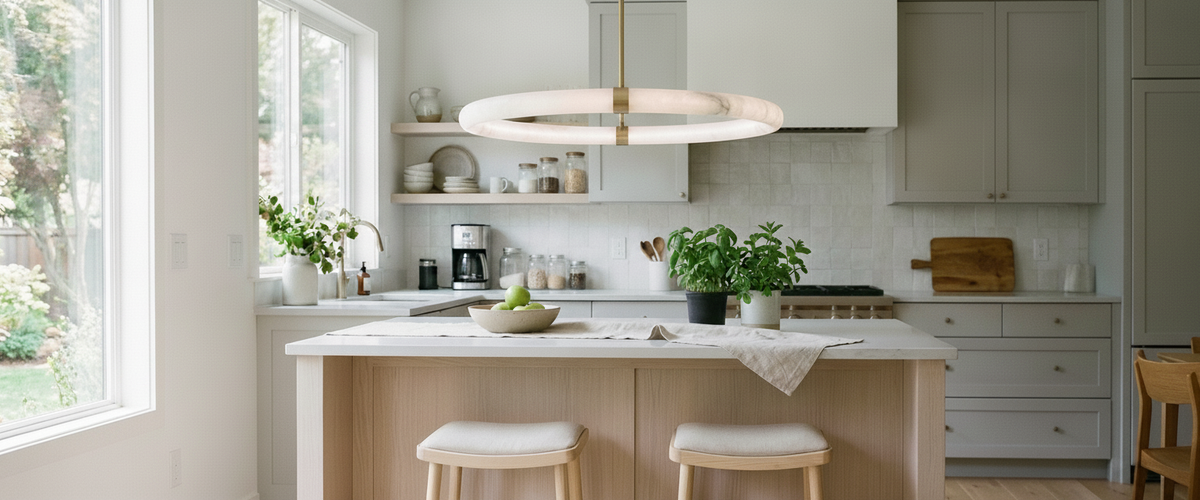

A pendant is the first thing your eye finds when you walk into a room, and the last thing you forgive if it gets the light wrong. Before anyone argues about shape or finish, pendant lighting is doing a job: it decides whether your kitchen island is a place to chop and read a recipe, or a shadowy counter you squint over. Get the job right and the looks follow. Get it backwards and you own a good-looking fitting that nobody wants to sit under.
At Niori we make alabaster and natural-stone lighting, so we spend our days watching how different materials throw light. That perspective shapes everything below, from how you size a piece of pendant lighting to which bulb keeps stone reading as stone rather than a cold panel.
An alabaster pendant glows across its whole form rather than exposing a bare lamp.

Key Takeaways
Decide what the light must do (task, ambient, or centrepiece) before you shop by looks.
Glass scatters, metal spots, alabaster glows. The material sets the mood more than the silhouette.
Size your pendant lighting to the surface beneath it, not the ceiling above it.
Plug-in pendants suit renters and quick refreshes; hardwired suits permanent island and dining schemes.
Warm, dimmable LEDs (roughly 2700K) keep an alabaster pendant soft and skin-flattering.

The Job a Pendant Is Doing Before You Argue About Looks
Ask one question first: is this pendant lighting task light, ambient light, or a centrepiece? A pendant over a prep zone is a working light and needs punch on the surface. A pendant in a bedroom or snug is ambient and should feel like a low fire, not a spotlight. A pendant over a dining table is a centrepiece; it flatters faces and food, and brightness matters less than warmth and glare control.
Most buyer regret starts here. Someone buys a beautiful clear-glass fitting for a kitchen island, then finds it dumps a hard beam and a bright filament straight into their eyeline every time they sit down. The fitting was never wrong. The job was never defined. Good pendant lighting starts with that decision, not with a thumbnail.

Glass Scatters, Metal Spots, Stone Glows: Three Fixtures, Three Moods
The material inside your pendant lighting does more than the outline you picked from a thumbnail.
Glass scatters and reflects. Clear glass shows the bulb and throws bright highlights; opal or frosted glass softens that but still reads crisp and modern. Good over a table where you want sparkle, riskier as a lone task light because the source stays visible.
Metal shades spot. A solid brass or painted dome pushes nearly all its light straight down in a defined pool, with the shade itself staying dark. That directional beam is exactly what you want over a kitchen island or a reading chair, and exactly what you do not want as the only light in a large open-plan room.
Alabaster and natural stone glow. Because the material is faintly translucent, the whole shade lights up rather than just the opening. You get a warm, diffused wash with no hot filament staring back. The Getty Conservation Institute notes that alabaster is a soft, water-sensitive stone, which is part of why it transmits light so gently; the same quality that makes it glow is why it wants care, not a scrubbing. If you want pendant lighting that reads as a soft object of light rather than a bright hole in the ceiling, stone is the honest answer. You can see the range of forms this takes across our alabaster lighting collection.
Sizing the Fitting to What Lives Beneath It, Not the Ceiling Above
The most common sizing mistake is choosing pendant lighting to suit the room and forgetting the surface it serves. A pendant answers to the table, island or console under it.
Over a dining table: aim for a fixture around one-half to two-thirds the width of the table. Hang the base roughly 30 to 36 inches (76 to 91 cm) above the tabletop so it lights the surface without blocking sightlines across it.
Over a kitchen island: think in a row. Two or three smaller pendants usually beat one large fitting on a long island, spaced evenly with clear gaps at each end. Keep the bottom around 30 to 34 inches (76 to 86 cm) above the worktop.
In a hallway or over a console: the pendant should feel proportionate to the furniture and the width of the space, not compete with a doorway.
Over a long island, two or three smaller pendants usually beat one dominant shade.
Where a long island calls for a repeated fitting rather than one dominant shade, a compact form such as the Gemini Pendant Light 42.5cm in brass sits at the right scale to hang two or three in a clean row. On a generous dining table, by contrast, the wider Gemini Pendant Light 105cm in white reaches the two-thirds proportion a single centrepiece needs.
Ceiling height matters for drop, not for choosing the diameter. A tall room lets you hang lower or add cluster length; a standard ceiling asks for restraint so nobody walks into it. When you are comparing shapes and drops, our full lighting range is organised so you can weigh pendant lighting against wall lights and ceiling fittings for the same spot.
Plug-In Versus Hardwired: When a Flex and Hook Actually Wins
A plug in pendant lights hangs from a hook and runs a fabric or braided flex to a wall socket, controlled by a switch on the cord or the socket. It is the right call more often than people expect. Renters who cannot alter the ceiling, a bedside pendant either side of a bed, a temporary layout you are still testing, a reading corner that needs light where there is no existing point: all of these are better served by a plug-in than by chasing new wiring into a wall.
Hardwired pendant lighting wins when the position is permanent and central: a dining table, an island, a stairwell. It gives you a clean drop with no visible cable run to a socket, and it can sit on the room's main dimmer circuit.
One honest limit on stone: alabaster and marble shades carry real weight, so a heavier stone pendant belongs on a proper fixed ceiling point rather than a lightweight hook. If you love a plug-in look but the fitting is substantial, treat the flex-and-hook as styling and still fix the load to the ceiling. Any new wiring should be signed off by a qualified electrician; in the UK that means work compliant with the current wiring regulations, and it is not a job to improvise.
Kitchen Islands Want Task Light, Dining Tables Want a Centrepiece
These two rooms sit metres apart in open-plan homes and still want opposite things, which is why kitchen pendant lighting so often disappoints when a dining logic is applied to it.
Over an island you are cutting, reading labels and checking colour on a plate, so you want clean light landing on the worktop. A shade that directs light downward, or a stone pendant with enough output on a dimmer, does this without glare. Match colour temperature to how you cook: a slightly cooler light reads crisp for prep, while warmer light softens the whole room in the evening. Where you want that crisp prep light in a dark finish that recedes against a worktop, the Gemini Pendant Light 61cm in black pushes a defined pool downward rather than scattering it across the room. This is where dimmable pendant lighting earns back its cost.
Over a dining table the pendant is scenery. Here you want the fixture to look good switched off and flattering switched on, with warmth over brightness. An alabaster pendant suits a dining table particularly well because the glow sits low and even, and nobody across the table gets a filament in the eye. If you are shopping pendant lights for kitchen and dining zones in one open room, buy for each job separately rather than repeating one pendant light everywhere and hoping.
Stairwells and Voids: Hanging a Pendant That Reads From Every Floor
A double-height stairwell is the one place a single large pendant, or a vertical cluster, truly earns its scale. The trick is that this pendant lighting must read well from three positions: looking up from the hall, level with it on the landing, and down into the void from above.
Choose a fitting with no ugly underside, since people will look straight up at it. Stone and opal glass both flatter this view because the whole form glows rather than exposing a bare lamp. Set the lowest point so it clears head height on the landing and still fills the vertical space; a fitting that stops too high looks marooned. And put it on a dimmer, because a stairwell doubles as a night route where you want a low, safe glow, not full output at 2am.
The Dimming and Bulb Choices That Keep an Alabaster Pendant Soft
Stone rewards the right bulb and punishes the wrong one. A cold, bluish lamp makes alabaster look grey and flat and kills the warm veining that made you buy it. Bulb choice is where pendant lighting either sings or sulks.
Colour temperature: around 2700K for living, dining and bedrooms; you can go a touch cooler over a working island if you prefer crisp prep light.
Dimmable LED: choose lamps rated as fully dimmable and pair them with a trailing-edge LED dimmer to avoid flicker and buzz.
Output: higher lumens on a dimmer beats a permanently dim, underpowered bulb. You want headroom to bring it down, not a lamp already at its limit.
Colour rendering: a high CRI (90+) keeps food, skin and stone looking true.
Because alabaster is porous, care is gentle by design: dust with a dry soft brush or microfibre cloth, avoid household sprays and water, and let a specialist advise before any deeper clean. Treat the bulb spec as part of the design decision, not an afterthought, and a good stone pendant will look considered for years rather than dated in one.
How to Install a Pendant Light
People search how to install a pendant light and how do you install a pendant light hoping for a five-minute answer. The honest version: swapping like-for-like hardwired pendant lighting on an existing ceiling point is straightforward for a competent DIYer only if you isolate the circuit and are confident with the connections; anything involving new points, heavier stone fittings or a consumer-unit query should go to a qualified electrician. A plug-in pendant is the genuinely simple route, needing only a ceiling hook rated for the weight and a nearby socket.