
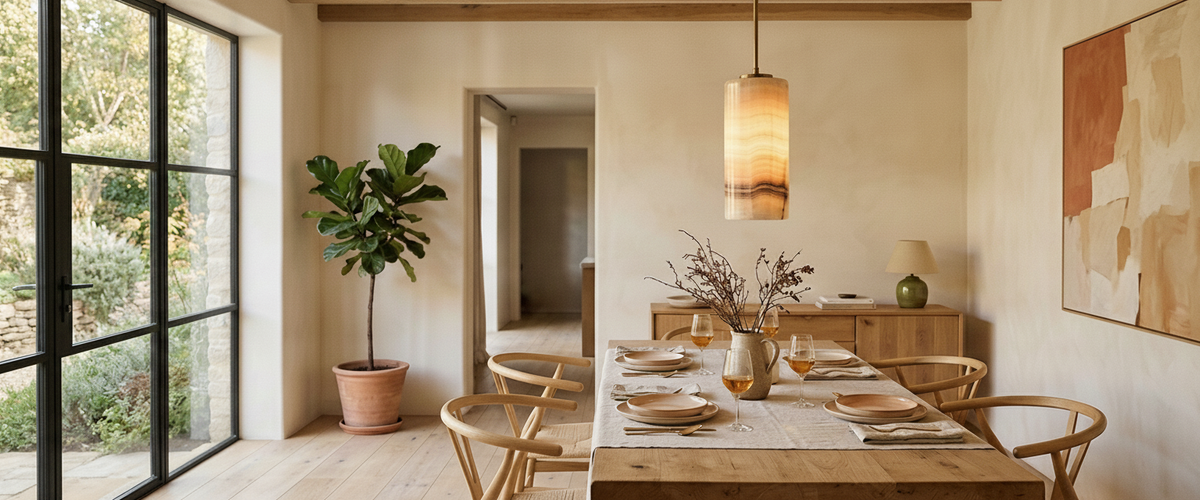

The whole reason to hang an onyx pendant lights is the banding. Lit from within, a good slab of onyx turns into ribbons of amber, honey, grey and cream that shift as you walk under it. Get the stone and the lamp wrong, and you have paid a premium for something that reads like frosted plastic. The difference is not luck. It comes down to how the stone is cut, how thick the slab is, and where the light sits behind it.
We have shipped enough onyx pieces to know which questions actually matter, so before you commit, here is the short version.

Key Takeaways
- Banding is the point. Buy for the veining you can see lit, not the pattern in a flat catalogue photo.
- Slab thickness controls the glow. Too thin and the colour washes out; too thick and the light barely gets through.
- Backlighting reveals the stone. The bulb position and beam decide whether veining shows or flattens.
- Weight is a real ceiling job. A stone pendant needs a proper fixing and, for wiring, a qualified electrician.
- Real onyx glows unevenly. Resin lookalikes glow too evenly and feel warm and light in the hand.

Why Onyx Banding Is the Whole Point, and Thin Slabs Kill It
Onyx is a banded variety of calcite, and those bands are what you are paying for. The Gemological Institute of America describes onyx marble as a layered stone laid down in translucent sheets, which is exactly why it comes alive when lit from behind. Hold a decent slab up to a window and you see depth: dark seams, cloudy pale areas, sudden flares of colour.
Cut that slab too thin to save weight and cost, and the banding loses its contrast. The light blasts straight through and the colour goes pale and even. You lose the drama that made onyx worth choosing in the first place. A well-made pendant keeps enough material to let the darker bands hold their shadow while the paler areas glow. That balance is the mark of a maker who understands the stone rather than one treating it as a generic shade.
When you browse onyx and other natural-stone pieces across our lighting collection, look past the overall shape first and ask what the stone is doing under the bulb.

Cylinder, Dome or Slab: How the Cut Changes the Glow
The form of the shade is not just styling. It changes how the light travels through the stone.
An onyx cylinder pendant lights wraps a continuous band of stone around the bulb, so the veining runs around the room in a horizontal sweep. It reads architectural and works well in pairs or rows over a kitchen island or a long dining table. Because the stone curves, the colour intensity shifts as it turns away from you, which gives a single cylinder real depth.
A dome or bowl throws more light downward and lets the underside glow like a pool of amber. This suits a spot where you want a warm downward wash: over a breakfast bar, a reading corner, or an entrance hall.
A flat slab pendant, cut as a disc or a squared panel, shows the banding as a single readable picture, almost like a lit painting. It is the most graphic option and the one where slab thickness matters most, because there is no curve to hide a thin cut.
Hanging onyx pendant lights in a group works best when the shades are cut from the same block, or at least the same colour family, so the banding relates from one piece to the next. Where a room calls for a run of matched fixtures over an island rather than a single stone shade, a linear form such as the Alfa Linear 5 Light Island Pendant shows how a repeated fixture holds a long surface together.
Blue, Green and Honey Onyx Under a Lit Bulb Versus a Dark One
Onyx colour behaves in two completely different ways depending on whether the lamp is on. Switched off, the stone shows its surface colour: cool, matte, quiet. Switched on, the internal bands light up and the colour deepens and warms. Plan for both states, because a pendant spends plenty of daytime hours unlit.
Honey onyx pendant light: the safest and most flattering choice. Off, it reads warm cream; on, it glows amber and gold. It pairs naturally with brass detailing and warm timber, and it forgives a slightly cooler bulb.
Blue onyx pendant light: dramatic and cooler, with grey-blue banding that can look almost stormy when lit. It wants a warm bulb to stop the glow turning clinical, and it suits a more contemporary, monochrome room where you want the pendant to be the coloured element.
Green onyx: sits between the two, with mossy and grey bands that lean earthy. It works beautifully against dark cabinetry and stone worktops.
A warm colour temperature, roughly 2700K, keeps honey and green onyx looking rich. Push cooler and you drain the warmth out of the stone.
The Backlighting That Reveals Veining Instead of Flattening It
Where the bulb sits inside the shade decides whether you see the stone or just a bright spot. A single bare bulb dead centre tends to create a hot core that bleaches out the banding directly around it. Better designs diffuse the source or position it to graze the stone, so the whole slab lights evenly and the veins stay legible.
This is where dimmable onyx pendant lighting earns its place. At full output the stone can look washed; dial it back and the banding gains contrast and the colour deepens. We tell clients to treat the dimmer as part of the fixture, not a nice-to-have. A honey onyx dome over a dining table looks entirely different at 40 percent than at 100, and the lower setting is usually the one you keep. Use a good-quality LED and a compatible dimmer to avoid flicker; the Chartered Institution of Building Services Engineers publishes helpful guidance on lighting quality and control if you want to go deeper. If your room leans toward diffused, warm-toned suspension rather than a hard stone downlight, a piece like the Glistis LED Spiral Pendant is closer to that design language, with its dimmable 3000K output built in.
For grouped onyx pendant light fixtures, wire them to a single circuit so they dim together. Nothing undoes the effect faster than one shade glowing hard while its neighbour sits dim.
Weight, Fixing and What a Heavy Stone Pendant Demands of the Ceiling
Stone is heavy, and this is the part buyers underestimate. A substantial onyx shade can weigh several times what a glass or metal pendant of the same size would. That load has to go into something solid: a joist, a proper ceiling box rated for the weight, or added blocking or a backing plate where the fixing point falls between joists.
A few practical points before you order:
- Confirm the pendant's weight and check your ceiling can carry it. A plasterboard fixing alone is not enough for a heavy stone piece.
- Ask the maker about the suspension: cable, rod or chain, and whether it is rated for the shade's load.
- Have the wiring and mounting done by a qualified electrician. Getting the fixing right on a heavy pendant is not a DIY afternoon.
- Plan the drop before installation. Over a table, the base of the shade usually wants to sit around 30 to 36 inches (76 to 91 cm) above the surface, adjusted for ceiling height.
Onyx is also softer and more porous than granite, so it needs gentler handling. The Natural Stone Institute notes that calcite-based stones are sensitive to acids, which is worth remembering for cleaning: a dry microfibre cloth for dust, and a barely damp cloth with pH-neutral cleaner if needed, never anything acidic or abrasive.
Telling a Real Glowing Pendant From a Resin Lookalike
The onyx look sells, so imitations exist. A resin or composite shade printed with an onyx pattern can fool a photograph, but rarely fools you in the room.
Here is how to tell them apart:
- Weight. Real onyx is heavy and cool to the touch. A lightweight, warm shade is almost always resin.
- Glow evenness. Printed lookalikes glow too uniformly. Genuine onyx has darker seams that stay darker even when lit, because the stone's density varies.
- Repeat patterns. If the veining repeats or looks suspiciously symmetrical, it is printed. Natural banding never tiles.
- Edges. Cut stone edges show the layered structure. Moulded resin edges look uniform and slightly plasticky.
- Depth. Onyx has translucency you can see into. A fake reads flat, like a lit sticker.
Buy from a specialist who talks openly about the stone, its origin and its variation, rather than one selling a generic pattern. Every natural slab is different, and a good maker treats that as the selling point, not a defect to airbrush out.
If you want a starting point for onyx and other stone pendants cut to keep their banding alive, our alabaster and natural-stone collection is where we group the pieces made to glow. Niori works only in alabaster and natural stone, so the light quality is the first thing we design around.