
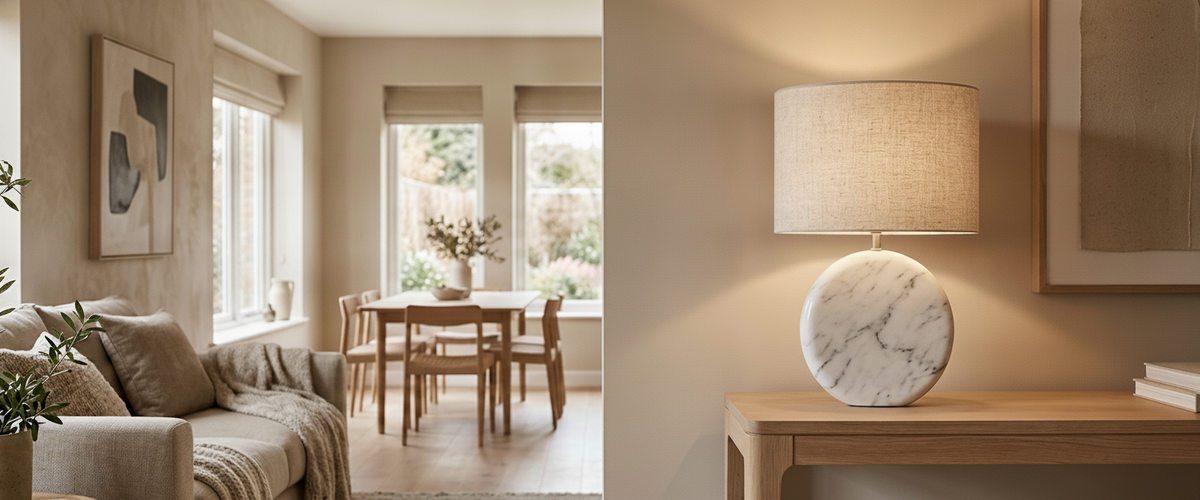

Hold a slab of marble up to a bulb and almost nothing gets through. That is the first thing to understand before you buy a marble table lamps: marble is a reflector, not a diffuser. It carries light across its surface, catches on the veining, and throws it back into the room. Alabaster does the opposite, glowing from within like a lit candle behind stone. Both are beautiful. They are not interchangeable, and knowing which one you actually want will save you an expensive mistake.
At Niori we work in alabaster and natural stone every day, and the question we field most often from buyers is why one lamp seems to pour warm light and another sits there looking handsome but dim. Density is the whole answer.
A veined marble base reflects lamplight rather than glowing from within.

Key Takeaways Before You Shop
Marble reflects, alabaster glows. If you want a lamp that lights from within, look at alabaster; if you want stone that catches light on a solid surface, marble is your material.
The base does most of the visual work in a marble lamp, so weight, seams, and veining matter more than the shade.
Colour changes everything. White reads calm, black reads architectural, heavy veining reads statement.
Warm bulbs (around 2700K) flatter stone. Cold light makes marble look clinical.
Cold, honest weight signals real stone. Resin fakes the look but not the heft or the seam behaviour.

Why Marble Mostly Reflects While Alabaster Glows
Marble is metamorphosed limestone, densely packed and low in translucency. Light hits the polished face and bounces; only the thinnest edges let a whisper through. That density is exactly why a marble base feels reassuringly heavy and grounds a lamp so well. Alabaster, a form of gypsum, is softer and more porous, which lets a bulb glow through a carved shade and produce the warm diffused light our pieces are known for.
This matters when you are choosing. If a client tells me they want a bedside lamp that gives a soft ambient wash, I steer them to alabaster. If they want a sculptural object on a console that reflects lamplight and anchors a room, a marble base earns its place. You can compare both approaches across our lighting collection and see how the materials behave differently under the same bulb.

Black, White, and Heavily Veined: What Each Stone Does to a Warm Bulb
Colour is not decoration here; it decides how the lamp reads once it is switched on.
A black marble table lamps drinks light and gives back sharp highlights along the polished edges. Under a warm bulb, black stone with grey or gold veining looks architectural and quiet, which is why it suits studies, dark-walled dining rooms, and modern interiors that already carry contrast. Pair it with a pale shade so the light itself stays generous while the base stays dramatic. Where a desk or study calls for a directional black fixture rather than a soft base glow, an adjustable piece such as the AGZAR 5W E14 Adjustable Desk Lamp in black sits closer to that architectural language.
White marble, usually Carrara or a similar grey-veined stone, does the opposite. It stays luminous even off, and under a warm bulb it warms to a soft cream rather than a cold white. This is the safest choice for a bright bedroom or a coastal-style living room where you want calm.
Black stone reads architectural under a warm 2700K bulb.
Heavily veined stone, think dramatic green, gold-flecked, or bold grey rivers, is the statement option. One veined marble base table lamp can carry an entire console. Two of them competing across a room usually cannot. If the veining is loud, keep everything around it plain.
Reading the Base: Cold Weight and Honest Seams Versus Resin That Fakes It
The base is where you spend most of your money and where fakes get exposed. Genuine marble is cold to the touch and stays cold; resin warms quickly under your palm. Real stone carries a weight that feels almost too heavy for its size. A solid marble base can run 5 to 8 lbs (2.3 to 3.6 kg) or more, while a resin copy of the same size often weighs half that and holds a faint chill even in a warm room.
Look at the seams and the veining pattern. Natural stone veining never repeats, never lines up perfectly across a join, and often runs slightly off from what a designer would draw. Printed resin veining repeats if you look long enough, and the pattern sits under a uniform glossy skin rather than in the stone. The Natural Stone Institute has good background on how genuine stone is quarried and finished if you want to understand what honest surfaces look like (naturalstoneinstitute.org).
Turn the lamp over. A real stone base usually shows a felt pad, a drilled channel for the cable, and sometimes tiny natural pits or fill lines. A moulded seam running around the base is a resin tell. None of this makes a resin lamp worthless; it just should not be sold at a marble price.
Antique and Vintage Marble Lamps: The Wear That Tells You It's Real
An antique marble table lamp earns its character through wear you cannot fake quickly. Softened edges, faint scratches on the underside, brass that has dulled to a warm patina, and old cloth-covered flex are all good signs. Marble picks up tiny surface losses over decades, and those are worth more than a flawless polish on a genuinely old piece.
A vintage marble table lamp from the mid-twentieth century (roughly 1940s to 1970s) often pairs stone with brass, and the join between the two is where you check quality. Loose fittings, wobble, or modern screws in an otherwise old lamp usually mean it has been rewired or repaired, which is fine for use but affects value. Always have any antique or vintage piece rewired by a qualified electrician before you plug it in; old flex and worn fittings are a genuine fire risk, and UK safety guidance is clear on this (electricalsafetyfirst.org.uk).
On value: prices for antique marble-based lamps swing wildly with maker, stone, condition, and originality of fittings. A rewired anonymous piece with chips sits at one end; a documented gueridon-style lamp table with an original marble top, single drawer, and intact hardware sits far higher. There is no fixed figure, so treat any single valuation with caution and get a specialist to assess condition, originality, and provenance before you buy or sell.
The Shade and Bulb Temperature That Let the Veining Stay the Star
Because marble reflects rather than glows, the shade does the lighting work. That gives you freedom: a linen or parchment drum in ivory or oatmeal pushes warm light down onto the stone and lets the veining catch it. Avoid stark bright-white shades that fight the warmth of the stone.
Bulb temperature is where most people go wrong. Choose around 2700K for a warm, flattering glow that brings out gold and grey tones in the stone. Cooler bulbs above 4000K make marble look like a kitchen worktop. Fit a dimmable LED and a compatible dimmer so you can drop the level in the evening; the highlights on polished stone look richer at lower light. The Chartered Institution of Building Services Engineers offers sensible reference on colour temperature and how it shapes a room's mood (cibse.org).
If you prefer a lamp that lights the room from the stone itself rather than from the shade, that is the moment to look at our alabaster lighting instead. Same sculptural weight, completely different light.
Placing a Marble Lamp So the Stone Carries a Quiet Room
A marble table lamp works hardest when the room around it stays calm. On a console in a hallway, a single white marble lamp table pairing looks composed and welcoming; flanking a bed, a matched pair frames the space without shouting. In a study, a black marble base beside dark shelving reads serious and grown-up.
Give the lamp room to breathe. Marble bases have visual mass, so crowding one with picture frames and objects buries the veining you paid for. Keep the surface around it sparse. And watch the height: a table lamp shade should sit roughly at eye level when you are seated nearby, usually with the bottom of the shade about 40 to 42 inches (100 to 107 cm) off the floor, so the bulb glare stays hidden and the warm light falls where you want it.
A Quick Placement Checklist
One statement veined lamp per sightline; pair only matched, quieter designs.
Keep the surrounding surface clear so the stone leads.
Warm bulb around 2700K, dimmable, with a compatible dimmer.
Ivory or oatmeal shade over stark white.
Felt pads underneath to protect timber and stone tops.
Rewire any antique or vintage lamp through a qualified electrician first.
So Which Stone Is Right for You?
If you want a solid, sculptural object that reflects lamplight and grounds a console or bedside, buy a marble table lamp and let a warm bulb and a soft shade do the lighting. If you want the light to come from the stone itself, glowing and diffuse, alabaster is the answer. Your budget for a stone lamp depends on the material, the scale, the base construction, and the quality of the fittings, so ask for a tailored quote rather than trusting a single headline figure. Either way, read the stone before you read the price tag.