
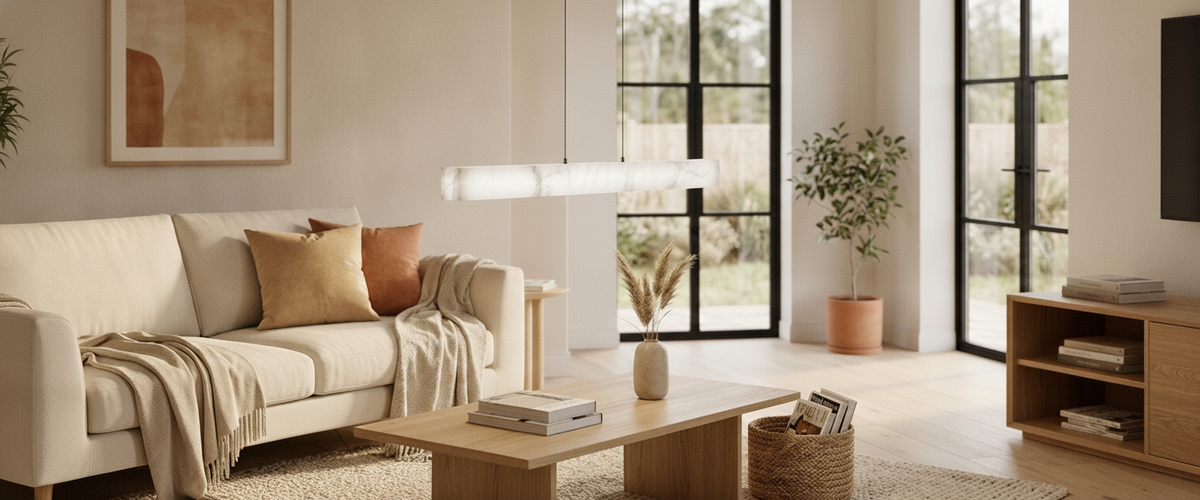

A living room pendant light is the one fixture people notice the second they walk in, and the one that goes wrong most often. Hang it too low and it splits the room in half. Choose it too small and it floats like an afterthought over a large sofa. Pick a harsh bulb and you get a spotlight instead of the settled, low light an evening lounge actually wants. Get the scale, the height, and the material right, and a single living room pendant light can carry the whole ceiling.
We build in alabaster and natural stone, so a lot of this comes down to how the shade handles the light rather than just how it looks switched off. That distinction matters more in a living room than almost anywhere else, because you spend hours under it in the evening.

Key Takeaways for a Living Room Pendant Light
Size to the room, not the table. Add your room's length and width in feet, and the sum in inches is a rough starting diameter for a single living room pendant light.
Hang high in open space. Over a coffee table or seating group, keep the bottom of the fixture around 7 feet (2.1 m) off the floor so nobody stares into a bulb.
Alabaster diffuses, glass exposes. A stone shade turns a bare downlight into a soft wash across the ceiling and walls.
Never make the pendant the only light. Layer it with lamps and wall lights so it isn't forced to do everything.
Dim it and warm it. A dimmable fixture on warm bulbs is what makes a living room feel finished after dark.

The Rooms a Pendant Transforms, and the Ones Better Served by a Floor Lamp
A living room pendant light earns its place where you want a clear focal point and a defined pool of light: over a coffee table, above a reading corner, centred on a seating group in a room with decent ceiling height. In an open-plan space, a good living room pendant light also draws an invisible boundary around the lounge and separates it from the kitchen or dining zone without a wall.
It struggles in a couple of situations. Low ceilings under roughly 8 feet (2.4 m) rarely give a hanging fixture room to breathe, and one you keep ducking around stops feeling elegant fast. Rooms where the seating floats in the middle, with no anchor point overhead, are often better served by a floor lamp arched over the sofa and a pair of table lamps. We had a client in a converted London warehouse with exposed steel beams and no ceiling box near the sofa; a sculptural floor lamp did more for that space than any pendant could have. Know when the ceiling is working for you and when it isn't.
Height Over Seating and Coffee Tables So Nobody Stares Into a Bulb
The single most common mistake we see is a living room pendant light hung as if it were over a dining table. In a living room, people sit lower and move through the space, so the rules shift. Over a coffee table or the open centre of a seating group, aim for the bottom of the fixture to sit around 7 feet (2.1 m) from the floor. That clears sightlines when people stand and keeps the light source out of the eyeline when they sit.
If the fixture hangs over a specific surface, like a console or a low table you'll never walk across, you can drop it a little, to roughly 30 to 36 inches (76 to 91 cm) above that surface. Ceiling height changes everything, though. For every extra foot above the standard 8, you can add a couple of inches of drop and still keep the balance. With a translucent alabaster shade, the height also affects how wide the glow spreads across the ceiling, so live with your living room pendant light on the chain for a day before you commit the fixing.
One Statement Piece or a Cluster: Reading the Scale of Your Lounge
Whether you want one bold living room pendant light or a cluster of smaller ones comes down to the shape and scale of the room. A single large piece suits a square-ish lounge with one clear centre; it reads as calm and deliberate. A cluster, or two matched shades in a line, works better over a long seating arrangement or an open-plan run where one fixture would look stranded.
For sizing a single piece, the old designer trick still holds: add the room's length and width in feet, then read that total as inches for a sensible diameter. A 14 by 16 foot lounge points you toward something around 30 inches (76 cm) across. It's a starting point, not a law. Ceiling height, the mass of your furniture, and how much other decoration is competing all pull the number up or down. This is exactly why the Gemini pendants run across several diameters: where a large room needs one commanding form, the Gemini Pendant Light 105cm in Brushed Brass can hold the ceiling on its own, while a smaller lounge or a clustered arrangement is better suited to the Gemini Pendant Light 42.5cm in White. To compare the full range of shapes and scales, our alabaster lighting collection is the place to see them side by side.
How an Alabaster or Stone Shade Turns Hard Downlight Into a Soft Wash
This is where the material does real work. A clear glass pendant shows you the bulb; a bare LED behind it can be sharp and clinical, and in a living room that reads as unwelcoming. Alabaster is naturally translucent, so light passes through the stone and comes out diffused, warmed by the mineral, and carrying the faint veining that makes each piece slightly different. The Natural Stone Institute notes that alabaster's softness and fine grain are exactly what let light travel through it, which is why it has been carved into lamps and window panels for centuries (naturalstoneinstitute.org).
The practical result is a fixture that glows rather than glares. Instead of a hard cone of downlight, you get a gentle wash that lifts the ceiling and softens the corners of the room. That quality is hard to fake with a shade material that only blocks light rather than transmitting it. If you're weighing pendant lighting for a living room where you'll spend real evening hours, the shade material is the decision that changes how the space feels, not just how it photographs.
Building the Layers So the Living Room Pendant Light Isn't Carrying the Whole Room
A living room pendant light should be one voice, not the choir. Ask a single fixture to light an entire lounge and you get flat, tiring light with dead corners. The Chartered Institution of Building Services Engineers has long argued for layered lighting at different heights rather than one bright source overhead (cibse.org), and a living room is the clearest case for it.
Think in three rough layers. The pendant gives you the central anchor and the ambient glow. A pair of table lamps or a floor lamp fills the seating zone at eye level, which is where people actually read and talk. Wall lights or a discreet uplight then lift the perimeter so the walls don't fall into shadow. Alabaster runs through all of these formats, so you can keep one material language across the room. If you're assembling the whole scheme rather than a single piece, browse the wider lighting collection to see how table lamps and wall lights sit alongside a pendant light living room setups depend on.
Dimming and Warm Bulbs for the Low, Settled Light Evenings Ask For
The last piece is control. A living room asks for bright, useful light in the daytime and low, calm light at night, and no fixed brightness gives you both. Put your living room pendant light on a dimmer, and use bulbs with a warm colour temperature; somewhere around 2700K is the classic warm-white living-room setting. Higher numbers push toward cooler, bluer light that suits kitchens and offices more than lounges.
A note on the bulbs themselves: alabaster looks best when the light source inside sits centred and hidden, so the whole shade lights evenly. Avoid a very bright, tightly focused LED that creates a hot spot on one part of the stone. Check that both the fixture and the driver are marked as dimmable before you buy, and if you're pairing it with a smart dimmer, confirm compatibility, because a mismatch causes flicker at low levels. Any hard wiring into your ceiling should be signed off by a qualified electrician; UK guidance on this is clear (electricalsafetyfirst.org.uk).
A Quick Buyer's Checklist
Measure first. Room length plus width in feet, read as inches, for a single living room pendant light diameter.
Confirm ceiling height. Under 8 feet, consider a flush option or a floor lamp instead.
Set the drop. Around 7 feet to the base of the fixture over open seating.
Choose single or cluster. One anchor for a square room, a run for a long one.
Pick the shade for light quality. Alabaster and stone diffuse; clear glass exposes the bulb.
Plan the layers. Table lamps and wall lights so the pendant isn't alone.
Dim and warm. Dimmable fixture, warm bulbs, compatible controls.
Get those in order and the pendant stops being a gamble. Good pendant lighting living room schemes turn on that discipline. The right living room pendant light becomes the piece that sets the tone the moment you walk in, and the reason the room feels right at nine in the evening. Niori builds in alabaster and natural stone precisely for that difference, where the material shapes the light rather than just decorating the ceiling. If you're comparing shapes and sizes, start from the Niori homepage and work toward the living room pendant light that fits your room.