

Two pendants can share the same silhouette, the same brass collar and the same photograph online, and still light a room completely differently. One glows like a lit lantern with soft, even warmth. The other shows dark patches, a hot bright core and a chalky, lifeless surface once the bulb is on. The difference is rarely the shape. It is the stone, the wall thickness and the engineering you cannot see. Choosing an alabaster modern pendant lights well means learning to read those three things before the box arrives. An alabaster modern pendant light lives or dies on those details.
We handle these fixtures at the Niori studio every week, and the questions buyers ask before purchase are almost never the ones that matter after installation. So here is the honest version of how to judge an alabaster modern pendant light.
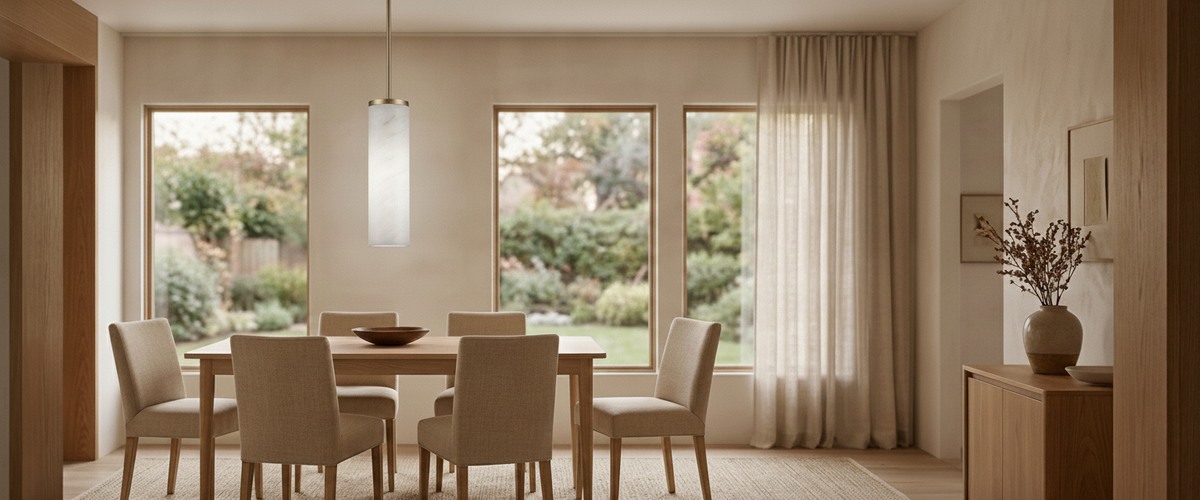
A genuine stone shade glows evenly when the bulb is on.

Key Takeaways Before You Buy
Real alabaster glows through the body of the stone. A hot spot over the bulb and dead corners usually means the wall is too thick or the material is not true alabaster.
Veining is character, not a flaw, but heavy dark mineral lines can block light and read as blotches when lit.
No two pieces light the same. Alabaster is a natural stone, so the sample you approve is the sample you should receive.
Diffusion and wiring do the quiet work. A clean alabaster modern pendant light still needs an internal diffuser and a properly rated lamp holder.
Budget depends on the stone, scale, engineering and finishing. Ask for a tailored quote rather than trusting a suspiciously round number.

What Separates a Genuine Alabaster Modern Pendant From a Lookalike
The most common substitute is resin or acrylic pressed to mimic stone veining. It photographs well and weighs almost nothing, which is the first tell. Real alabaster is a gypsum or calcite stone; it is dense, cool to the touch and heavy for its size. A carved shade the size of a dinner plate has real heft in the hand, and that weight is exactly why the fixing and canopy of an alabaster modern pendant light have to be engineered properly.
Light behaves differently through each too. Genuine alabaster carries a faint internal depth, almost a glow that seems to come from inside the material rather than sitting on the surface. Resin tends to look flat and slightly plastic once lit, and it can yellow near a warm bulb over time. The Natural Stone Institute keeps useful reference material on how alabaster and other calcite stones are classified, worth a read if you want to understand what you are actually paying for (naturalstoneinstitute.org).
If you want to compare shapes and finishes across genuine stone, our alabaster lighting collection is a good place to see how the same modern language reads in white, honey and darker veined stone.

How Veining and Wall Thickness Decide Whether It Glows or Blotches
Here is the part nobody explains in a listing. Light passes through alabaster, but it does not pass through it evenly. Where the stone is thinner, more light escapes. Where a dense vein runs across the shade, light slows and darkens. That is why wall thickness is the single most important variable in whether an alabaster modern pendant light glows or looks patchy.
A shade carved too thick will fight the bulb. You get a bright halo directly over the lamp and gray, underlit flanks. A shade carved too thin can look wonderful cold but reveal every internal fitting the moment it is switched on, and it becomes fragile in transit. Skilled makers aim for a consistent wall that is thin enough to transmit warm light and thick enough to blur the source into a soft field. When you hold a well-made alabaster modern pendant light up to a window, the light should feel graded and continuous, not sharply bright in one patch and dead in another.
Fine, cloud-like veining reads as movement when the shade is lit.
Veining is where taste comes in. Fine, cloud-like veining reads as movement and warmth when lit. Heavy black or rust mineral lines can be beautiful unlit, then act like curtains across the glow. Neither is wrong; you just need to see the stone lit, not only photographed on a white studio background.
Stone Selection: Why Two Identical Designs Never Light the Same
Alabaster comes out of the ground in blocks, and every block has its own color temperature, translucency and vein pattern. Two examples of the same alabaster modern pendant light cut from different blocks will glow at slightly different warmths, and that is normal for natural stone rather than a defect.
We once shipped a pair of matching pendants for a kitchen island where the client wanted them to look like twins. We hand-selected both shades from a single block so the honey tone and vein direction ran the same way. That is the level of matching serious stone lighting requires, and it is why a good supplier will ask questions about your room before cutting rather than pulling the nearest box off a shelf.
For a single statement pendant over a dining table, this variation is a gift. For a run of three or more alabaster modern pendant lights, ask directly how the stone will be matched. If the answer is vague, treat that as information.
The Wiring and Diffusion Work Hidden Inside a Clean Silhouette
A modern alabaster pendant is meant to look calm and uncluttered. That simplicity is deceptive, because a clean shell has nowhere to hide poor engineering. Inside a good fixture you will usually find an internal diffuser (often opal glass or a frosted lens) that spreads the light before it reaches the stone, a lamp holder rated for the heat of the bulb, and a properly secured cable that carries the real weight of the shade rather than letting the stone hang on its wiring.
Heat matters more than people expect. LED runs cooler than halogen, but any enclosed shade traps warmth, so ventilation and a suitable lamp rating keep the fixture safe over years of use. Wiring should always be installed by a qualified electrician, and it is worth following the guidance from Electrical Safety First on fixed lighting connections (electricalsafetyfirst.org.uk). An alabaster modern pendant light is heavy; the ceiling fixing has to be right the first time.
On bulbs, warm white in the region of 2700K to 3000K flatters honey and white alabaster and brings out the internal glow. Cooler 4000K lamps look crisper and more architectural, which suits some black-collared modern designs; a fixture like the Gemini Pendant Light 42.5cm 4000K in Black shows how that crisper tone reads against a dark collar, though a 4000K lamp can drain the warmth from paler stone. Always check the fixture is dimmable and pair it with a dimmer rated for LED so you can drop the level in the evening without flicker.
Scale and Drop: Keeping It Modern Without Making It Clinical
Modern does not have to mean cold, and scale is where that balance lives. An alabaster modern pendant light that is too small over a large island looks like an afterthought; one hung too low turns a sculptural piece into an obstacle. As a rough working rule for a dining table, aim to leave around 30 to 36 inches (75 to 90 cm) between the tabletop and the base of the shade, adjusting up for taller ceilings.
Over a kitchen island, a longer horizontal form or a pair of round shades often reads better than a single small globe. Where a run of counter needs a generous horizontal presence, a longer form such as the Gemini Pendant Light 105cm 4000K in White holds the space more convincingly. In an entrance hall with height, a generous drop gives the stone room to be seen from below, which is exactly where its translucency shows best. If you are weighing a single large pendant against a linear multi-shade design, browse the full lighting range to see how proportion changes the feel of the same room.
Keep the fixings and cable honest to the style. A slim brushed brass or matt black cable and a discreet canopy keep the look modern. Ornate chains and heavy rosettes pull the piece back toward traditional, which may not be what you want under a flat plaster ceiling.
Red Flags in Cheap Alabaster Pendants Worth Walking Away From
Some warning signs show up before you have even parted with money on an alabaster modern pendant light.
Every product photo looks identical. Natural stone varies. If ten listings show the exact same vein pattern, you may be looking at a moulded material or a heavily edited image.
No lit photograph. A seller confident in the stone will show it switched on. If you only ever see it off, ask why.
Suspiciously low weight or a plastic feel described as "lightweight alabaster". Genuine stone is not light.
Vague material wording such as "alabaster-effect", "stone resin" or "alabaster style". These are usually not solid stone.
No mention of the internal diffuser or lamp rating. A serious fixture tells you what is inside.
Rigid one-size-fits-all matching when you need a set. Real stone requires hand selection for runs.
None of this means the highest number wins. Price reflects the stone grade, the size, the carving and diffusion work, and the finishing, so a tailored quote is far more useful than a headline figure. When you know how to judge an alabaster modern pendant light on stone, wall thickness and wiring, you buy once and buy well. If you want help judging a particular alabaster modern pendant light, our team at Niori works with alabaster and natural stone every day and would rather talk you out of the wrong pendant than sell you one that blotches.