
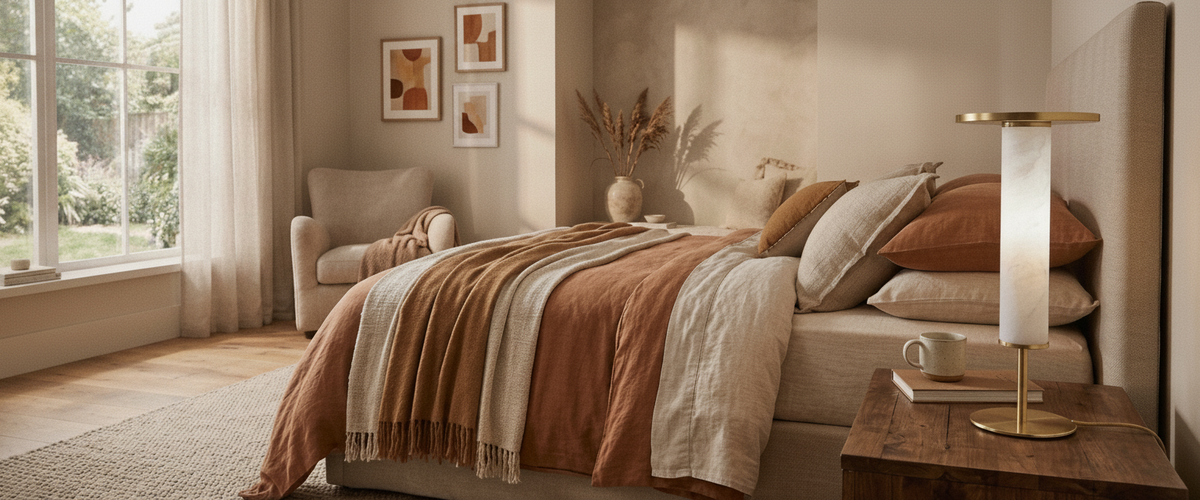

The fastest way to waste a beautiful lamp is to put it in the wrong place. A modern alabaster table lamp lives or dies on its setting: the surface beneath it, the wall behind it, the light around it. Get those right and the stone reads like it is lit from within, veining warming up as the bulb comes on. Get them wrong and you have paid for a sculptural object that sits there looking cold and flat during the day and washed out at night.
Alabaster is a soft, translucent gypsum stone that has been carved and lit for centuries, and its whole appeal is the way it holds and scatters light rather than blocking it. That is why placement matters more than it does for a solid ceramic or metal base. A modern alabaster table lamp asks a little more of the room, and repays it. Below is how we think about it at Niori, drawn from rooms we have actually shipped to.
A modern alabaster table lamp on a mid-tone timber bedside, lit warm and low.

Key Takeaways
Matt, mid-tone surfaces flatter alabaster; high-gloss and busy patterns fight it.
On a bedside table, aim for the shade base to sit roughly at seated shoulder height so light falls on the page, not in your eyes.
Corded or cordless decides where the lamp can live before style ever enters the conversation.
A warm bulb around 2700K on a dimmer is what makes the stone read as candle-like rather than clinical.
A dark or textured wall behind the lamp deepens the glow more than any bulb swap.

Reading the Room First: Surfaces That Suit a Modern Alabaster Lamp
Before you decide which lamp, decide what it will stand on. A modern alabaster table lamp has a soft, chalky surface and gentle veining, and it looks best against materials that let it breathe. A limed oak console, a matt-painted bedside cabinet, a linen-covered surface, a walnut sideboard: these all give the stone room to be the interesting thing in the frame.
What fights it is high-gloss lacquer and heavily patterned marble. Put a pale alabaster base on a busy Calacatta top and the two sets of veining compete, and the lamp loses. Mirror-polished glass tabletops are the other common trap; they bounce the reflection of the bulb straight back and flatten the depth you paid for. If your surface is glossy, break the contact with a small tray or a stone coaster in a quieter tone.
Colour underneath matters too. Alabaster reads warmest against mid-tone timbers and deeper paint colours. Set a modern alabaster table lamp on stark white and it can look grey by daylight. To see the range of forms that suit these surfaces, our alabaster lighting collection shows how the same stone behaves across rounded and squared bases.

Scale and Sightlines: Getting the Height Right
Height is where most people go wrong, and it is easy to fix once you know the rule of thumb. The point is to control where the light and the top edge of the shade sit relative to your eye.
On a bedside table, you want the bottom of the shade, or the top of the lamp on a shadeless alabaster design, to land around seated shoulder height when you are propped up reading. Too tall and the bulb glares into your eyes; too short and the light pools on the tabletop instead of the book. As a starting figure, a bedside table around 24 to 26 inches (61 to 66 cm) high pairs well with a modern alabaster table lamp in the region of 16 to 20 inches (40 to 51 cm) tall, but measure against your own bed rather than trusting a number.
On a console or sideboard, the lamp is usually seen standing up and often flanks a mirror or artwork. Here you want the lamp tall enough to hold its own against the wall above without crowding whatever hangs there. Leave a hand's width of breathing space between the top of the lamp and the bottom of the frame. A pair of matched alabaster table lamps on a long console reads more deliberate than a single lamp stranded to one side.
A matched pair of modern alabaster table lamps balanced on a hallway console.
Room by Room: Bedroom, Living Room and Hallway
In the bedroom, a modern alabaster table lamp does a job no downlight can: it gives a low, warm wash that signals wind-down without lighting the whole room. Where the scheme is soft and calm, a rounded base such as the Essence Round Table Lamp keeps the silhouette gentle; where the room is more architectural, the squared lines of the Essence Square Table Lamp read sharper against a clean wall. Keep the light on a dimmer beside the bed and you can drop it right down for reading.
In the living room, treat the lamp as one layer among several. It should not be the only light in the room, but it can be the one that stays on latest. Placed on a side table beside a sofa, a modern alabaster table lamp throws a pool of warmth at head height that flatters faces and evening company far better than an overhead source. For layering ideas across pendants, wall lights and lamps, the wider lighting collection is a useful reference for what works together.
In a hallway, a single alabaster table lamp on a narrow console is one of the most welcoming things you can do to an entrance. It softens a space that is usually lit harshly from above and gives arriving guests something warm to walk towards. This is also where a cordless option earns its place, which brings us to the next decision.
Corded or Cordless: The Alabaster Modern Table Lamp Question
Where a lamp can live is decided by its power source before anything else. A corded lamp needs a socket within tidy reach, or you are trailing cable across a walkway. A cordless alabaster table lamp with a rechargeable battery goes anywhere: the centre of a dining table, a windowsill, a bathroom shelf, an outdoor table on a still evening.
Cordless models have become far more capable in recent years, with dimmable LEDs and useful run times on a single charge, though the exact hours depend on the model and brightness setting. The trade-off is that you commit to recharging and, usually, to a fixed LED rather than swapping bulbs. If you have seen a Houa alabaster table lamp or similar portable design and liked the freedom, the thing to check is not the styling but the charging routine you will realistically keep up.
Our advice: use corded lamps where they will sit permanently, on a bedside table or console with a socket nearby, and reserve cordless for the surfaces that have no power and the moments you want to move the light around. Many clients end up with one modern alabaster table lamp of each kind.
Bulb, Dimming and Backdrop: Making the Stone Glow
The single biggest lever on how alabaster looks is colour temperature. Aim for a warm bulb around 2700K. Go cooler and the stone turns clinical; the whole point of a modern alabaster table lamp is that candle-adjacent warmth. The Chartered Institution of Building Services Engineers publishes lighting guidance on colour temperature and glare if you want the technical grounding (cibse.org).
Put the lamp on a dimmer wherever you can. Alabaster rewards low light more than almost any other material because at low output the veining glows and the surface stops looking like a daytime object. Check that the bulb and any control gear are dimmable before you buy; a non-dimmable LED locked at full brightness wastes the effect.
Then think about the wall behind. A dark or textured backdrop deepens the glow by contrast, which is why a modern alabaster table lamp against a deep green or charcoal wall looks richer than the same base against bright white. If your walls are pale, lean on the surface and surrounding objects to create the shadow the stone needs to read as luminous.
Placement Mistakes We Keep Seeing
These are the ones that come up again and again in client rooms.
The lonely single lamp. One lamp on a wide console looks unfinished. Pair them, or balance the lamp with a stack of books and an object of similar height.
Bulb glare at eye level. A lamp chosen for looks but too tall for the bedside table shines straight into your eyes when you lie down. Check the height against your actual bed.
Cold bulbs. A 4000K or 5000K bulb in a piece like this is the most common own goal. It drains the warmth the stone exists to give.
Gloss on gloss. Alabaster on a mirror-polished top doubles the reflection and flattens the depth. Break it with a tray or move the lamp to a matt surface.
No dimmer. Running the lamp at full brightness all evening means you never see the low, glowing register that makes alabaster special.
A quick fix for most of these is to test before you commit. Live with your modern alabaster table lamp switched on in its intended spot for a few evenings, at different brightness levels, before you decide it belongs there.
Care So the Glow Lasts
Alabaster is soft and slightly porous, so keep water off it. Dust with a dry, soft cloth and lift marks with a barely damp cloth, then dry at once. Avoid household sprays and anything acidic. The Natural Stone Institute has sound general guidance on caring for soft stones (naturalstoneinstitute.org). Treated gently, a modern alabaster table lamp holds its surface for decades and only grows more characterful.