
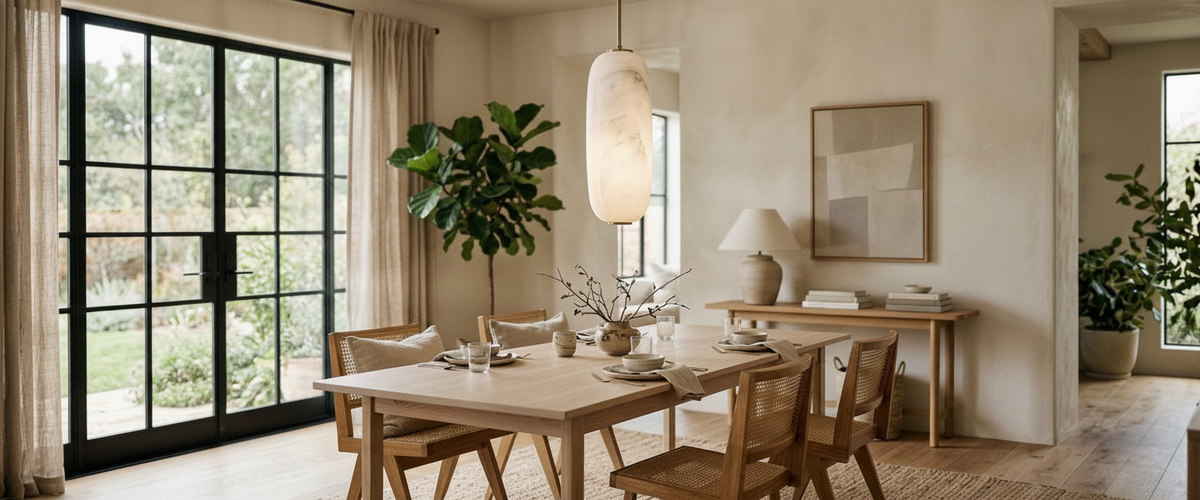

Hold a raw slab of alabaster up to a lamp and you see the whole argument for it in a second. The light does not sit flat on the surface; it sinks in, catches the veining, and comes back out softened and warm. That living quality is exactly why an alabaster pendant light reads so differently from a frosted-glass shade, and it is also why two pendants that look identical online can behave completely differently once they are switched on over your table.
Choosing an alabaster pendant light is less about the label and more about the stone, the shape, and the way the light is driven behind it. Get those three right and you have a fixture that flatters faces and food for years. Get them wrong and you get a pale disc with a hot spot in the middle.
A well-chosen alabaster pendant light glows as an even gradient rather than a blotchy disc.

Key Takeaways Before You Buy
Veined alabaster glows unevenly on purpose; opal glass diffuses flat. Decide which look you actually want.
Wall thickness and stone quality decide whether the alabaster pendant light glows evenly or blotches in patches.
Shape throws light differently: a gong disc washes down and out, a globe glows all round, an elongated form pools light on a surface.
Drop and diameter depend on whether you are lighting an island, a dining table, or a narrow hallway.
Warm LEDs around 2700K with a good driver keep the honeyed tone; a poor dimmer creates dead spots and flicker.

The Difference You Can See: Veined Alabaster Versus Flat Opal Diffusion
Opal glass is engineered to erase itself. It scatters light so evenly that the shade almost disappears and you are left with a uniform, milky glow. Useful, but characterless. Alabaster does the opposite. It is a translucent gypsum stone, and light travels through it at slightly different rates depending on density and mineral banding, which is what produces those amber and honey striations when it is lit from within. The Metropolitan Museum of Art notes that carvers have prized alabaster for exactly this soft translucency since antiquity, working it into lamps and window panes long before electric light existed.
The practical takeaway for an alabaster pendant light: you are buying pattern as well as illumination. No two shades are identical, and the veining you can see when it is off becomes the glow you get when it is on. If you want a clean, repeatable, machine-perfect wash, opal glass will serve you better. If you want warmth with grain and movement, alabaster is the point.

Why One Pendant Lights Up Evenly and the Next Blotches in Patches
This is the question we hear most from designers, and the answer is almost always wall thickness and stone selection. Alabaster that is cut too thin, or cut from a slab with dense mineral concentrations, will show dark clouds and bright hot spots when lit. A thicker, more evenly translucent shade holds the light and releases it gradually, so the glow reads as a gradient rather than a blotch.
Three things separate a good shade from a bad one. First, consistent wall thickness so no single area lights up brighter than the rest. Second, careful stone selection that rejects slabs with heavy dark banding for internally lit fixtures. Third, the position of the bulb; a lamp sitting too close to one wall will scorch a bright patch through the stone. A well-made alabaster pendant light centres the source and keeps a sensible gap. When we photograph fixtures in the studio, we always switch them on before signing off, because a shade can look flawless cold and reveal a cloud the moment it is lit. You can see the range of forms we work with across our alabaster lighting collection.
Gong, globe and elongated forms each throw the glow across a different footprint.
Gong Disc, Globe, or Elongated Form: What Each Shape Throws Downward
Shape is not decoration. It decides where the light lands.
The Gong Disc
A flat or shallow disc, sometimes called a gong alabaster pendant lighting, sits like a plate below the ceiling. It washes light downward and out to the edges, so it is generous over a round table or a reading corner. The broad face shows off the veining beautifully, and this style of alabaster pendant light suits rooms with average ceiling height where a deep fixture would feel heavy.
The Globe
A globe glows in every direction, which makes it more of a soft ambient source than a task light. It reads as a warm moon in the room. Lovely in a bedroom, an entry, or flanking a bed as a pair, but not the shape to choose if you need bright, focused light directly on a work surface.
The Elongated Form
Cylinders, loops, and linear bars concentrate the glow into a tighter footprint. An elongated alabaster contemporary pendant light pools light onto a defined area, which is why linear and loop designs work so well over kitchen islands and long dining tables. Where a single decorative point of glow over a smaller table is the goal, a compact loop such as the Serava LED Small Alabaster Loop Pendant keeps the footprint tight, while a full linear run like the Oria LED Linear Alabaster Chandelier carries light along the length of a kitchen island rather than spreading it thin.
Drop and Diameter Over an Island Versus a Table Versus a Hallway
Getting the scale of your alabaster pendant light right is where most rooms are won or lost. A few working rules from projects we have shipped:
Dining table: hang the bottom of the pendant roughly 30 to 36 inches (76 to 91 cm) above the table surface. For diameter, aim for a shade around one third to one half the width of the table so it reads as balanced, not perched.
Kitchen island: keep the same drop range, and if you are running multiple pendants or a linear form, allow even spacing with clearance from the counter edges. A single elongated fixture often looks calmer than three separate globes fighting for space.
Narrow hallway or entry: here ceiling height and sightlines matter more than table maths. Keep the fixture high enough that nobody knocks it, and choose a slimmer diameter so the piece does not crowd the corridor. A compact gong or globe suits these spaces well.
Over a wide island where a single fixture needs real presence, a longer linear piece like the Selvara 3 Light Horizontal Alabaster Linear Chandelier reads more confidently than a small shade that vanishes above a large stone counter. When in doubt, size up slightly. To compare pendants against chandeliers and wall fixtures for the same room, the full lighting range is a useful place to weigh options side by side.
The Bulb That Flatters Stone
An alabaster pendant light wants warm light. A bulb around 2700K brings out the honey and amber tones in the stone; push the colour temperature up towards 4000K and the glow turns clinical, draining the warmth that made you choose the stone in the first place. For most homes, 2700K is the sweet spot, and 3000K is as cool as we would go over a dining or living space.
Lumen output matters too. Because the stone absorbs and softens a portion of the light, you need enough output to read as a proper source, not a nightlight, but not so much that you force a hot spot through a thin patch. Look for bulbs with a high colour rendering index (CRI 90 or above) so skin tones and food look natural under the glow. The U.S. Department of Energy's lighting guidance explains how color temperature and rendering affect the way we read a room. Many of our alabaster pendant light designs are supplied with integrated LED tuned to the stone, which removes the guesswork of matching a bulb yourself.
Dimming Without Dead Spots
A beautiful shade ruined by flicker is a common and avoidable disappointment. The culprit is usually a mismatch between the driver behind the LED and the dimmer on the wall. Cheap combinations produce visible stepping, a buzz, or a floor of brightness below which the light simply cuts out, leaving dead spots in the dimming range.
For a smooth, gradual fade that suits an alabaster pendant light, specify a dimmer that is compatible with the driver in the fixture, and confirm the two are matched before installation. Trailing-edge dimmers generally pair better with modern LED drivers than older leading-edge units. And because this is mains wiring, always have the fixture installed by a qualified electrician; it protects both the fixture and your warranty.
A Quick Buyer's Checklist
Switch the shade on before you commit, or ask to see it lit, to check for blotching.
Match the shape to the job: gong or globe for ambient, elongated for task and islands.
Set the drop to 30 to 36 inches (76 to 91 cm) above a table.
Size the diameter to the surface below, and size up if unsure.
Choose 2700K, high CRI, warm output.
Confirm dimmer and driver compatibility before install.
Book a qualified electrician for fitting.
An alabaster pendant light chosen this way tends to outlast trends. The stone does not date, the warm glow keeps flattering the room, and the piece earns its place as the quiet centre of the space rather than a fixture you notice only when it flickers. A good alabaster pendant light is one you stop thinking about, because it simply works.