
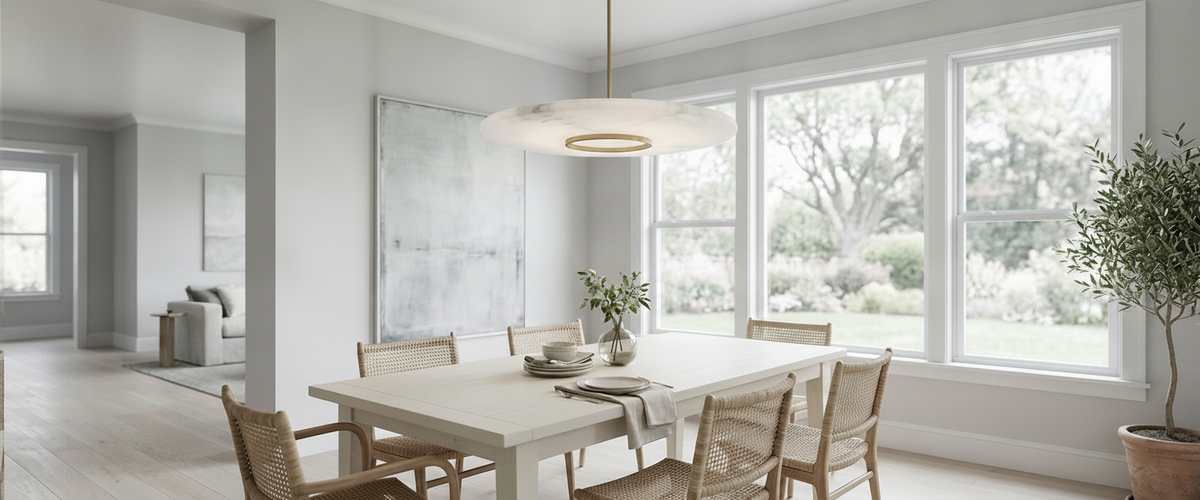

Get the drop height wrong on an alabaster pendant and the effect collapses. The stone stops glowing, the veining reads a flat gray, and a piece that should look carved from light looks like a dimmed disc hanging in the wrong place. Alabaster pendant light fixtures reward a bit of planning, because the material does something no glass or metal shade can: it turns light into a soft, honey-toned wash that follows the mineral grain. The trick with alabaster pendant light fixtures is choosing the shape, mount, scale and bulb that let that grain show.
At Niori we work only in alabaster and natural stone, so most of what follows comes from fitting alabaster pendant light fixtures into real rooms rather than from a spec sheet.
Warm, dimmable bulbs let the veining in alabaster pendant light fixtures read as depth.

Key Takeaways
Shape controls direction. Gong discs wash light down, globes spill it everywhere, drums contain and frame it.
Drop height decides the glow. Too high and the stone dims; too low and it blinds. Aim for clearance that keeps veining lit at eye level.
Warm-white, dimmable bulbs are non-negotiable. Cool bulbs turn honey-coloured stone a dead grey.
One well-scaled pendant often beats a cluster when the stone itself is the feature.
Budget depends on material, scale and finishing. Request a tailored quote rather than assuming a fixed figure.

The Gong Disc: Why a Flat Face Washes Light Down
A gong alabaster pendant lights piece is a broad, flat disc hung on the horizontal, and it behaves very differently from a globe. Because the face sits parallel to the floor, most of the light pushes downward in a soft column while the disc itself glows across its whole surface. That flat plane is also where alabaster pendant light fixtures earn their keep: the veining stretches across the width, so instead of hiding the grain it shows it off, backlit and edge to edge.
Gongs suit rooms where you want the fixture to read as a quiet ceiling event rather than a chandelier. Over a long dining table, a single large disc gives you even task light without the visual noise of multiple shades. The one thing to watch is the underside; a raw bulb glaring through thin stone can create a hot spot, so look for fixtures with an internal diffuser or a recessed lamp position.

Globes and Drums Compared
Globes and drums are the two shapes buyers weigh up most when choosing alabaster pendant light fixtures, and they do almost opposite jobs.
A globe spills glow in every direction. It lights the ceiling, the walls and the space beneath more or less equally, which makes it a generous ambient source and a natural fit for entryways, stairwells and bedrooms where you want a soft sphere of light rather than a directed beam. In alabaster, a globe glows like a small moon, and the veining wraps around the whole form so it reads well from any angle.
A drum contains light. The straight sides push most of the output up and down through the open ends while the stone walls glow gently, so you get a more defined pool below and less spill onto surrounding walls. That containment makes drums the calmer choice over kitchen islands and desks, where you want the light to land on the surface and not bounce around the room. If you are torn between the two, ask what you want the light to do: fill a room, or mark a spot.
A single wide gong dropped close to the countertop keeps sightlines clean over an island.
One Pendant as Sculpture
Kitchen design has a habit of hanging three identical pendants over an island because that is what everyone does. Sometimes a single fixture is the stronger call. A large alabaster pendant light, hung alone, becomes a piece of sculpture that happens to give light, and the eye rests on it instead of counting shades. This is one place where alabaster pendant light fixtures earn their price as a feature.
We shipped a single wide gong to a client fitting out a Cotswolds farmhouse kitchen with a run of dark timber cabinetry. The brief had asked for a trio, but the island was short and three pendants would have chopped the sightline into thirds. One disc, centred and dropped to graze the countertop with light, did the whole job and left the beams overhead uncluttered. Single pendants also work well in stairwell voids, in a reading nook, or above a round breakfast table where a cluster would feel fussy. You can see how the proportions play out across our alabaster lighting range, where several pieces are designed to stand alone.
Contemporary Versus Transitional Mounts
The stone shade tells one story; the mount that holds it tells another. A contemporary alabaster pendant light usually pairs the shade with a slim rod, a discreet ceiling cup and a cool metal such as brushed chrome or matte black. Where the aim is to let the frame recede so the stone reads as pure form, a slim multi-light fitting such as the CALLA E27 Contemporary 3 Light Pendant in Brushed Chrome shows how understated the metalwork can be, which suits minimalist kitchens, gallery-style hallways and any interior leaning modern.
A transitional mount softens that geometry with brass, aged bronze or a shaped canopy that nods to older fixtures without becoming ornate. Brass is the quiet workhorse here because its warm tone echoes the honey glow of lit alabaster, so the metal and the stone feel like they belong together. Many alabaster pendant light fixtures live or die on this pairing. For a room where a warm metal needs to carry across a longer run, a linear fitting such as the Gemini Pendant Light 105cm in Brushed Brass gives you that bridge between period features and modern lines. Browse the wider lighting collection to compare how the same stone shade changes character depending on its metalwork.
Drop Heights That Keep the Stone Glowing
This is where most installations of alabaster pendant light fixtures go wrong. Alabaster only glows convincingly when the light source sits close enough to the stone and the fixture hangs at a height where you actually see the lit surface. Hang it too high and you lose the material entirely.
Over a kitchen island or dining table: leave roughly 30 to 36 inches (76 to 91 cm) between the countertop or tabletop and the bottom of the pendant. Lower for a single statement disc, higher for a taller room.
Over a round table: keep the fixture centred and low enough that seated guests see the glow, not the underside glare.
In a stairwell or double-height void: position the pendant so the lit stone is visible from both the upper and lower landings; hang a long globe or a cascade rather than a single disc lost in the ceiling.
General clearance: keep at least 7 feet (2.1 m) below the fixture in any walkway so nobody catches their head.
The point of a low, considered drop is to keep the veining lit at or near eye level, because that is when the mineral grain reads as depth rather than as a flat surface. It is the single habit that separates good alabaster pendant light fixtures from disappointing ones.
Scale Against Ceiling Height
Matching mass to the room stops a pendant from either vanishing or crowding the space. A useful starting rule: add the room's length and width in feet, and the sum in inches gives a sensible pendant diameter. A 12 by 14 foot room lands around a 26 inch (66 cm) fixture. Treat that as a guide, not gospel, then adjust for ceiling height.
Tall ceilings can carry a larger, heavier form without it dominating; low ceilings need a shallower, wider shape so the fixture does not press down on sightlines. For a smaller room or a spot above a breakfast table where a full-width fitting would crowd the space, a more compact form such as the Gemini Pendant Light 42.5cm in White holds its proportions better than a wide statement piece. Weight matters with alabaster pendant light fixtures too. Natural stone is dense, so confirm your ceiling can take the load and that the fixture is fitted to a suitable joist or fixing by a qualified electrician. The Natural Stone Institute has good background on how natural stone behaves as a material, which is worth reading if you are specifying heavier pieces.
Warm-White Bulbs and Dimming
Alabaster is warm-toned stone. Light it with a cool bulb and the honey and cream tones flatten into a grey that looks nothing like the piece you bought. Choose bulbs in the 2400K to 2700K range so the stone reads warm and the veining keeps its depth. Anything at 4000K or above will fight the material and undo the point of an alabaster pendant light.
Fit the circuit to a dimmer, and match the dimmer to the driver or bulb type; a mismatched dimmer causes flicker or buzz. Dimming does two jobs with alabaster: it lets you drop to a low, candle-like glow in the evening when the stone looks its best, and it lets you push brighter for genuine task light over a work surface. For guidance on lighting levels and colour temperature in the home, the Chartered Institution of Building Services Engineers publishes practical recommendations at cibse.org. Always have the wiring and dimmer specified and installed by a qualified electrician.
A Quick Buyer's Checklist
Decide what the light should do: wash down (gong), fill the room (globe), or pool on a surface (drum).
Pick a mount finish that suits your interior; brass warms, chrome and black cool.
Set the drop height so the lit stone sits near eye level over tables and islands.
Size the diameter to the room, then adjust for ceiling height and weight.
Specify 2400K to 2700K, dimmable, and confirm dimmer compatibility.
Book a qualified electrician for fixing and wiring, especially with heavier stone.
Ask for a tailored quote, since cost depends on material, scale, complexity and finishing.
Alabaster pendant lighting rewards patience more than it rewards spending. Get the shape, the height and the bulb right, and even a single alabaster pendant light will do more for a room than a wall of downlights ever could. Chosen with care, alabaster pendant light fixtures do the quiet, heavy lifting that no other shade can.