
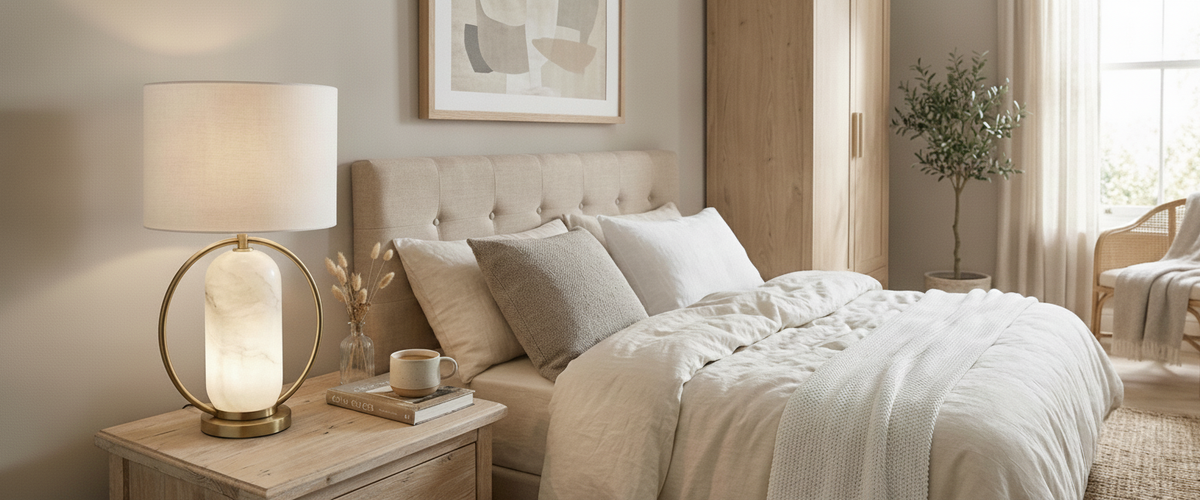

A stone table lamps does one of two jobs, and it helps to decide which before you buy. Either the base catches light and becomes a soft source in its own right, or it stays solid and anchors a busy corner of the room. Confusing the two is where most people go wrong. They buy a heavy black marble base hoping for a glow it will never give, or a slim translucent alabaster piece expecting it to hold down a wide console, and neither delivers.
At Niori we work with alabaster and natural stone every day, so we spend a lot of time steering buyers toward the stone that matches the job. The material decides almost everything: how the light behaves, how heavy the piece feels on a slim shelf, and how it reads across a room in the evening.
A translucent alabaster base becomes a soft light source in its own right.

Key Takeaways
Translucent stones glow: alabaster and onyx let light pass through, so the base becomes part of the lit effect.
Dense stones hold the room: marble, travertine and black stone stay opaque and work as visual weight and grounding.
Scale to the surface: the lamp should read as roughly two-thirds the height of the furniture piece, shade included.
Shade choice controls direction: a lined drum pushes light down onto the surface; an open top loses it to the ceiling.
Bulb warmth flatters veining: aim for warm white around 2700K so the stone's colour reads true.

The Two Jobs a Stone Base Does
Start with intent. If you want a lamp that softens a dark corner or gives a bedside a gentle evening glow, you want a stone that light can travel through. Alabaster and onyx are the obvious candidates; switch them on and the whole base warms up, veining and all. That effect is the reason people fall for natural stone table lamps in the first place.
If instead you have a wide console under a mirror, or a sideboard that already carries a lot of visual noise, you may want the opposite. A dense stone base sits there as ballast. It reflects light off its polished surface rather than passing it through, and it grounds everything around it. A black stone table lamp is the clearest example of this second job: it reads as weight, full stop, and that is exactly why it works in a scheme that needs an anchor.

Marble, Travertine, Onyx, Alabaster: Which Stones Glow
Not all stone behaves the same under a bulb, and the difference is largely down to how translucent the material is.
Alabaster is the softest of the group and the most reliably translucent. Lit from within, it produces the warm, diffused light Niori is built around, with subtle cloudy veining that shifts depending on where the block was cut. It has been prized for exactly this quality for centuries; the Metropolitan Museum of Art holds carved alabaster pieces that show how long makers have exploited its glow. You can see how we work the material across our alabaster lighting range.
Onyx glows too, often more dramatically, with bolder banding in ambers, greens and honeyed browns. It is showier than alabaster and rewards a table lamp where the base is meant to be the focal point.
Marble is mostly opaque. Thin slivers can catch a little light at the edges, but you buy marble for its surface: the polish, the cool feel, the way veins run across a solid form. It is a holding stone, not a glowing one.
Travertine is opaque as well, warmer and more matt than marble, with an open, pitted texture. It brings a grounded, earthy weight and pairs well with brass detailing and linen shades.
An opaque marble or travertine base grounds a surface through weight rather than glow.
Why Black Stone Reads as Weight and Pale Stone Reads as Light
Colour does a lot of the talking before the lamp is even switched on. Pale alabaster and cream travertine recede; they lift a corner and feel airy even at scale. A black stone table lamp advances. It draws the eye, holds it, and carries visual mass far beyond its actual footprint.
This matters for balance. Where a room needs grounding rather than glow, a dense black base such as the Essence Round Table Lamp in black earns its place through weight, and the squarer Essence Square Table Lamp reads even more firmly against soft furnishings. Drop one onto a pale oak sideboard and it grounds the whole surface. Put the same piece on an already dark, cluttered console and it can disappear or feel heavy. Pale stone would have lifted that second scene instead.
Scaling the Base to a Console, Sideboard or Bedside
Getting the size right is where a lamp either sits comfortably or looms. A useful rule: the lamp, shade included, should read as around two-thirds the height of the furniture it stands on, and the shade should never overhang the front edge of the surface. As a starting point, a bedside lamp of roughly 16 to 20 inches (40 to 50 cm) tall suits most nightstands, while a console or sideboard often carries a piece of 24 to 30 inches (60 to 76 cm).
Bedside table: keep the base compact so you can reach the switch lying down, and check the shade's lower edge sits near eye level when seated in bed, so the bulb is not glaring.
Console table: a taller, slimmer stone lamp table pairing suits a hallway, where you want height without depth eating into the walkway.
Sideboard: here you have room for large stone table lamps, often as a matched pair flanking a mirror or artwork. Give each lamp breathing space rather than crowding the top.
One lesson from the studio: buyers routinely underestimate weight. A solid marble or travertine base can run several kilograms, which is a virtue on a stable sideboard and a nuisance on a flimsy bedside with a single fixing. Check the furniture can take the load before you commit to a heavy stone.
Matching the Shade So the Glow Reaches the Surface
The shade decides where the light goes, and it is the most overlooked part of a stone table lamp purchase. A tightly lined drum shade in a warm ivory pushes light down onto the tabletop, which is what you want for reading or for a pool of light on a console. An open-topped or very pale shade lets a good share of the output escape upward, washing the ceiling and leaving the surface dimmer than you expected.
With a translucent alabaster or onyx base, remember the base itself is a light source, so you can afford a slightly more enclosing shade up top and still get a lovely overall effect. With an opaque marble or travertine base, the shade is doing all the lighting work, so choose it with the room's needs firmly in mind. If you are comparing bases and shades side by side, our full lighting collection is a good place to see how different pairings behave.
Bulb Warmth That Flatters the Veining
Colour temperature can make or break a natural stone base. Go too cool and a warm honey onyx turns grey and lifeless; the veining that sold you on the piece bleaches out. Warm white, roughly 2700K, keeps the stone's natural colour reading true and gives that candlelit quality alabaster is loved for. For guidance on colour temperature and lighting comfort at home, the Chartered Institution of Building Services Engineers publishes useful reference material.
A few practical notes:
Use a dimmable LED so you can drop the level in the evening. Many warm LEDs shift warmer as you dim, which suits stone well.
Check the fitting before you buy a replacement bulb; a table lamp stone base may use an E27, E14 or a small integrated LED depending on the design.
Match a pair from the same batch of bulbs so two lamps flanking a mirror glow at the same warmth. Mismatched colour temperatures are surprisingly obvious once they are lit.
A Quick Buyer's Checklist
Decide the job: glow (alabaster, onyx) or anchor (marble, travertine, black stone).
Match the colour to the scheme: pale to lift, black or dark to ground.
Scale to the furniture: around two-thirds its height, shade inside the front edge.
Confirm the surface can take the weight, especially on bedsides.
Choose a shade that sends light where you need it.
Set warm white, dimmable, matched across pairs.
How Niori Approaches Stone Table Lamps
Because we cut and finish alabaster and natural stone specifically for lighting, we tend to advise on the whole piece rather than just the look. A stone base table pairing that photographs well can still disappoint at home if the shade throws all the light upward or the bulb runs cold. Budget varies with the stone, the scale, the engineering and the finishing, so the honest answer on cost is to tell us the room and the surface and ask for a tailored quote. Get the material and the light right first, and the stone table lamp does its job for years.