
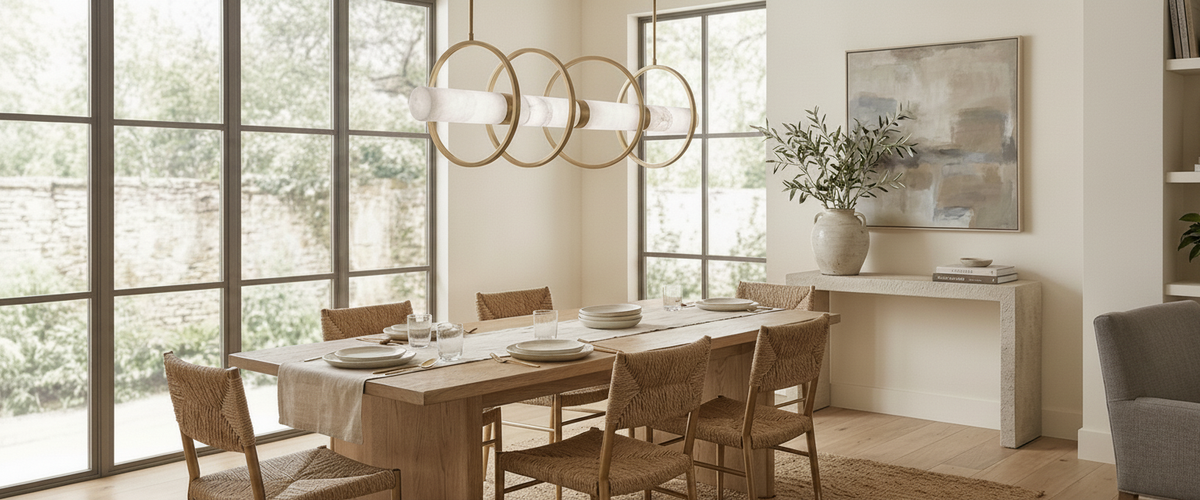

The fastest way to spoil a beautifully laid table is a dining room chandelier that fights it. Too high and it floats off on its own; too bright and everyone squints across the roast; sized to the room instead of the table and it looks like a fixture that wandered in from a hotel lobby. Get three things right, proportion, height and light quality, and the piece settles into the space as if it were always meant to be there.
We ship a lot of these into homes and restaurants, and the same questions come up before every order. So here is the honest version of how to choose a dining room chandelier, from a studio that works in alabaster and natural stone every day.

Key Takeaways
Size to the table, not the room. Aim for a fitting roughly half to two-thirds the width of the table.
Hang it low. Around 30 to 36 inches (76 to 91 cm) above the tabletop for a standard 8-foot (2.4 m) ceiling.
Match the shape. A linear chandelier for a rectangular or oval table; a round one for a round or square table.
Choose diffused light. Alabaster and stone turn a bare bulb into soft face light with no glare.
Always dim. Warm, flicker-free control lets one dining room chandelier carry you from prep to dessert.
Size to the Table, Never the Room
The proportion rule that holds up across almost every dining space is simple: measure the table, not the walls. Among chandeliers for the dining room, the fitting should read as roughly half to two-thirds the width of the table below it. For a table 40 inches (102 cm) wide, that puts your dining room chandelier somewhere around 20 to 26 inches (51 to 66 cm) of fixture width or diameter.
People go wrong when they walk into a large open-plan space, feel the volume of the room, and buy something to fill it. The table is the anchor, not the ceiling area. A generous fitting over a modest table looks top-heavy and makes seating feel cramped; a small one over a banqueting table disappears. When you browse the full lighting range, keep your table dimensions written down and hold every dining room chandelier against them.
Length matters more than you think for long tables. A single round fitting over an 8-foot (2.4 m) table leaves the ends in shadow. That is exactly the problem a linear chandelier for the dining room solves, and it is where most rectangular tables should be looking. A wide-format piece such as Wisteria 16 Light Crystal Linear Chandelier is built to carry light the whole length of a banqueting table rather than pooling it in the centre.

The Hang Height People Botch
Here is the mistake we see most often: the dining room chandelier is hung as if people will stand under it. They will not; they will sit under it. Set it too high and you get glare straight into the eyes, a table that feels underlit, and a fixture that has lost its relationship to the surface it is meant to light.
For a standard 8-foot (2.4 m) ceiling, hang the bottom of the fitting roughly 30 to 36 inches (76 to 91 cm) above the tabletop. Add around 3 inches (7.6 cm) of height for every extra foot of ceiling above 8 feet. On a 10-foot (3 m) ceiling, that means the piece sits a little higher but the light source stays comfortably below eye level for anyone standing, and well clear of foreheads for anyone seated.
The real test is eye contact. Sit at the table, look across at the person opposite, and the fixture should not sit in that sightline. With alabaster and stone this is easier to get right, because even if a shade edges into view it glows softly rather than flashing a bright filament back at you. If you are lighting a kitchen island or a console rather than a dining table, the same low-hang logic applies, just adjusted for the traffic that passes beneath.
Linear or Round? Match the Fitting to the Table
Shape is where a lot of good intentions come apart. Your dining room chandelier should echo the footprint of the table.
Rectangular or oval tables want a linear chandelier or a run of aligned pendants. The light spreads along the length of the table instead of pooling in the middle. A linear alabaster piece gives you an even wash from end to end and looks intentional rather than improvised.
Round or square tables want a round or compact fitting centred over the middle. A long linear piece over a round table looks stranded.
Within the linear category you have real choice on mood. A crystal linear fitting throws sparkle and sharp highlights; that suits a formal, high-gloss scheme. Where the room calls for a cleaner, more contemporary spread of light, Cosmic 5 Light Glass Crystal Linear Chandelier sits closer to that language, with the glass softening the crystal rather than pushing pure glitter. This is where contemporary dining room chandeliers earn their place, keeping the light modern and unfussy. Alabaster and natural-stone linear fittings do the opposite. They read calmer, warmer, more architectural. Where the goal is soft, diffused light rather than reflective highlights, a stone piece such as Axis 27 Light Alabaster Linear Chandelier sits better against plaster walls, oak, and pared-back joinery.
You can compare linear and round forms across the alabaster lighting collection to see how the material changes the whole feeling of a dining room chandelier.
How Alabaster and Stone Soften Glare Into Flattering Face Light
This is the part specific to what we make. Alabaster is a fine-grained form of gypsum, translucent enough to let light pass through while scattering it internally. That scattering is what removes the harsh point of glare. Instead of one bright bulb, you get a glowing volume of stone. Its workability and translucency are the reasons alabaster has been carved for lamps and windows for centuries; you can read more on the Natural Stone Institute resources.
Why does that matter over a dining table? Diffused light is flattering light. It softens shadows under the eyes and nose, warms skin tones, and makes food look appetising rather than clinical. Every slab of alabaster carries its own veining, so an alabaster dining room chandelier is never perfectly uniform; it has depth and movement that a frosted glass diffuser cannot fake. When guests say a room feels welcoming and cannot say why, this is usually part of the answer.
Natural stone also brings weight and permanence to a scheme. A stone dining room table chandelier does not date the way a fashion-led fixture does, and it pairs comfortably with brass detailing, which we use for warmth against the cooler tones of the stone.
Centre the Fixture Over the Table, Not the Ceiling
The dining room chandelier belongs to the table, so it should be centred over the table, even if that means it is off-centre in the room. This trips people up constantly in extensions and knock-through kitchens, where the table sits in a bay or to one side. Align the fixture to the centre of the tabletop and let the ceiling look after itself.
Plan this before the electrician first fixes the ceiling. Moving a fixed point later means chasing plaster and making good, which is avoidable if you mark the table position on the floor and work up from there. If you are still deciding on furniture, at least commit to the table's final footprint before the wiring goes in. And whatever the fixing detail, a dining room chandelier of any real weight needs a qualified electrician and a proper structural fixing; do not improvise the mounting.
Dimming for Courses: Warm, Flicker-Free Control
One dining room chandelier should carry a whole evening, from bright and practical while you serve to low and intimate over coffee. That only works with dimming, and dimming only works well when the light source and the control are matched.
Choose LED sources rated as dimmable, and confirm the driver is compatible with your chosen dimmer. Mismatched pairings are the usual cause of flicker and buzz.
Favour a warm colour temperature, around 2700K, for dining. It flatters skin and food and reads as candlelight rather than office light.
Look for a high colour rendering index (CRI of 90 or above) so wine, plates and skin tones look true.
Where possible, choose fittings that warm slightly as they dim; the effect mimics candles and feels natural late in a meal.
Alabaster rewards low light in particular. As you dim, the stone keeps glowing gently instead of collapsing into a dull dark shape, so your dining room chandelier stays present even at the softest setting.
Let the Wall and Accent Layers Carry the Chandelier
No single fixture should do all the work. A dining room chandelier sets the centre of gravity, but it needs support. Alabaster wall lights either side of a sideboard, a low table lamp on a console, or discreet accent lighting on artwork give the room depth and stop the table from feeling like a lit island in a dark space.
Balance the layers so the central dining room chandelier is the brightest thing at the table and the wall pieces sit a step quieter. That hierarchy is what makes a room feel considered. Get the layers right and you can run the light low and warm all evening, because the supporting fittings are doing the quiet work of filling the room.
A Quick Buyer's Checklist
Table width measured, dining room chandelier chosen at half to two-thirds of it.
Hang height planned at 30 to 36 inches (76 to 91 cm) above the tabletop, adjusted for ceiling height.
Shape matched: linear for rectangular or oval, round for round or square.
Material chosen for mood: alabaster and stone for warm, diffused face light.
Ceiling point centred over the table, marked before wiring.
Dimmable LED sources and a compatible dimmer confirmed.
Wall and accent layers planned to support, not compete.
Structural fixing and installation by a qualified electrician.
Niori designs alabaster and natural-stone lighting for exactly this kind of decision: pieces that flatter a table, hold up over years of dinners, and give warm light you actually want to eat under. Measure carefully, hang low, dim warm, and the right dining room chandelier will do the rest.