
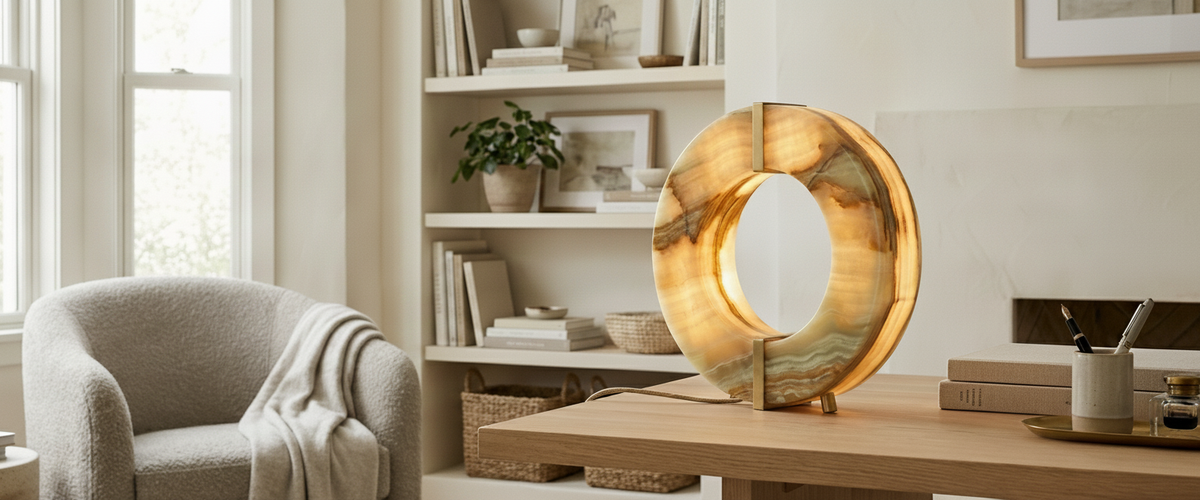

The difference between an onyx table lamps that looks expensive and one that looks murky comes down to a decision most buyers never think about: which part of the stone sits in front of the bulb. Onyx is banded, translucent, and unpredictable. Light it well and the bands read like slow amber weather across the shade. Light it badly and the same stone goes flat and brown. This is the part of buying an onyx lamp that no product photo tells you.
We ship a lot of stone lighting, and onyx is the material that generates the most questions and the most delight once it is on. So before you look at prices or shades, learn to read what you are actually buying.
A well-oriented onyx lamp shows movement as light pools along its translucent seams.

Key Takeaways for Buying an Onyx Table Lamp
Translucency beats colour. A lamp glows because light passes through the stone, so thin, even sections matter more than the prettiest surface pattern.
Warm bulbs flatter onyx. Aim for roughly 2700K; cooler light drains the honey and green tones that make the stone worth having.
Size it to the console, not the room. An onyx lamp anchors a surface; it should not swallow it.
Pair with restraint. Brass, aged bronze, and warm timber sit with onyx. Bright chrome and cool grey fight it.
Budget depends on the stone. Onyx varies wildly block to block, so a tailored quote makes more sense than a headline figure.

Why Onyx Banding Behaves Nothing Like Plain Alabaster
Alabaster is the quieter cousin. It scatters light in a soft, fairly even wash, which is why it forgives almost any angle and any bulb. Onyx does not forgive. Its structure is layered mineral banding, so light does not spread evenly; it pools, brightens along translucent seams, and stalls where the stone thickens or the colour deepens. That is the whole appeal. An onyx table lamp lit from within shows movement that alabaster simply cannot.
The catch is that this drama is directional. Turn an onyx block ninety degrees and the same piece can go from luminous to dull. When a lamp is well made, the maker has already chosen the orientation so the bands run in a way that carries light. When it is made carelessly, you get a lamp that looks like a photograph of onyx rather than a lit one. If you are new to stone lighting, it is worth understanding how translucency works across the wider alabaster and natural-stone range before you commit to something as characterful as onyx.

Reading the Stone: Which Veining Glows and Which Goes Muddy
Hold two rules in your head when you look at onyx. First, thin and even lets light through; thick and dense blocks it. Second, warm honey and translucent green bands come alive when backlit, while heavy opaque browns and deep reds tend to read as shadow. A little of that shadow gives contrast. Too much and the lamp turns brown when it is on.
Green onyx table lamps are a good example. Cool daylight makes green onyx look grey and clinical. Put a warm bulb behind it, and the same stone turns to a soft mossy glow with pale gold veins running through it. The stone did not change; the light did. This is why we always tell buyers to judge onyx lit, never unlit, and never under a phone flash.
Under warm light green onyx glows mossy and gold; under cool daylight it can read grey.
Antique onyx table lamps and vintage onyx table lamps are a slightly different case. Older pieces were often cut thicker than modern lighting stone, which is why some vintage examples glow beautifully around the edges but stay dark through the body. That is not a fault; it is period cutting. If you are buying an older onyx lamp table piece for atmosphere rather than brightness, that partial glow can be exactly the effect you want. Just know what you are getting so you are not disappointed when it does not light up like a modern shade.
Sizing an Onyx Lamp So It Anchors a Console Without Hijacking It
An onyx table lamp is a weight, visually and literally. Stone is dense, so even a modest lamp has presence and heft. The job of sizing is to let it anchor a surface without crowding everything else off it.
A few practical anchors:
Console tables and entryways: allow the lamp to occupy roughly a third of the surface length, leaving room for a tray, a bowl, or a piece of art to breathe alongside it.
Bedside tables: a shorter, rounded onyx form usually sits better than a tall column; you want the light near reading height, not glaring down.
Sideboards in living rooms: a taller table onyx lamp can carry a longer run of furniture, but keep the shade top below eye level from the sofa so the bulb never shows.
Where a desk or study surface needs adjustable task light rather than a lit stone body, a compact fixture such as the PREDA LED Desk Lamp makes more sense than forcing an onyx column into a working corner. Because stone is heavy, check the surface can take the load, especially on slim antique consoles or floating shelves. A solid onyx marble table lamp on a delicate leg is a wobble waiting to happen. If you are furnishing a whole room, it helps to see how table pieces sit against pendants and wall lights across the full lighting collection so the scale reads as intentional rather than accidental.
Warm Bulbs Behind Onyx: The Colour Temperature That Flatters the Bands
This is the single most common mistake we see. People buy a beautiful onyx stone table lamp, drop in whatever bulb was in the drawer, and wonder why it looks cold. Onyx wants warmth. Around 2700K is the sweet spot; it brings out the honey, amber, and green tones the stone is prized for. Push up to 3000K only if your room already runs warm and you want a touch more crispness. Go cooler than that and you flatten the very colour you paid for.
A few bulb notes specific to stone:
Choose a high colour rendering bulb (CRI 90 or above) so the mineral tones stay true rather than washed out.
Dimmable matters more with onyx than with most lamps. As you dim, the darker bands recede and the translucent seams keep glowing, which is a genuinely lovely effect at night.
Keep to LED. It runs cool, which matters when the bulb sits close to a natural material. The US Department of Energy notes how little heat modern LEDs give off compared with older incandescent bulbs, and that gentle running temperature is kinder to stone over years of use.
Where the lamp is designed to be lit through the stone rather than through a shade, a colour-selectable engine such as the 24W CCT LED Module lets you dial the tone toward that 2700K warmth instead of gambling on a fixed bulb. If the lamp uses a shade rather than a fully lit body, warm light still matters, because it spills onto the stone base and sets the mood around it. The rule holds either way: warm, high-CRI, dimmable.
Pairing Onyx With Metals and Timber That Don't Fight the Stone
Onyx already carries a lot of colour information, so its hardware should support the stone rather than compete with it. Warm metals win. Brass, aged bronze, and antique gold echo the honey bands and make the whole piece feel considered. A brass collar or base on a honey-onyx column looks intentional; a bright polished chrome one looks like an accident.
Timber follows the same logic. Walnut, oak, and warm mid-browns sit happily under an onyx lamp. Cool grey-washed woods and stark black-stained timber can make the stone look dirty rather than rich. If your room leans cool and modern, do not force onyx into it; a paler, quieter alabaster lamp will read better, and you can save the onyx for a warmer corner.
Green onyx is the one exception worth flagging. It can take a slightly cooler metal, a brushed nickel or a soft pewter, because the green already leans away from gold. Even then, keep the finish matt rather than mirror-bright so it does not pull attention off the stone.
Where One Onyx Lamp Belongs and Where It Needs a Quieter Partner
Onyx is a soloist. One well-placed onyx table lamp in a room is a statement; two matched ones on either side of a bed can be handsome, but three or more scattered around and the eye stops knowing where to rest. The stone is busy enough on its own that it rarely wants company from other patterned pieces nearby.
Where it shines: a single lamp on an entry console setting the tone as you walk in, or on a study desk where its low, warm pool of light is doing real work in the evening. Where it needs a quieter partner: an open-plan living space, where a second light source should be plain and calm, an alabaster or simple ceramic lamp, so the onyx keeps its billing as the interesting one. We once helped a client in a period home light a long hall with a single green onyx lamp on an antique console; everything else in the space was kept deliberately plain, and the lamp did all the talking. That restraint is what made it work.
A Quick Buyer's Checklist
Judge the onyx lit, in warm light, not off or under white daylight.
Look for even translucency, not just a pretty surface pattern.
Match the lamp to about a third of the surface it sits on.
Fit a 2700K, high-CRI, dimmable LED bulb.
Choose warm brass, bronze, or gold hardware (soft nickel for green onyx).
Confirm the surface can carry the weight of solid stone.
Give it room; let one onyx lamp be the star.
Buy on those terms and an onyx table lamp earns its place for decades. It is one of the few lighting pieces that looks as good switched off, as sculpture, as it does switched on, as a soft column of amber light. Niori works exclusively with alabaster and natural stone, so if you want help matching a specific block of onyx to your room and lighting, a tailored quote is the honest starting point, because no two pieces of the stone are ever quite the same.