
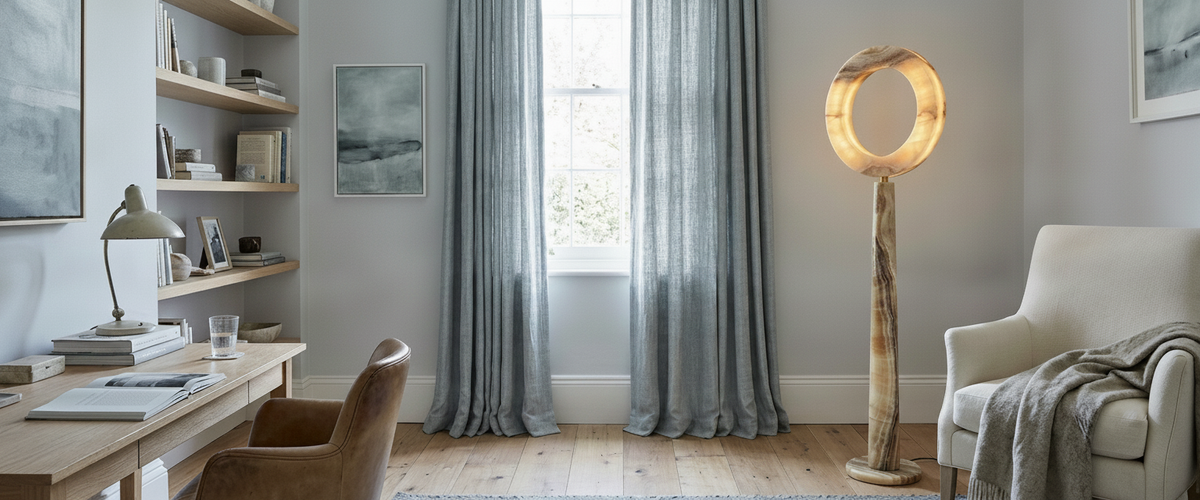

The difference between a good and a disappointing onyx floor lamps comes down to one thing: whether light passes through the stone or simply bounces off it. A poor example holds a bulb behind an opaque shade and calls it luxury. A proper one turns the whole column into a lantern, so the banding inside the onyx lights up from within and the room picks up a warm, honeyed cast you cannot fake with a fabric shade. That distinction decides everything else, from the bulb you fit to where you stand it.
Onyx is a banded form of calcite, and its translucency is exactly what makes it worth lighting. At Niori we work with alabaster and natural stone precisely because the material itself becomes the light source, not a cover for it. So before you look at price or style, learn to read the stone.

Key Takeaways Before You Buy
Lit-through beats lit-behind. The best onyx floor lamps light the column itself, so the stone glows.
Banding is the whole game. Even, warm banding reads rich; muddy or grey banding reads cheap under light.
Weight signals quality. A well-proportioned base feels heavy for its size and sits without wobble.
Bulb warmth matters more than wattage. Aim for a warm white around 2700K on a dimmer.
Placement decides the payoff. Stand it where the internal glow reads against a darker background.

What Separates a Lit-Through Onyx Column From a Lamp That Just Holds a Bulb
Pick up any onyx floor lamp and ask where the bulb sits relative to the stone. If the light source is tucked inside the column, or the column is a shallow sleeve wrapped around a light, you get that unmistakable internal glow: veins and bands lighting up at different rates, edges catching, the whole piece reading like something lit by candle rather than switch. If the bulb sits above or below the stone in a separate shade, the onyx is just decoration and you have paid stone prices for a fabric lamp.
Look for a slim, even wall thickness in the stone, typically somewhere around 8 to 12 mm (roughly 0.3 to 0.5 inch) on a lit-through column. Thin sections transmit warmly; thick, dense sections stay dim and can look muddy where the rest of the column is bright. Hold a phone torch behind a corner in the showroom or ask the seller for a lit photograph. If nobody can show you the piece switched on, that tells you something.

How Natural Banding Decides Whether the Stone Reads Rich or Muddy
No two onyx panels are alike, and the banding is what you are really buying. Warm honey, amber, and caramel bands with the occasional milky streak tend to light beautifully, glowing gold and cream when the lamp is on. Cooler pieces heavy with grey or greenish veining can look handsome unlit and then grey out completely once the bulb is behind them, because those minerals block rather than pass light.
Ask to see the stone both on and off. The unlit face flatters everyone; the lit face is the truth. A good alabaster and natural-stone lamp should look better switched on, not worse. The Natural Stone Institute publishes useful background on how banded calcite forms and why translucency varies from block to block, which is worth a read if you want to understand why one slab glows and another sulks (naturalstoneinstitute.org).
One more thing we have learned in the studio: symmetry of banding across the column reads as quiet quality. When the maker has taken the trouble to book-match or align the bands around the piece, the glow feels intentional. Random offcuts stitched together tend to fight each other under light.
Warm, aligned banding glows gold when lit; grey veining tends to block the light.
Vintage Versus Antique Onyx: What Age Does to Translucency and Colour
People use vintage and antique loosely, so pin down the age before you pay for provenance. As a rough rule, dealers treat pieces from the 1950s to 1970s as vintage and anything over 100 years old as antique. A vintage onyx floor lamps generally means mid-twentieth-century, often Italian, with turned columns and brass fittings. An antique onyx floor lamp means older still, and here the stone may have been cut thicker to survive handling, which can dim the glow. Age is not automatically better for light quality.
Old onyx can develop a warmer patina and sometimes fine surface crazing that scatters light softly, which many buyers love. It can also hide filled cracks and repairs that go opaque under a bulb, showing up as dark bruises when lit. Always inspect a vintage or antique piece switched on. Check the wiring too; older lamps frequently need rewiring to meet current UK standards, and that should be done by a qualified electrician rather than treated as a weekend job. Electrical Safety First has clear guidance on why secondhand and inherited lamps deserve a proper inspection before use (electricalsafetyfirst.org.uk).
Base Weight and Proportion: Spotting Quiet Quality Over Showy Bulk
A floor lamp lives or dies on its base. Onyx and stone sit high on the column, so the lamp needs enough mass low down to feel planted. Most freestanding onyx columns stand around 55 to 65 inches (140 to 165 cm) tall, so the base has to work hard against that height. Lift it, or at least try to nudge it with a foot. A quality base feels heavy for its footprint and does not rock. A hollow, lightweight base under a tall stone column is a tipping hazard and reads cheap the moment you touch it.
Proportion is the subtler test. The best pieces balance a generous stone section against a restrained base and slim brass or metal detailing, so the eye goes to the glow rather than the hardware. Where you want the stone to be the whole event rather than the fitting, a quietly detailed column such as the Essence Round Floor Lamp shows how a restrained base lets the lit stone carry the piece. If your setting is more architectural, the squared profile of the Essence Square Floor Lamp keeps the same discipline with harder edges. Showy bulk (chunky bases, heavy collars, oversized finials) usually compensates for stone that cannot carry the piece on its own. Aim for the fixture where you notice the light first and the engineering second.
Stability: stands firm on carpet and hard floors, no rock.
Cable exit: tidy, ideally routed through the base rather than dangling.
Switch position: reachable without stooping; inline or foot switch is a bonus.
Fittings: brass or metal that feels solid, with joints that do not flex.
Finish: stone edges polished, not chipped; seams tight.
Bulb Warmth and Output That Make Onyx Glow Instead of Grey Out
This is where most owners go wrong. Cool or daylight bulbs turn warm onyx grey and lifeless, killing exactly the effect you paid for. Fit a warm white LED around 2700K, and if you want the candlelit end of the range, drop toward 2400K. Cooler than that and the amber bands go flat.
Output should be modest. An onyx column is an accent and a mood light, not a reading lamp, so a lower-lumen bulb (think 300 to 500 lumens) often looks richer than a bright 800-lumen one that washes the banding out. Choose a dimmable LED and a compatible dimmer so you can pull the level down at night; the glow deepens and the veining gains contrast as you dim. Frosted or opal bulbs diffuse more evenly through the stone than clear ones, which can throw a hot spot. The Chartered Institution of Building Services Engineers offers sensible background on colour temperature and comfortable domestic lighting levels if you want to get the numbers right (cibse.org).
Where to Stand One So the Internal Light Actually Shows
An onyx floor lamp needs a darker background to read against. Place it in front of a deep-toned wall, beside a bookcase, or in a corner where the surrounding light is low, and the glow will do real work. Set it against a bright white wall in a fully lit room and the internal light vanishes into the ambient glare.
Some rooms that work well:
Living room: beside a sofa or in a reading corner, as the low, warm layer you switch to in the evening.
Bedroom: in a corner rather than beside the bed, for a soft night-time wash that does not glare.
Hallway or landing: a single lit column at the end of a dim corridor pulls you through the space.
Hospitality: flanking a bar back or lounge seating, where the honeyed glow suits low-lit interiors.
Give it space to breathe. A stone column crowded by furniture loses its silhouette, and the glow gets lost. If you are pairing it with other pieces, keep the colour temperatures matched so the room reads warm and coherent rather than patchy. You can browse the full natural stone lighting range to see how floor lamps sit alongside pendants and wall lights in the same material family.
A Quick Buyer's Checklist
Ask for a photograph of the lamp switched on before you commit.
Check the banding lights warm, not grey, and look for filled cracks that go dark.
Confirm the base is heavy and stable for the height of the column.
Buy a dimmable warm-white LED around 2700K, frosted rather than clear.
For vintage or antique pieces, budget for rewiring by a qualified electrician.
Plan placement against a darker background before it arrives.
Get those six right and an onyx floor lamp stops being an ornament that happens to light up and becomes the warmest layer in the room. Because onyx is cut and lit individually, budget depends on the size of the stone, the quality of the banding, the base engineering, and the finishing, so it is worth requesting a tailored quote rather than assuming a fixed figure. If you want to see how the same warm, diffused quality carries across other fixtures, the wider Niori collection shows alabaster and natural stone worked into pendants, chandeliers, and table lamps too.