
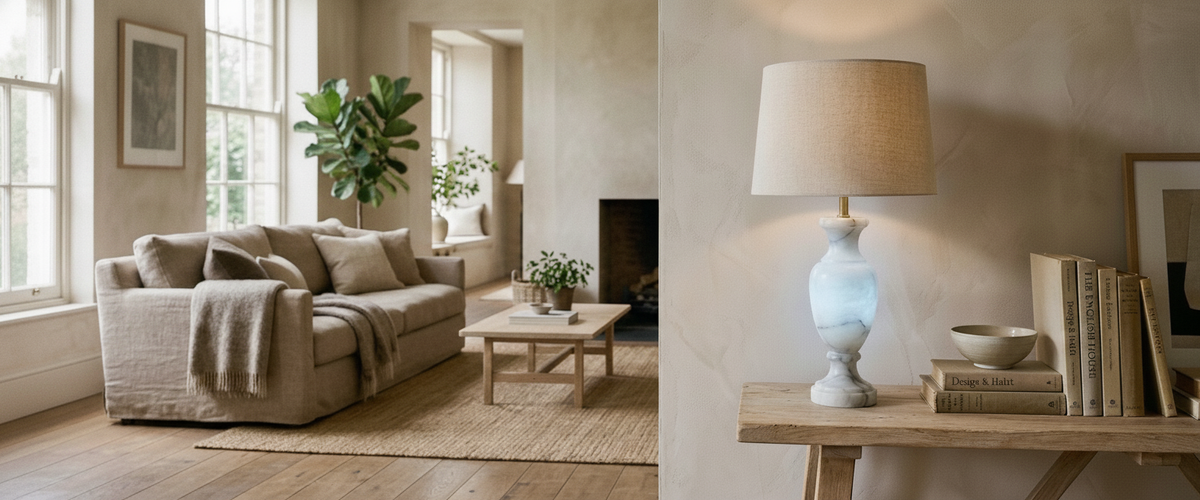

Hold an antique alabaster table lamps up to a window and the stone tells you where it has been. Decades of touch soften the surface, oils from countless hands settle into the grain, and the mottling reads deeper and warmer than anything just cut. That patina is exactly what buyers of an antique alabaster table lamp are chasing, and it is also where reproductions get caught out. A genuine period base behaves differently under light than a re-cut modern copy, and once you know the tells you stop paying antique money for something finished last year.
At Niori we work in alabaster and natural stone every day, so we get asked to look at inherited and auction pieces constantly. The good ones share a set of traits. The disappointing ones share a different set. Here is how to tell an honest antique alabaster table lamp from a pretender before you commit.
Aged alabaster carries a honey cast and uneven glow that freshly cut stone cannot fake.

Key Takeaways
Aged alabaster reads warmer and more mottled because handling and age change the surface, not because the stone is a different material.
A genuine period base shows honest wear at the foot, tool marks that predate modern machining, and translucency that varies across the piece.
Old wiring almost always needs replacing; do this without over-lining the stone or you will kill the glow.
Thinner, older stone wants a cooler-running LED and a proper dimmer, not a hot high-wattage bulb.
One aged piece against clean contemporary lines reads as heirloom rather than clutter.

Why Aged Alabaster Reads Warmer Than Freshly Cut Stone
Alabaster is a soft gypsum stone, and softness is the whole story. It scratches with a fingernail, it takes a hand polish, and it slowly absorbs traces of everything it touches. The base of an antique alabaster table lamp that has sat on a hall table for decades takes on a faint honey cast that no new block has, because time and skin oils build up in the microscopic pores. When you light it from within, that warmth throws forward and the veining looks like it has depth rather than sitting flat on the surface.
Fresh alabaster, by contrast, is cleaner and often colder in tone. It can be lovely; our own new pieces are cut and finished to show off crisp banding and even translucency. If you want that new-stone clarity alongside period character, it is worth browsing the current alabaster lighting range to train your eye on what freshly worked stone actually looks like before you judge an old base.

Tells That Separate a Period Base From a Re-cut Reproduction
Start at the bottom. Turn the lamp over. A real antique alabaster table lamps shows uneven wear on the foot, tiny chips at the contact edge, and a base that was never machined perfectly flat. Reproductions tend to have a suspiciously level, felt-covered base and clean factory edges.
Then look at the tooling. Older alabaster was often hand-turned or hand-carved, so you find slight asymmetry and shallow chatter marks that catch raking light. Modern CNC work leaves regular, repeating patterns. Run a light across the surface at a low angle and the difference shows quickly.
Honest foot wear and shallow hand-tool marks separate a period base from a machined copy.
Veining is the third check. Genuine aged stone has translucency that varies as the block did, so one shoulder of the lamp glows brighter than the other. A re-cut copy is usually chosen for even, marketable figuring and lights up uniformly. The Metropolitan Museum's alabaster holdings are a useful reference for how genuinely old worked stone carries irregular color and surface, not showroom evenness.
A vintage alabaster table lamp will also feel heavier than it looks and slightly cool to the touch. If a piece is light, perfectly symmetrical, and glass-smooth everywhere, treat the antique label with suspicion.
What Decades of Handling Do to Translucency, and Why That Is the Point
Handling wears the high points of the surface and leaves the recesses alone, so an old base develops a soft, uneven sheen that a machine polish cannot fake. That same wear thins the stone very slightly in places, which is why aged alabaster often lights up in pools rather than as one flat sheet. People sometimes read this as damage. It is character, and it is the reason a genuine antique alabaster table lamp looks alive when lit.
There is a limit, of course. Hairline cracks that run with the veining are usually stable; cracks that cut across the grain are a structural worry, especially near the point where a rod passes through the base. We have turned down commissions to rewire pieces where a cross-grain crack sat right under the fixing, because heat and vibration would have finished the job the previous century started.
Rewiring a Vintage Base Without Dulling the Light It Was Made to Throw
Most period bases come with cloth-covered flex, brittle insulation, and connections nobody should trust. Rewiring is not optional. The job needs a qualified electrician, and any work should meet current wiring standards; Electrical Safety First is a sensible starting point for what safe practice looks like.
The specialist part is doing it without wrecking the light. An alabaster table lamp is lit from a source sitting inside a hollow or behind a thin section of stone, and the temptation is to line the cavity or fit an oversized lampholder that blocks the throw. Keep the internal fittings slim. Use a compact lampholder, run the flex tight to the rod, and resist the urge to pack the interior. The stone was carved to a thickness that lets a specific amount of light through; anything that shades that cavity dulls the effect you paid for.
If a base was never wired for mains, a modern cordless alabaster table lamp conversion using a rechargeable LED module can be a clean solution, especially for a piece you want to move around. It avoids drilling fresh channels through old stone and keeps the antique alabaster table lamp intact.
Setting One Aged Piece Against Clean Contemporary Lines
An antique base earns its keep when it is the only old thing in the frame. Put a mottled, hand-turned antique alabaster table lamp on a spare oak console, next to plain plaster walls, and it reads as an heirloom rather than a junk-shop find. Surround it with more brown furniture and it disappears.
We saw this work well for a client furnishing a quiet reading corner: a single inherited alabaster base on a slim steel-legged table, everything else in the room low and modern. The lamp became the thing your eye returned to. That contrast is the whole trick. If you would rather the piece blend into a contemporary scheme than stand apart, a clean-lined modern alabaster table lamp such as the Essence Round Table Lamp, Black plays a quieter role, so decide early which job you want the lamp to do. An alabaster modern table lamp reads as one piece with the room rather than a standout.
The same logic applies overhead. Where a room wants alabaster to carry the light without competing with an antique focal point, a soft diffused fixture like the Oria LED Linear Alabaster Chandelier 1m, Brass keeps the stone language consistent across the space rather than fighting it. If you are building a scheme from scratch, the wider lighting collection shows how alabaster sits alongside brass and glass across pendants, wall lights and lamps.
Bulb and Dimming Choices That Respect Thinner, Older Stone
Older alabaster is often thinner and more fragile than new pieces cut to modern tolerances, so heat is the enemy. Choose a low-wattage LED that runs cool. Skip halogen and incandescent bulbs; the temperature they reach can stress fine stone and, over years, worsen existing cracks.
For color, stay warm. A color temperature around 2400K to 2700K flatters the honey tones aged stone develops. Push cooler and you flatten the very warmth that made you want an antique alabaster table lamp in the first place.
Dimming matters as much as the bulb. A good dimmer lets you drop the output at night, which both protects thin stone from constant full heat and gives you the soft pooled glow these lamps do best. Use a dimmable LED and a compatible dimmer module; mismatched pairings flicker and buzz. Keep the bulb small enough to sit clear of the stone walls inside the cavity, so nothing touches and nothing scorches. This is the setup any antique alabaster table lamp deserves.
Quick Buyer Checklist
Turn it over: honest foot wear and an imperfect base point to a genuine period piece.
Rake a light across the surface: hand-tool marks good, repeating machine patterns suspect.
Check for cross-grain cracks near the fixing rod before you buy.
Budget for a full rewire by a qualified electrician.
Fit a slim, cool-running LED at 2400K to 2700K on a compatible dimmer.
Place it against plain, modern surroundings so it reads as heirloom.
Buy on the stone and the story, then light it gently. An honest antique alabaster table lamp rewards that patience with a glow no freshly cut block can match, and it will keep throwing that light for another generation if you treat the stone kindly.