
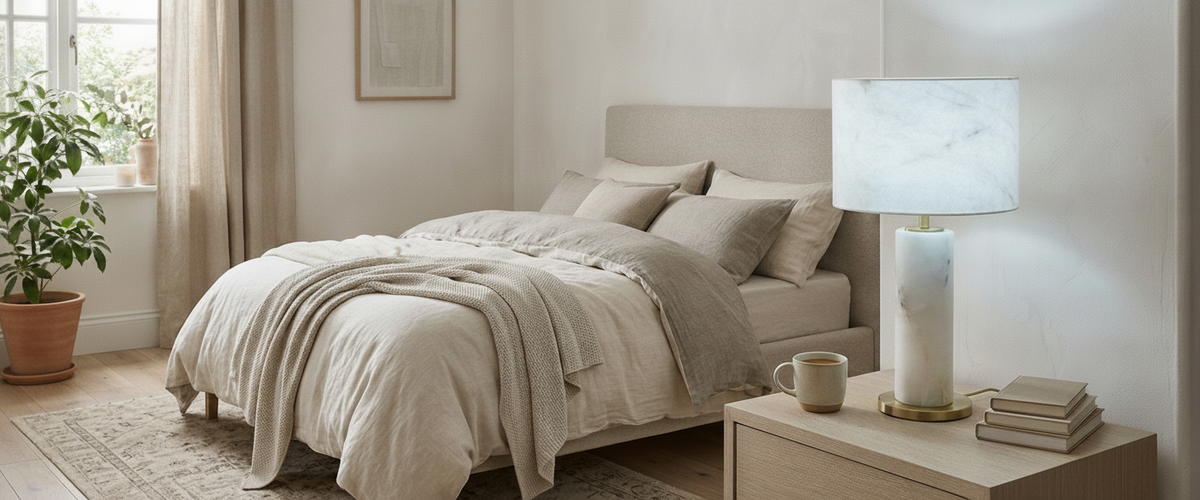

The pitch for a cordless base is seductive: pick up your alabaster table lamps, carry it to the garden table, set it on a windowsill with no socket in sight. What the marketing rarely mentions is what that freedom costs you in glow, run time and the way the stone reads once a small battery is doing the work instead of the mains. Both versions have a place. The trick is knowing which compromise you can live with before the lamp arrives.
Alabaster is a gypsum stone that lets light pass through its body rather than bounce off it, so the fitting inside matters far more than it would with an opaque ceramic base. A weak or cool light source turns a warm, honeyed stone flat and grey. That single fact should shape most of your buying decision.

Key Takeaways
- Corded (mains) gives you the fullest, warmest glow and no run-time limit; it lives where a socket lives.
- Cordless (rechargeable) buys you portability at the cost of brightness, run time, and often a slightly cooler light.
- Colour temperature around 2200K to 2700K flatters alabaster; anything cooler drains the veining.
- Scale matters more with a lamp you actually lift: check weight before you fall for the look.
- Both need the same gentle care, but a travelling lamp collects more knocks and fingerprints.

Modern Rechargeable Bases Against the Fixed Traditional Lamp
A traditional alabaster table lamp is wired, weighted and meant to stay put. It sits on a hall console or a bedside table and does its job for years without a thought. A modern rechargeable version swaps the cable for a battery and a USB-C port, which reframes the whole object: now it can be a portable stone lamp that moves with you through the day.
The difference is not only about the wire. A fixed lamp can carry a larger, brighter LED or a mains bulb of your choosing. A cordless piece has to run everything off a compact cell, so the maker caps the output to keep the run time sensible. If you love the ritual of one lamp lighting one corner, corded still wins. If you want something that follows you from the kitchen island to the terrace, the modern rechargeable format earns its keep. Our alabaster lighting range covers both formats, so it is worth deciding which behaviour you actually want before you shop.

What a Cordless Base Costs You in Glow and Run Time
Alabaster wants to be backlit generously. A translucent stone body glows properly only when enough light floods through it, and that is where small batteries struggle. Expect a cordless design to run softer than its mains cousin, more of a low ambient pool than a reading light. For a bedside or a dinner table that is often exactly right; for a workspace it is not.
Run time depends on brightness setting and battery size, and honest brands publish both. A dimmed rechargeable unit can carry an evening comfortably; run it at full output and the figure drops. If you plan to use one lamp every night, a mains fitting saves you the nightly charge cycle and the slow decline every rechargeable battery goes through over a few years. Ask the retailer for the run-time figures at low and high output rather than a single headline number.
Battery Colour Temperature Versus Mains, and Why It Shifts the Stone
Colour temperature is measured in kelvin, and it changes how alabaster reads more than almost anything else. Warm light, roughly 2200K to 2700K, pulls out the amber and caramel tones in the stone. Cooler light flattens the veining into grey. Many cordless LEDs sit slightly cooler than a good mains bulb because warmer diodes at the same brightness draw more power, which shortens run time. That is the quiet trade the battery imposes.
Before buying, check the stated colour temperature and, if you can, ask whether it is tunable. The Chartered Institution of Building Services Engineers treats warm tones as the norm for restful domestic spaces, and alabaster is happiest in that band. A vintage alabaster table lamp fitted with a modern LED filament in warm white will usually out-glow a cool cordless unit, which is worth remembering if you are weighing an antique alabaster table lamps against a contemporary rechargeable one.
The Rooms and Corners a Portable Stone Lamp Actually Earns
Cordless shines where sockets do not reach. A deep windowsill, the centre of a dining table, a garden bench for a summer evening, the top of a bookcase you would rather not trail a cable across. On a recent project we sent a pair of small cordless lamps to a converted barn where the owners wanted low light on a long refectory table with no floor sockets nearby; they now carry the same pair out to the courtyard when they eat outside. That is the format working as intended.
Mains lamps belong where the lamp anchors a scene and never moves: a bedside pairing, a hallway console, either end of a sofa. Here the fuller glow and steady output matter more than mobility. A modern alabaster table lamp in a living room reading corner should almost always be corded, because you want it bright and reliable, not rationed by a battery. Where a corner leans more contemporary than the honeyed softness of stone, a defined form such as the Essence Round Table Lamp in Black holds the same anchoring role with a sharper design language. If you are still mapping fixtures across a whole room, the wider lighting collection helps you see how table lamps sit alongside pendants and wall lights.
Scale and Proportion for a Lamp Built to Be Picked Up
Proportion decides whether a lamp looks right; weight decides whether a cordless one is pleasant to carry. Alabaster is dense, so even a small carved base has real heft. A general rule for a lamp on a bedside or console: it should stand tall enough that a seated person's eye does not catch the bare bulb, and the base should feel balanced rather than top-heavy.
For a portable piece, be honest about the lift. A lamp you carry from room to room every evening wants to be genuinely liftable in one hand, so a smaller cordless design usually makes more sense than a large statement base. Save the heavier, wider forms for fixed positions where nobody has to move them. If you are pairing two lamps, match their height within an inch or two so the eye reads them as a set. A houa-style rounded alabaster table lamp, for instance, reads calmer in a pair than a single tall column would. Where a room wants a more geometric silhouette to sit beside softer stone, something like the Essence Square Table Lamp in Black gives that contrast without competing for attention.
Caring for the Stone When the Lamp Travels Around the House
Alabaster is soft, around 2 on the Mohs scale, and it dislikes water. It is more porous and more easily scratched than marble, which the Victoria and Albert Museum notes among the reasons gypsum alabaster needs careful, dry handling. A lamp that stays on a shelf collects dust; a lamp that travels collects fingerprints, the odd knock, and the risk of a splash near a sink or a garden table.
Care Checklist
- Dust with a dry, soft cloth. Skip sprays, wipes and anything abrasive.
- Lift a cordless lamp by the solid base, never by the shade or neck.
- Keep it away from wet surfaces; blot any splash straight away rather than letting it soak.
- Charge on a stable surface and avoid dragging the base across grit or stone worktops.
- For a mains lamp, let a qualified electrician check any hard-wiring or damaged flex rather than attempting it yourself.
Treat the stone gently and an alabaster table lamp lasts for decades, which is exactly why so many antique and vintage pieces survive. A cordless base simply asks a little more attention because it moves; the stone itself does not care whether it is wired or charged, only whether it is handled kindly.
So, Corded or Cordless?
Choose mains when the lamp will live in one spot and you want the fullest warm glow every night. Choose rechargeable when portability is the whole point and you are happy with a softer, more ambient light. Either way, favour a warm colour temperature, check the run time honestly, and match scale to the job. Get those right and the alabaster does what it has always done best: turn a plain bulb into something that looks lit from within.