
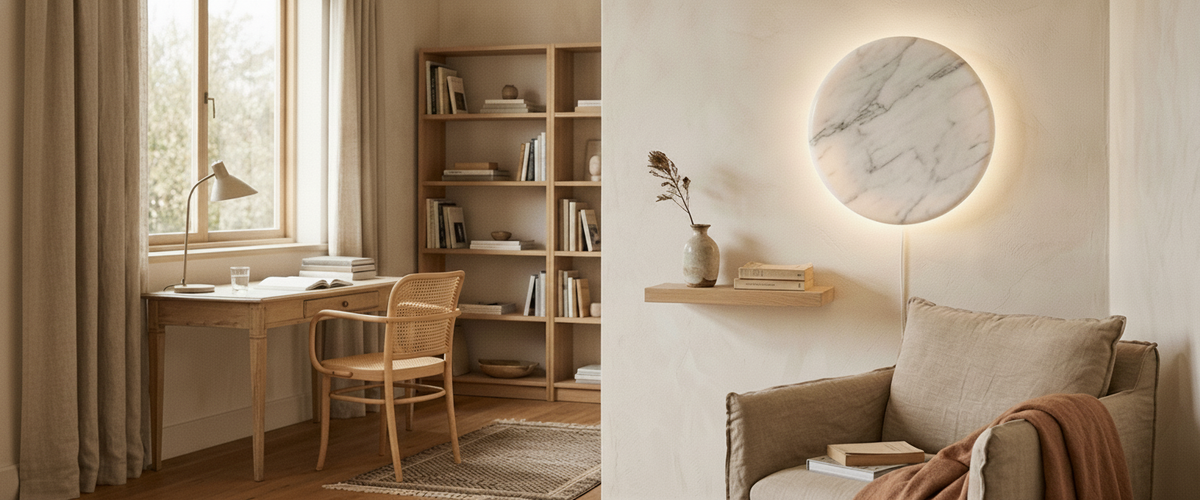

Half the marble wall lights sold online never really light up. They hang on the wall, catch a little brightness from a hidden lamp, and look expensive in the photograph. Put a bulb behind them and nothing happens, because the stone is too dense to let light through. If you want a marble wall lights that actually glows, the first thing to understand is that marble and light have a complicated relationship, and the slab decides the outcome long before the electrician arrives.
At Niori we work with alabaster and natural stone precisely because of how they handle light, so we spend a lot of time explaining the difference between a stone that transmits and a stone that blocks. Here is the short version before we get into detail.

Key Takeaways
- Some marble transmits light, most doesn't. Translucency depends on the slab, its thickness, and how it's cut.
- Backlit sconces glow from within; front-lit ones wash the surface. Two different effects for two different walls.
- Veining changes character once a bulb sits behind it. Lines that look grey in daylight can read amber or green when lit.
- Warm, low-wattage output keeps stone from looking clinical. Cool white flattens the veining and kills the appeal.
- If it only works as a shape, it's decoration, not a light. Learn the signs before you buy.

Marble That Transmits Light Versus Marble That Blocks It
Marble is a metamorphic stone, and its ability to pass light depends on its crystal structure and mineral content. A thin, pale, fine-grained slab can glow softly when backlit. A dense, heavily mineralised block stays opaque no matter how bright the bulb behind it. This is why alabaster, a gypsum or calcite-based stone, became the traditional choice for windows and lamps long before electricity; its softer, more porous body carries light in a way most true marble cannot. The Metropolitan Museum of Art holds Roman and medieval alabaster pieces made specifically because the stone glows when lit from behind.
So when you're looking at a marble wall light, the honest question is: does this piece transmit light, or does it reflect it? A genuine backlit sconce uses a thin slab, often only a few millimetres, so a warm lamp behind it turns the whole face into a soft panel of light. A front-lit design uses thicker, more opaque stone and relies on a bulb positioned to graze or wash the surface. Both are legitimate. They just do completely different jobs, and confusing the two is the most common buying mistake we see.

Backlit Sconces Versus Front-Lit: Which Effect Suits Which Wall
A backlit marble sconce reads as a glowing object. The light comes from inside the stone, the veining lifts into view, and the piece works as a quiet focal point even at low brightness. This suits walls where you want the fixture itself to draw the eye: a hallway, a bedside run, a fireplace flank, a stair landing. It's the effect people picture when they imagine a marble sconce wall lights, and it's the one that photographs best. The same translucency principle governs stone table lighting too, so a piece like the Sleepy Marble Table Lamp is a useful reference for how thin stone and a warm shade behave together at close range.
A front-lit design is different. Here the marble is a body, not a lens, and the light spills up, down, or across the wall around it. This is the piece you want when the job is to light up a marble wall or a textured plaster surface, throwing a graceful arc of brightness rather than glowing from within. Front-lit sconces earn their place beside artwork, along a corridor that needs rhythm, or either side of a mirror where you want illumination on faces rather than a bright panel competing for attention.
Ask yourself which you actually want before you shortlist anything. If you browse our alabaster lighting collection, you'll see both approaches, and it's worth being clear on the effect you're after so the fixture delivers it.
How Veining Reads Once a Bulb Is Behind It
Veining is the whole point of stone, and it behaves unpredictably under light. A slab that looks cool and grey on a showroom shelf can turn warm honey once a 2700K bulb sits behind it, because backlighting picks up the mineral colour the daylight was flattening. This catches people out constantly.
With a green marble wall light, the green deepens and can pick up gold or amber threads you didn't notice unlit. A black marble wall light is a different animal again: dense black marble rarely transmits, so these are almost always front-lit or edge-lit pieces where the drama comes from the polished surface catching light, not the stone glowing. If a seller shows you a black marble sconce blazing from within, be sceptical; that's usually a resin or a very thin, heavily backlit onyx rather than true black marble.
When you're choosing among wall lights in marble, ask to see the piece lit, not just styled. A single studio shot with flattering side light tells you nothing about how the veining behaves when the internal lamp is on. We photograph our pieces lit because the lit state is the one you'll live with every evening.
Warm Output and Low Wattage: Keeping the Stone From Looking Clinical
Cool white light is the fastest way to ruin a marble wall sconce light. It strips the warmth out of the veining, makes pale stone look grey, and gives the whole fixture a bathroom-strip-light quality that undoes everything the material was chosen for. Stone wants warmth behind it.
We recommend a colour temperature around 2700K, sometimes as low as 2400K for bedrooms and lounges where the mood should be soft. Keep the wattage modest; a backlit sconce doesn't need a bright lamp because the stone is doing the diffusing. An overpowered bulb will hotspot, showing a bright patch where the lamp sits and leaving the edges dim. Low, warm, and evenly placed is the recipe. A dimmable LED with a high colour rendering index (CRI 90 or above) keeps the veining honest; the Chartered Institution of Building Services Engineers publishes lighting guidance worth reading if you're specifying for a project rather than a single room.
Walls That Reward a Marble Sconce and Walls That Swallow It
A marble sconce needs the right backdrop to earn its keep. Some walls flatter it. Others make it disappear.
- Walls that reward it: deep, matt colours (ink blue, charcoal, forest green) let a glowing sconce stand out. Textured plaster and limewash catch front-lit spill beautifully. A dark hallway or a windowless landing is transformed by a warm glowing panel.
- Walls that swallow it: bright white walls under strong daylight give the glow nothing to contrast against, so the piece looks flat until dusk. Busy wallpaper competes with the veining. Reflective gloss surfaces bounce hotspots around and cheapen the effect.
Placement height matters too. For a general glow, centre a sconce around eye level or a little above, roughly 60 to 66 inches (150 to 168 cm) from the floor. Flanking a mirror or bed, drop them so the light falls where people's faces will be rather than above their heads. In a stairwell, stagger them to follow the rise so the glow leads you up rather than sitting in one bright cluster.
For exterior walls the calculation shifts, because weatherproofing takes priority over translucency. Where a porch or entrance needs a durable rated fixture rather than a glowing stone panel, a sealed unit such as the Outdoor Wall Light E27 IP44 15W Max in Black is the honest choice, and it pairs the same warm-bulb principle with an IP44 body that stone alone won't give you outdoors.
Signs the Fixture Is Decoration Pretending to Be a Light
Some marble wall lights are ornaments with a bulb bolted on. Here's how to spot them before you commit.
- The listing never shows the piece lit. Every image is a styled daylight shot. That's a tell that the lit state isn't the selling point, usually because it isn't much to look at.
- The stone is described as thick and solid. Solid is fine for front-lit, but if it's sold as a glowing sconce, thick opaque marble won't glow.
- No mention of bulb type, wattage, or colour temperature. A maker who understands the effect will tell you what to fit. Silence here means they haven't thought about it.
- Wildly cheap for the material claimed. Real backlit stone is cut thin, finished carefully, and wired to avoid hotspots. If the price seems impossible for hand-finished natural stone, the material claim is probably loose.
Budget for a marble or alabaster sconce depends on the slab, the scale, the complexity of the carving, the wiring, and the finishing, so the sensible move is to request a tailored quote rather than assume a number. Genuine natural-stone lighting carries real material and labour cost, and that cost is exactly what buys you the glow. If you want to compare fixture types across a room, our full lighting collection sits alongside the alabaster pieces so you can see how a sconce works with pendants and lamps in the same space.
A Short Buyer's Checklist
- Decide backlit (glowing object) or front-lit (light on the wall) before shortlisting.
- Ask to see the piece lit, not just styled.
- Match the veining colour to how it reads warm, especially for green or black stone.
- Specify a warm bulb, around 2700K, dimmable, CRI 90+.
- Keep wattage low to avoid hotspots.
- Choose a wall that gives the glow contrast, and use a qualified electrician for the install.
Get those six right and a marble wall light stops being a shape on the wall and starts doing what stone has done for centuries: turning a bulb into something worth looking at.