
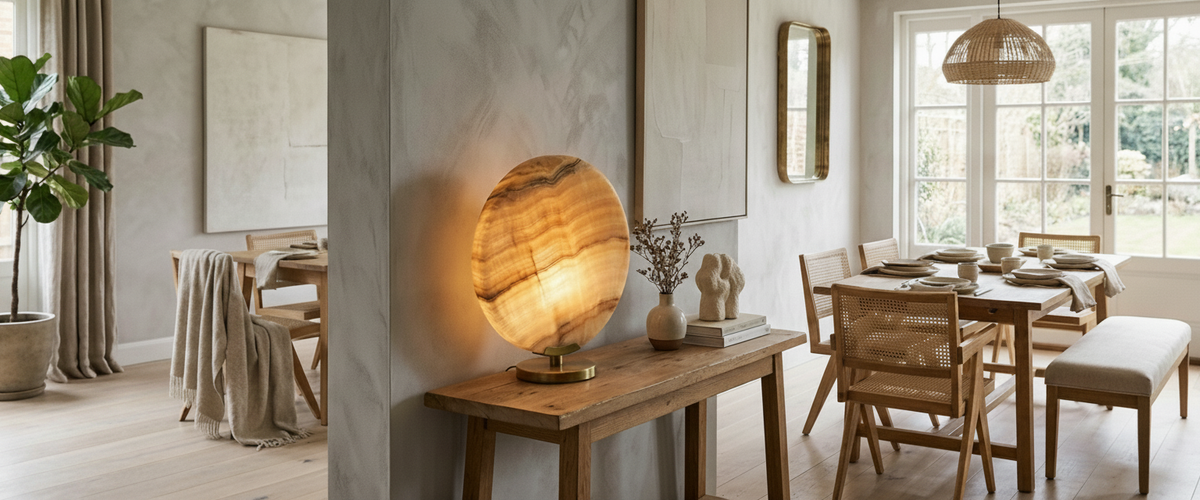

An antique onyx table lamps can look either like a genuine heirloom or like something rescued from the back of a charity shop, and the difference is rarely the lamp itself. It is placement. Onyx that has spent decades in daily use develops a patina no factory can fake: softened edges, a faint amber deepening in the banding, tiny surface marks that catch raking light. Set that on the wrong surface, against the wrong wall, and the worn detail vanishes. Set it well and the same lamp anchors a room.
Niori works with alabaster and natural stone every day, and antique onyx sits close to that world. The rules for showing off antique onyx table lamps overlap with how we advise clients to place carved alabaster: it is about light quality, sightlines, and contrast rather than the object in isolation.
Antique onyx table lamps read as considered when given a clear surface and warm light.

Antique Onyx Table Lamps at a Glance
Patina is the point. Aged onyx has deeper colour and softer edges than new stone. Do not hide it under a heavy shade or in shadow.
Sightline first. Position the lamp so its most worn, most characterful face reads from where people actually sit.
Contrast wins. Pale green onyx needs a darker or warmer backdrop; honey-toned onyx needs something cooler behind it.
Rewire before you display. Old flex and fittings are the fastest way to make an antique look neglected, and a qualified electrician should handle it.
Warm, dimmable light. A 2400K to 2700K bulb on a dimmer flatters the natural banding far more than cool white.

What Decades of Use Do to Onyx
Onyx is a banded form of calcite, softer and more translucent than granite or most marble, which is exactly why it was prized for lamp bases in the first place. Light passes through the thinner sections and picks up the layered banding from inside. Over decades, that surface changes. Handling polishes the high points. Oils from hands and furniture wax settle into the grain. Sunlight can warm the colour, especially in green onyx, nudging it towards a deeper olive. Antique onyx table lamps carry this record more clearly than any new piece.
None of this is damage in the way a chip or crack would be. Calcite-based stones are reactive and porous, as the Natural Stone Institute notes, so the patina you see on a vintage onyx table lamp is the record of its life (naturalstoneinstitute.org). That history is what separates a real antique from a reproduction. Your job is to place it so the history is visible.
This is why placement for aged pieces differs from placement for new ones. A brand-new onyx marble table lamp looks its best clean and evenly lit. An antique wants a little raking light across its surface so the softened edges and worn banding catch. Flat, front-on light erases exactly the detail you paid for.
Sightlines: Setting the Lamp Where Its Worn Detail Reads Best
Before you plug anything in, sit down. Whatever seat gets the most use, a reading chair, one end of a sofa, the head of a bed, becomes your reference point. Turn the lamp so its most interesting face, usually the side with the strongest banding or the most obvious hand-polish, points towards that seat at roughly eye level when seated. Antique onyx table lamps reward this small effort more than most objects.
Height matters more than people expect. A table onyx lamp set too low on a deep console disappears behind other objects; too high and the base, which is the antique part, sits below the sightline while the shade dominates. Aim for the widest, most characterful part of the base to sit between about 24 and 34 inches (60 to 85 cm) off the floor when it is on its table. That keeps the stone in view.
In a dim study, aged onyx throws a low amber glow that reads as lived-in after dark.
One lesson from the studio: we had a client in a period flat who kept insisting their green onyx table lamp looked "dead". It was pushed flat against a mirror. The reflection doubled the shade and hid the base entirely. Pulling it four inches forward and rotating it thirty degrees brought the banding back into the sightline instantly. Nothing wrong with the lamp; everything wrong with the angle.
Room by Room, from Hallway Console to Study Corner
A hallway console is a natural home for a single antique onyx lamp. It is the first thing seen, and low warm light near the entrance reads as considered rather than showy. Keep the console surface fairly clear so the lamp does not compete with keys, post, and clutter. One characterful object beats five ordinary ones, and a good antique onyx table lamp does the job alone.
In a living room, pair a vintage onyx table lamp on a side table with softer general lighting rather than an overhead flood. The lamp then becomes a warm pool people gravitate towards. If you have two, resist perfect symmetry; antiques rarely match, and a near-pair with slightly different banding looks more collected and less catalogue.
A dim study corner is where onyx earns its keep. Aged green onyx table lamps in particular sit beautifully against dark bookshelves, throwing a low amber glow that makes a working corner feel lived-in after dark. Where a desk needs a companion light for close work rather than mood, something with a tunable warm-to-cool output such as the PREDA LED Desk Lamp keeps the onyx as the character piece while handling the practical task light separately. Bedrooms suit antique onyx table lamps too, where the softer light off the stone is kinder late at night than a hard bulb. If you are building a wider scheme around stone, browsing our alabaster lighting range shows how the same warm, diffused quality carries across table lamps, wall lights, and pendants.
Retrofitting Old Wiring Without Dulling the Character
Most genuinely old onyx lamps arrive with wiring that belongs in a museum, not a socket. Cracked flex, brittle insulation, and outdated plugs are common. Rewiring is essential, and it is the single upgrade that stops an antique looking neglected. In the UK, this is work for a qualified electrician; do not treat lamp rewiring as a casual DIY job, and check that the finished lamp meets current standards through guidance such as Electrical Safety First (electricalsafetyfirst.org.uk).
To keep the character, ask for period-appropriate details. Braided fabric flex in a colour that suits the metalwork looks right on antique onyx table lamps in a way that grey PVC never will. If the original brass fittings are sound, have them cleaned and reused rather than swapped for shiny new ones; a little tarnish on the collar matches the aged stone. Where a harp or finial is missing, source antique-style replacements rather than modern chrome.
Handle the stone gently during any work. Onyx is softer than it looks and the banding can flake at the edges if a base is over-tightened. A good restorer packs the fittings so the stone is never taking mechanical stress.
Backdrop and Contrast: Letting Aged Stone Stand Out
Onyx disappears against the wrong colour. Pale green onyx table lamps washed out against a white wall look like a mistake; the same lamp against a deep bottle-green, charcoal, or warm terracotta wall suddenly reads as an object with depth. The rule is simple: give the stone something to push against.
For honey and amber onyx, cooler backdrops work best; a soft slate blue or muted olive stops the warm tones from turning muddy. For green onyx, a warm neutral or a darker shade lets the banding hold its own. Texture behind the lamp helps too. A limewashed wall, a panelled section, or a run of book spines gives the eye something to compare the smooth stone against. Where you want to lift a dark shelf recess behind the lamp with a hidden wash rather than a visible fixture, a low-glare run of concealed strip such as this COB LED strip can add depth behind the stone without competing with the lamp itself.
Think about what sits underneath as well. A dark timber or aged brass tray beneath the base grounds the lamp and reflects a little light back up into the stone. A glossy glass tabletop, by contrast, tends to fight the antique surface with its own hard shine. This is where antique onyx table lamps ask for a little more thought than modern pieces.
Placement Traps That Make a Real Antique Look Like a Mistake
A few habits reliably undercut genuine antique onyx table lamps:
The shade mismatch. A cheap, over-bright modern shade on an antique base screams reproduction. Match the shade's scale and warmth to the age of the stone.
Cool LED bulbs. A 4000K daylight bulb turns warm onyx flat and grey. Stay at 2400K to 2700K and add a dimmer.
Symmetry overkill. Two perfectly identical antique lamps rarely exist. Forced pairs look staged.
Overcrowded surfaces. Antiques need breathing room. Surround one with clutter and it becomes clutter.
Flat frontal light. No side light means no shadow, and no shadow means the worn detail you love goes invisible.
Get the sightline, the light temperature, and the backdrop right and an onyx stone table lamp holds a room the way only aged material can. Handled well, antique onyx table lamps do the work of art and lighting at once. If you are still deciding between a genuine antique and a new stone piece with similar warmth, our wider lighting collection is a useful reference for how carved stone behaves under warm, dimmable light before you commit.
A Quick Placement Checklist
Choose the seat the room is built around, and aim the lamp's best face at it.
Set the characterful part of the base between roughly 24 and 34 inches (60 to 85 cm) off the floor.
Rewire through a qualified electrician, keeping period-style flex and fittings.
Give the stone a contrasting backdrop; pale onyx wants dark, warm onyx wants cool.
Fit a 2400K to 2700K dimmable bulb and pull the lamp forward of any mirror.
Leave the surface uncluttered so one antique onyx table lamp reads as one antique.