
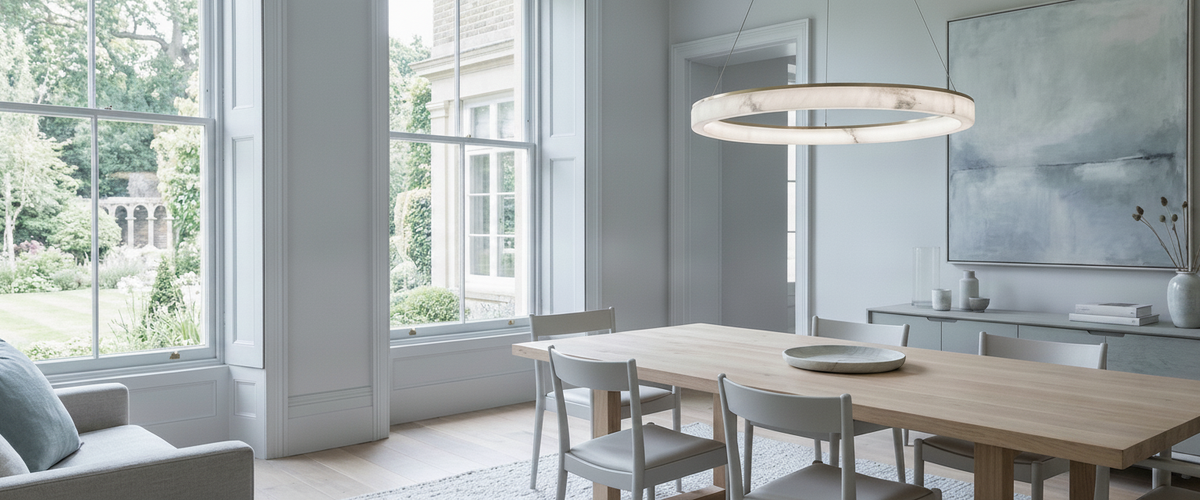

The wrong bulb can drain the life out of a beautiful stone fixture in seconds. Fit a cold, bluish lamp inside a hand-carved alabaster pendant and the veining goes flat, the surface looks chalky, and the warm honey tone that made you want the piece disappears. Choose a good warm white LED instead and the same fixture reads exactly as it did in the showroom: soft, golden, alive. For alabaster and natural stone, colour temperature is not a detail. It is the whole game.
We ship a lot of alabaster from the Niori studio, and the single most common question after a piece arrives is which bulb to use. So here is the honest, specialist answer, without the marketing gloss.

Key Takeaways
- Aim for 2700K in living spaces, bedrooms and dining rooms; it flatters warm stone and skin tones.
- Check the CRI (colour rendering index). Look for 90 or above; it matters more than most buyers realise.
- A warm white LED can be dimmed, but the bulb and dimmer need to be compatible or the light shifts colour or flickers.
- Warm white lamps do exist and are the default choice for alabaster; cool daylight bulbs are the wrong tool here.
- Blue light is minimal in a quality 2700K lamp compared with a cool white or daylight bulb.

What 2700K Actually Does That Daylight Bulbs Can't
Colour temperature is measured in kelvin. A candle sits around 1800K, a traditional incandescent bulb glowed at roughly 2700K, and midday daylight can hit 5000K to 6500K. A warm white LED at 2700K recreates that familiar incandescent glow, which is the light most people find restful at home.
Daylight bulbs push more blue into the spectrum. That is useful over a bathroom mirror or a workshop bench, but it does something unkind to natural stone. Alabaster and onyx carry warm mineral pigments, iron oxides, soft ambers and creams. A cool lamp fights those tones and turns them grey. A 2700K lamp works with them. If you want to understand why translucent stone behaves the way it does under light, the Smithsonian's overview of gems and minerals is a good primer on how mineral structure scatters and colours transmitted light.

Warm White on Stone, on Wood, on White Plaster: Three Outcomes
The same bulb behaves differently depending on what it lights. This is worth thinking through before you commit.
On alabaster and onyx: a warm white LED sends light through the stone and picks up its internal veining, so the fixture itself becomes the glow. This is the effect our pieces are built around. A 2700K lamp deepens the amber; a cooler lamp bleaches it. For a fixture where light travels through a solid carved form, a mains-voltage source such as the 12W LED Module Light Engine Warm White keeps the internal glow even rather than pooling in bright spots.
On wood and warm plaster: this softer tone flatters oak, walnut and lime-washed walls, adding depth without going orange. It reads cosy rather than clinical.
On cool grey plaster or crisp white paint: here the warmth can tip slightly yellow if the walls are very pale and cool. It is rarely a problem, but in a minimalist grey scheme some buyers prefer a 3000K lamp for a fractionally crisper feel. If you are pairing stone with a lot of cool surfaces, test before buying a full set of bulbs. You can see the range of alabaster forms this affects across our alabaster lighting collection.
The Colour-Rendering Number Nobody Checks but Everyone Feels
Colour temperature gets all the attention. Colour rendering quietly decides whether a room looks good. CRI, the colour rendering index, scores how faithfully a light source shows colours compared with natural light, on a scale to 100. A cheap lamp might sit at 80. It will light the room, but reds go slightly muddy and skin looks tired.
For alabaster and natural stone, aim for CRI 90 or higher. The extra faithfulness lets the pinks, ambers and soft browns in the stone read properly instead of collapsing into beige. The ENERGY STAR guidance on light bulbs is a useful reference for reading the numbers on packaging. Most people cannot name CRI, but they can absolutely feel the difference between a room at 80 and the same room at 95.
Where Warm White Flatters and Where It Turns a Room Muddy
This softer tone earns its place in the rooms where people relax and gather. A living room, a bedroom, a dining table set for a long dinner: all of these want 2700K. It softens edges and makes faces look healthy.
The danger zones are rooms that need clarity. A dressing area where you check make-up, a home office with a lot of screen work, a utility room: a warm lamp can feel murky in these. That does not mean you never use it there. It means you layer. A warm ambient glow plus a crisper task light near the mirror gives you both comfort and accuracy.
Are Warm White LED Bulbs Good in the Kitchen?
Kitchens are the real debate. A warm white LED reads beautifully across an island, in pendant lights and in the softer corners of a kitchen-diner. Where it can struggle is the working surface: chopping, reading labels, judging whether chicken is cooked. Our usual advice is a warm tone for the pendants and mood layer, and a slightly cooler, high-CRI task light under the cabinets over the main prep zone. For that continuous line of light under a run of cabinets, a dot-free option such as the COB LED Strip 10W/m 24V Warm White gives an even wash rather than the visible spots you get from older strip lights. You keep the atmosphere without squinting at a chopping board.
Dimming Warm Lamps Without Shifting Them Cold or Green
Here is the trap. Dim a cheap warm bulb and it can flicker or shift towards a slightly green or cold cast at low levels. That last one is jarring on stone, because you notice the colour drift immediately against the veining.
Two things fix it. First, buy bulbs and modules labelled as fully dimmable, ideally with a stated compatible dimmer type. Second, if you love the candle-glow effect where light warms as it dims, the way a real incandescent did, look specifically for a warm-dim or dim-to-warm lamp. These are engineered to drift towards amber as you lower them, which suits alabaster perfectly.
A note on wiring: any hard-wired dimmer, driver or transformer should be installed by a qualified electrician. The advice here is about how the light behaves, not a DIY rewiring guide.
Mixing Warm Light With Task Light So Faces Still Read True
Good lighting is layered, and a warm white LED is the base layer, not the only one. In practice that means a warm ambient wash from your stone pendants, chandeliers or wall lights, then a second layer for tasks that need clarity.
The trick when mixing is to keep the two layers close in temperature. Pair a 2700K ambient glow with a 3000K task light and the transition feels natural. Jump straight to a 4000K cool task light next to warm stone and you get an uncomfortable clash, one pool amber and one pool blue-grey in the same eyeline. Keep faces lit by the warmer side of the scheme; keep the cooler light on work surfaces and shelves where accuracy matters. You can browse fixture types to build these layers across the full lighting collection.
A Quick Buyer's Checklist
- Colour temperature: 2700K for living, dining and bedrooms; consider 3000K if your scheme is very cool and grey.
- CRI: 90 or above, always, for natural stone.
- Dimmable: confirm the bulb is dimmable and pick a matching dimmer; consider dim-to-warm for alabaster.
- Fitting and shape: match the cap (E27, E14, GU10) and choose a bulb shape that sits neatly inside the fixture without pressing against the stone.
- Heat and clearance: a warm white LED runs cool, which is ideal near alabaster; still leave the recommended clearance so nothing overheats.
- Buy a spare set: keep bulbs from the same batch so the colour stays consistent across a room.
Why This Matters More for Stone Than for Anything Else
With a fabric shade or an opaque metal pendant, the bulb just throws light outward and the fixture stays neutral. With alabaster, the light travels through the material, so the bulb and the stone become a single visual object. The quality of your warm white LED is not hidden behind a shade; it is on display, lit from within. That is exactly why we steer buyers so firmly towards 2700K and high CRI. Get those two right and a Niori piece does what it was carved to do, which is to glow like the stone is holding the light rather than merely passing it on.