
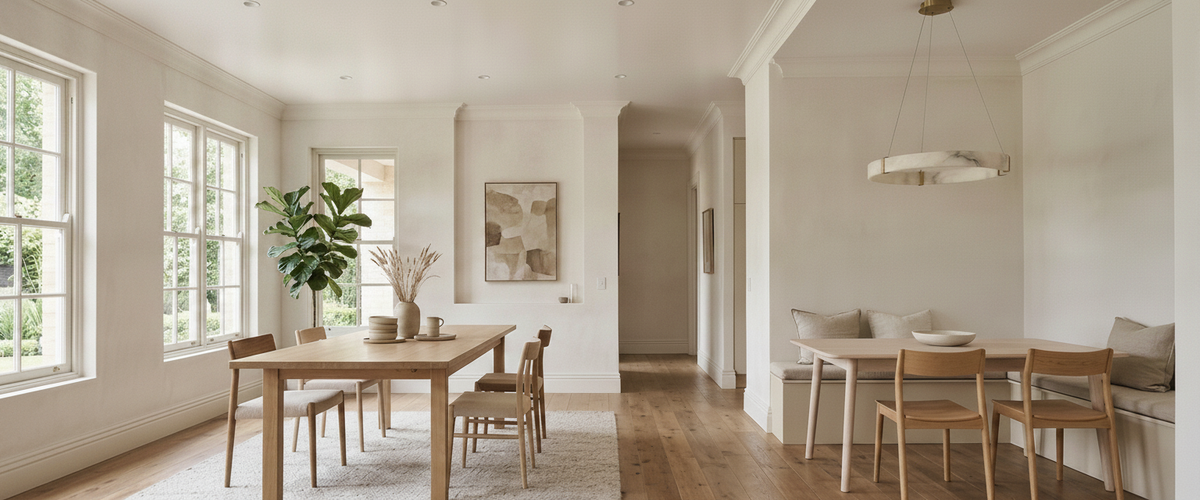

Swap the wrong bulb into a beautiful alabaster pendant and you can flatten it in seconds. The stone stops glowing, the veining goes muddy, and a fitting that should read as warm and alive looks like a grey pebble on the ceiling. The fixture gets the compliments, but the LED light bulbs inside it decide whether alabaster earns them. Get the bulb right and the material sings; get it wrong and no amount of styling rescues the room.
This matters more with natural stone than almost any other material, because you are lighting through it, not just near it. Alabaster and onyx are translucent, so the LED light bulbs sit behind a filter that shows every flaw in the light source. That is why we spend as much time advising on bulbs as we do on the pieces themselves.
A warm 2700K bulb lets the veining in an alabaster pendant read true.

Key Takeaways Before You Buy
Colour temperature: stay warm. 2700K flatters veining; 4000K and above tends to grey it out.
Lumens and beam: aim for an even wash inside the cavity, not a single bright point that burns a hotspot into the stone.
Dimming: only buy dimmable LED light bulbs if your dimmer and driver are matched to them, or the glow will flicker and drop out.
Fit: check the cap (B22 or E27), the bulb shape, and whether it physically clears the internal cavity.

Why the Bulb, Not the Fixture, Decides Whether Alabaster Glows
Alabaster is a soft, semi-translucent stone, and light passes through it rather than bouncing off. That single fact changes how you shop for LED light bulbs. With an opaque shade you can hide a mediocre lamp behind fabric or metal. With stone there is nowhere to hide. The bulb's colour, its brightness, and even the shape of its emitting surface all pass straight through the slab and land on the wall or table below.
We had a client in a period London flat who loved an alabaster wall light in the showroom, took it home, and rang us convinced the piece was faulty. It was not. They had fitted a cool daylight bulb left over from a kitchen refit. One swap to a warm 2700K source and the wall light looked like the one they had seen. The stone had not changed at all.
If you are still choosing between fittings, it helps to see how the stone reads across different forms in the alabaster lighting range before you lock in a spec, because a pendant, a wall light and a table lamp each want slightly different LED light bulbs.

2700K vs 4000K: Why Warm Flatters Veining and Cool Flattens It
Colour temperature, measured in kelvin, is the first thing to get right when picking LED light bulbs. Lower numbers are warmer and more golden; higher numbers are cooler and bluer. Alabaster and onyx carry warm mineral tones: honey, amber, soft grey and cream. A warm bulb at around 2700K sits inside that palette and lifts the veining. A cool one at 4000K or 5000K fights it, pulling the stone toward a flat, clinical grey and killing the depth people buy the material for.
For living rooms, bedrooms, dining spaces and hospitality settings, we almost always recommend 2700K. Some very pale marbles can take 3000K without losing warmth, which reads as a crisp, slightly brighter white while staying friendly. Reserve anything cooler for task-only situations where the stone is not the point. The Chartered Institution of Building Services Engineers publishes lighting guidance that backs this up: warmer colour temperatures suit relaxed domestic and hospitality spaces, cooler ones suit focused work.
One more thing designers care about: colour rendering. Look for a CRI of 90 or higher on your LED light bulbs. A high-CRI warm source shows the true browns and creams in the stone; a cheap one with poor rendering makes even good alabaster look dull.
Warm 2700K on the left keeps the veining alive; cool 4000K on the right flattens it to grey.
Lumens and Beam Spread: The Line Between a Wash and a Hotspot
Brightness is measured in lumens, not watts. Watts tell you energy use; lumens tell you output. A rough guide many of our customers use: a 60W-equivalent bulb sits around 806 lumens, and a 100W-equivalent around 1521 lumens. For a stone fitting the goal is an even internal wash, so the whole slab lights up rather than one hot patch.
Beam spread is the quiet hero here. A wide beam, 220 degrees or more, or a filament bulb that emits close to 320 degrees, fills the cavity and lights the stone evenly. A tight spotlight beam does the opposite: it throws a bright point at one section of the alabaster and leaves the rest dim, so you see the source through the stone instead of a soft glow. For pendants and larger shades, wide-emitting GLS or filament LED light bulbs almost always beat directional ones. Where a bright pendant needs to fill a generous shade evenly, a wide 320-degree source such as the E27 GLS 11W Filament LED Bulb is closer to the right design language than a narrow-beam spotlight.
Match output to the room. A bedside alabaster table lamp wants gentle light, so a lower-lumen warm bulb is plenty; for that kind of soft glow a 60W-equivalent piece such as the E27 GLS 7W Filament Dimmable LED Bulb makes more sense than a full 100W-equivalent lamp. A dining pendant over a big table can take more. Oversizing is a common mistake; too many lumens through thin stone looks harsh and shows the bulb outline. You can compare fixture scales across the wider lighting collection to judge what output each piece realistically needs.
Dimmable LED Bulbs and Their Drivers: What Holds a Low Warm Glow
This is where most people come unstuck. Dimmable LED light bulbs are not a single, simple thing. A bulb has to be labelled dimmable, and it has to be paired with a compatible dimmer and, where relevant, a driver rated for LED loads. Mix an old-style dimmer built for filament bulbs with modern dimmable LED lights and you get flicker, buzzing, a limited dimming range, or a glow that cuts out well before the dial reaches the bottom.
Dimmable LEDs work by rapidly switching the current on and off, or by reducing it, faster than the eye can see. Good bulbs and matched drivers hold a smooth, low, warm glow. Poor pairings collapse at the bottom of the range, which matters enormously with alabaster because a low, warm setting is exactly the mood most people want in the evening. If your fitting takes a bayonet cap, a dimmable option like the B22 GLS Filament 12W Dimmable LED Bulb keeps that warm bottom-of-range glow when it is on a matched dimmer. If you plan to dim, buy the bulb, the dimmer and the driver as a considered set, and confirm they are listed as compatible.
The same logic applies to dimmable LED strip lights. Some designers hide LED strip inside larger alabaster or onyx installations to backlight a panel evenly. That works beautifully, but the strip needs a matched dimmable driver and careful heat management, so it should be planned with your electrician rather than improvised. Any mains wiring, dimmer or driver work should be signed off by a qualified electrician. The guidance from Electrical Safety First is a sensible reference point.
Cap, Shape and Cavity: Fitting the Bulb to the Space You Cannot See
The technical fit is easy to overlook and expensive to get wrong. Start with the cap. Bayonet caps (B22) push and twist; screw caps (E27, and the smaller E14) thread in. Check which your fitting takes before you order LED light bulbs, because the numbers are not interchangeable.
Then think about shape and size. A GLS bulb is the classic rounded shape and suits many pendants and lamps. Candle and golf-ball shapes fit slimmer stone fittings and multi-arm pieces. Filament LED light bulbs give a wide, soft emission that flatters stone, but they run a little longer, so measure the internal cavity. We have seen customers buy a lovely filament lamp only to find it will not sit inside a compact alabaster wall light. Measure the space the bulb has to live in, not just the socket.
A Pre-Purchase Spec Check for a Stone Fitting
Cap type: confirm B22, E27 or E14 against the fitting.
Colour temperature: 2700K for warmth; 3000K only for pale marble if you want crisper white.
CRI: 90 or higher so the veining reads true.
Lumens: match output to room and stone thickness; do not oversize.
Beam spread: wide (220 degrees plus) or filament-style for an even wash.
Dimming: if dimming, confirm bulb, dimmer and driver are a compatible set.
Physical size: measure the internal cavity, not just the socket.
Heat: LED runs cool, which protects the stone; still allow ventilation where the fitting expects it.
Run that list before you check out and you will avoid almost every complaint we hear about LED light bulbs. The stone does the heavy lifting once the light behind it is warm, even and correctly sized. Choose your LED light bulbs as carefully as you chose the fitting, and an alabaster piece from Niori will glow the way it did in the studio.