
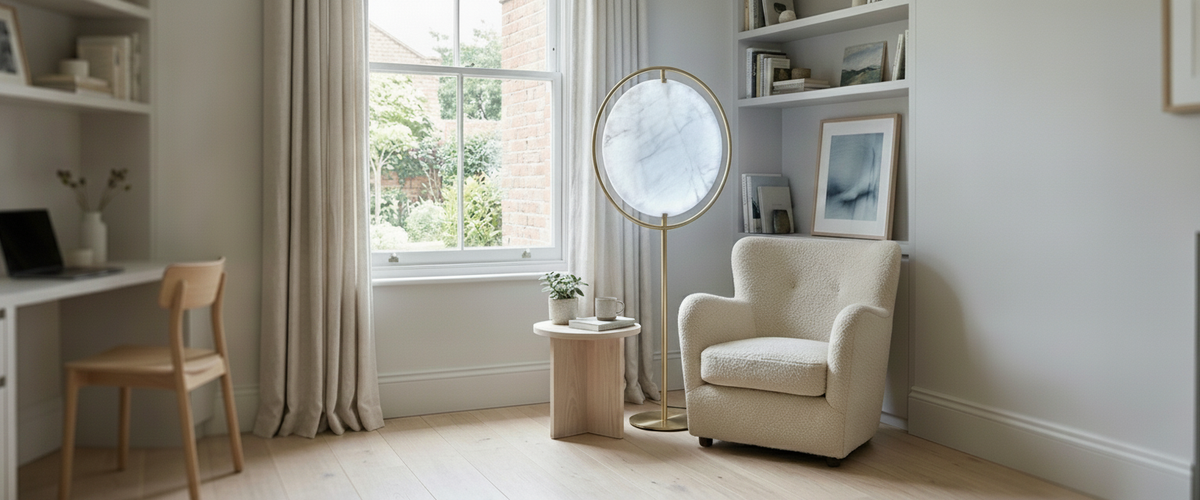

Floor lamps living room schemes earn their place by lighting the spot you actually use: the corner of the sofa where you read, the armchair angled toward the window, the dead zone beside the bookcase that swallows light. A ceiling fixture lights the room from above and a table lamp lights the surface it sits on, but neither reaches the place you live. Get the height, reach, and placement right and the lamp slips into the scheme while quietly doing the heavy lifting. Get it wrong and you have a glaring bulb at eye level or a puddle of light two feet from where you sit. This guide shows how to choose the floor lamps living room schemes need and place them so they light the seat, not the surface.
Floor lamps living room schemes do best when they light the seat, not the surface.

Key Takeaways
A floor lamp lights the seat, not the surface; that is its real advantage over table lamps and ceiling fixtures.
Shade height and arm reach decide whether light lands on your lap or washes the ceiling.
Uplight gives ambient glow; downlight gives reading light; arc and adjustable lamps try to do both.
An alabaster or natural-stone base keeps a busy scheme quiet and softens the light it carries.
Two floor lamps living room schemes carry is fine, and often better than one, if you balance them across the space.

The Job a Floor Lamp Does That Nothing Else Can
Living rooms are rarely one room. There is the sofa zone for evenings, the armchair you read in, and the corner that never quite worked. A single ceiling light treats all three the same and flatters none of them. Table lamps help, but they need furniture to stand on and they pool light low. This is where floor lamps living room owners rely on pull ahead of every other fitting.
A floor lamp answers a more specific question: where do I want light, and at what height, without rearranging the room to get it? It stands free, so you can place it behind a sofa arm, beside an armchair, or tucked into a corner with no surface in reach. For renters and anyone who moves furniture seasonally, that freedom is the reason floor lamps in the living room beat fixed fittings.
Three Rooms Within One Room
Think of the living room as three jobs, and match floor lamps in the living room to each one.
The sofa flank. A lamp at the end of a sofa fills the gap a table lamp leaves when there is no side table, or when the table is already crowded. Set the shade so the bottom edge sits roughly level with your shoulder when seated, around 58 to 64 inches (147 to 163 cm) to the top of the shade for most designs. Any lower and you see the bulb; any higher and the light skims past you. Floor lamps in the living room live or die on this single measurement.
The reading nook. Beside an armchair you want directional light over the shoulder, falling onto the page rather than into your eyes. An adjustable or arc lamp earns its place here because you can aim it. Position the head slightly behind and to the side of the chair, and you have one of the most useful floor lamps for the living room.
The dead corner. Every living room has one: the spot that goes black after sunset and makes the room feel smaller than it is. An uplight lamp, or a tall alabaster column that glows along its whole body, turns that corner into a soft anchor. Where a corner needs a vertical glow that reads as a lit object rather than a fixture pointed at the wall, a stacked stone column such as the Varelle Stacked Alabaster Floor Lamp turns the material itself into the light source rather than just a stand. Among the floor lamps living room corners need, this is the kind that does double duty as sculpture.
Why Shade Height and Arm Reach Decide Everything
The most common mistake we see is buying on looks alone and ignoring the geometry. Two numbers govern whether floor lamps in the living room work: the height of the shade relative to your seated eye line, and how far the arm reaches over the place you sit.
For seated tasks, the bottom of the shade wants to sit near eye level when you are settled into the cushions, not standing in the showroom. Stand-up height readings mislead people constantly. If the shade is too high, light spills onto the wall behind you; too low and you catch the source directly. For an arc or cantilevered lamp, check that the head actually clears the front edge of the seat, otherwise the light lands on the floor in front of your knees instead of on your lap. This is why so many floor lamps in the living room underperform out of the box.
Arc and uplight forms suit different jobs in the same room.
Uplight, Downlight, and the Lamps That Try Both
Floor lamps in the living room split into three broad behaviors, and matching that to the task saves you from disappointment.
Uplight throws the beam at the ceiling, which bounces a soft, even wash back down. It is the gentlest ambient light in the room and the kindest to tired eyes. An alabaster lamp that glows through its stone does a version of this naturally, scattering warm light in every direction. Where a sofa flank needs a diffused glow rather than a hard downlight, a tall translucent piece such as the Atria LED Large Alabaster Floor Lamp reads as a lit object instead of a glaring point. Uplight is often the calmest choice among floor lamps living room schemes can carry. You can see how that diffusion works across the pieces in the alabaster lighting range.
Downlight sends the beam onto a defined patch below, which is what you want for reading, knitting, or anything that needs contrast on a page. These are task lamps first and mood lamps a distant second, and they are the most literal of the floor lamps in the living room.
Arc and adjustable lamps try to do both, and the good ones succeed. A tall arc with a tiltable head can wash a wall when you want calm and drop over a chair when you want to read. They cost a little more in floor space because the base sits away from the light, so leave room for both ends. Of all the floor lamps for the living room, these are the most forgiving when your seating moves around.
Pairing a Stone or Alabaster Base With a Quiet Scheme
The reason designers reach for stone here is restraint. A carved alabaster or marble base brings weight and a natural surface that catches light without shouting. Each piece carries its own veining, so no two columns read the same, but the palette stays calm: warm whites, soft grays, the occasional amber thread in onyx. Stone is what makes floor lamps in the living room feel built rather than bought.
Alabaster is a gypsum-based stone prized since antiquity precisely because light passes through it; the Metropolitan Museum of Art holds carved alabaster vessels that show how thin the material can be worked while still holding a glow. That translucency is the whole point of a stone lamp. The base is not a stand alone; it is part of the diffuser, which is part of why stone floor lamps in the living room read so differently from a metal stem.
For pairing, let the lamp be the texture in a quiet room. Against a linen sofa and a plain rug, a stacked alabaster column or a slim brushed-brass stem with a stone shade gives the eye something to rest on without fighting the rest of the furniture. Where a room wants several soft points of light rather than one, a multi-globe form like the Orlena 3 Light Globe Alabaster Floor Lamp spreads the glow without raising the overall brightness. Brass detailing warms a cool scheme; matte black grounds a brighter one. If the room is already busy with pattern, a stone lamp calms it down rather than adding to the noise. Stone is one of the easier ways to pick floor lamps in the living room without clashing. Browse the broader lighting collection if you want to match a floor lamp to pendants or wall lights in the same material family.
Where the Cable Run and Switch Quietly Kill a Good Spot
The perfect corner is worthless if there is no socket within reach and a cable trailing across a walkway. Before you commit floor lamps to a position in the living room, check three things, because even the best floor lamps living room corners can hold fail when the wiring fights them.
Outlet distance. Measure from the proposed lamp position to the nearest socket. A cable stretched taut across an open floor is both a trip hazard and an eyesore. If the run crosses a route people walk, rethink the spot or run the cable behind furniture. This is one of the planning steps that decides whether floor lamps in the living room sit cleanly or look like an afterthought.
Switch access. A lamp you have to bend down to switch on gets used less. Look for an inline foot switch, a switch on the stem, or smart control. Lamps wired into a switched socket can join a dimmer circuit, which is the cleanest way to set evening mood, and it is what makes floor lamps in the living room feel effortless to live with. Any new wall switching or socket work should go to a qualified electrician.
Dimming and bulbs. Warm light matters more than raw brightness in a living room. A bulb around 2700K reads cozy; pair it with a compatible dimmer and you can pull the level down for film nights. Where a lamp has integrated LED, check it is rated as dimmable before you buy. Dimming is what lets floor lamps living room owners use shift from task light to mood light on the same switch. The Chartered Institution of Building Services Engineers publishes guidance on lighting levels worth a look if you are planning a whole-room scheme rather than a single lamp.
A Quick Buyer's Checklist
Sit where the lamp will light and measure your seated eye line, not your standing height.
Decide the job first: ambient wash (uplight), reading (downlight), or both (arc or adjustable).
Check arm reach clears the front of the seat for task lamps.
Measure to the nearest socket and plan the cable run off walkways, the way good floor lamps in the living room always start with placement.
Confirm the switch is easy to reach and the lamp dims if you want evening control over your floor lamps in the living room.
For a calm room, let an alabaster or stone base be the only texture in that corner. It is one of the simplest ways to keep floor lamps living room schemes need from clashing.
Can You Have Two Living Room Floor Lamps?
Yes, and in a large or open-plan space two floor lamps in the living room often work better than one. The trick is balance. Place them diagonally across the room rather than side by side, so the light reaches both seating zones and the corners stay lit. Two matching alabaster columns give a calm, symmetrical look flanking a sofa; a mismatched pair, say an arc reading lamp at the armchair and an uplight column in the dead corner, covers different jobs without looking like a showroom display. Keep the bulb color temperature consistent across both so the room reads as one space. A balanced pair of floor lamps living room corners share beats a single lamp working too hard.
Budget for floor lamps in the living room depends on the material, the scale of the stone, the engineering of the stem and switching, and the finishing. Hand-carved alabaster sits at a different level from a pressed shade for good reason. When you weigh up floor lamps in the living room against the room you actually have, ask us for a tailored quote rather than guessing from a range. The right floor lamps living room schemes deserve repay the planning every evening you switch them on.