

The best desk lamps home office workers can rely on are adjustable, diffused task lights that put warm-neutral light (3000K to 4000K) exactly where you work, without bouncing glare back off your screen. By 3pm your eyes know the difference. A ceiling light floods a room evenly and calls it a day, which is exactly the wrong approach for focused work. This guide explains how to pick a desk lamps home office setup that survives a full eight-hour day: reach, glare control, color temperature and the small placement tricks that decide whether your study feels comfortable or quietly punishing. Get the light quality right and you can read, write and work for hours without that low-grade eye fatigue that creeps in around mid-afternoon. Get it wrong and you will feel it whether you can name the cause or not.
At Niori we work mostly in alabaster and natural stone, materials that soften and spread light in a way few desk lamps home office buyers find elsewhere. That softness matters more on a desk than people expect, so this guide weighs both the engineering of a good fixture and the kind of glow that keeps a working room from feeling like an office strip.
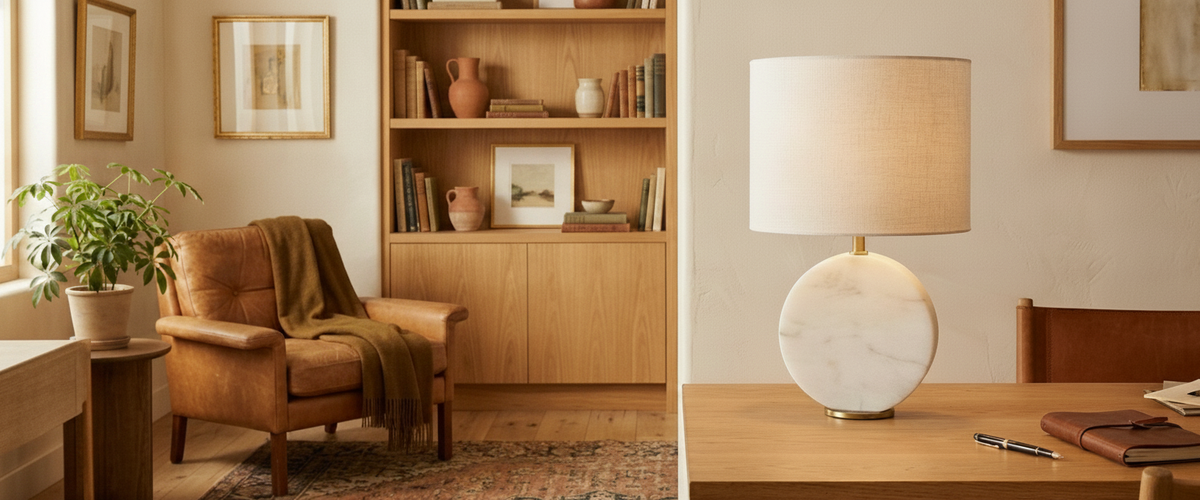
An alabaster task light spreads soft, even light across the working surface.

Key Takeaways Before You Buy
Reach beats brightness. An arm that can place light where you need it outperforms a brighter lamp stuck in the wrong spot.
Two glare problems, not one. Screen glare and paper glare want different head positions; the best desk lamps home office setups let you fix both.
Aim for warm-neutral light. Roughly 3000K to 4000K keeps you alert without the clinical chill of an office ceiling.
Mind your writing hand. Light should arrive from the side opposite your dominant hand to avoid casting a shadow over your own work.
Footprint counts. A heavy stone base steadies the lamp but eats desk space; measure before you commit.

What a Desk Lamp Has to Do That a Ceiling Light Never Will
Overhead lighting sets the mood of a room and lets you walk through it safely. It cannot follow your eyes down to a contract, a sketchbook or a laptop screen. Desk lamps home office buyers choose exist to do localised work: deliver enough illumination on the surface that your pupils are not fighting between a bright screen and a dim page. The British standard guidance for office task areas sits in the region of 500 lux on the working plane, and the Chartered Institution of Building Services Engineers publishes the detail if you want to go deeper. You do not need to measure lux at home, but the principle holds: the desk needs noticeably more light than the rest of the room, and that light needs to be controllable.
This is where a fixed ceiling fitting fails. It cannot dim to suit a video call, cannot tilt away from a glossy magazine, and cannot move closer when you are doing fine work. A proper desk lamp does all three, which is why desk lamps home office setups earn their place beside a screen.
Reach, Arm Articulation and Footprint on a Real Working Desk
The single most useful quality in a desk lamp is the ability to put the light source where you want it and leave it there. A jointed or weighted arm that holds position lets you push light forward over a keyboard, swing it sideways onto a notebook, or lift it clear when you spread out drawings. Stiff, single-pivot desk lamps home office shoppers find look tidy in a photo and frustrate you within a week.
Footprint is the quiet decider. A solid stone or alabaster base gives a lamp real stability, which you want, but it also claims territory on a desk that is probably already crowded. Measure the clear space to the side of your monitor before you fall for a wide, sculptural base. On a deep desk you have room to enjoy a substantial piece; on a slim console you are better served by a taller, narrow-footed desk lamp that lifts the light above the clutter rather than competing with it. Where desk space is genuinely tight and you simply need clean, directional light over a keyboard, a compact USB-powered fixture such as the LYYT 12 LED USB Desk Lamp takes up almost no territory and pairs neatly with a softer ambient piece nearby.
If you want the calm, diffused glow of stone without a task arm, a small alabaster table lamp parked at the back corner of the desk does a different job: it lifts the ambient level so your screen is not the only bright thing in your field of view. Many of our customers run both, a directional desk lamp for the close work and a stone lamp for the background. You can see the range of forms across our alabaster lighting collection.
Keeping the head below eye line and to the side controls both screen and paper glare.
Screen Glare Versus Paper Glare: Positioning the Head for Both
Glare is two separate problems wearing the same coat. Screen glare happens when a light source reflects off your monitor and into your eyes; you see a bright smear over your work. Paper glare happens when a bare, point-source bulb bounces hard off glossy paper or a laminated page. They demand different fixes, and the better desk lamps home office buyers choose let you address each one separately.
For screens, the rule is to keep the lamp head below your eye line and angled away from the display, lighting the desk surface and the area in front of the keyboard rather than the screen itself. For paper, you want a diffused source rather than a naked LED chip, so the light arrives soft and broad instead of as a hot pinpoint. This is exactly where alabaster earns its keep on desk lamps for the home office. The stone scatters light through its body, so even a directional alabaster fixture reads gentler on the eye than a clear-glass or metal-shaded lamp pointed at the same spot. Less hot spot, fewer harsh shadows on the page.
Colour Temperature for Focus Without the Office-Strip Chill
Color temperature, measured in Kelvin, sets the mood and the alertness of a room. Very warm light around 2700K is lovely for a sitting room and slightly soporific over a desk. Cold blue-white light around 5000K and up keeps you alert but turns a home study into a server room. For most desk lamps home office setups, set the output to warm-neutral light between 3000K and 4000K. It holds focus through the afternoon without that flat, clinical feel of an office ceiling.
Two more details matter. Choose a bulb with a high color rendering index, ideally CRI 90 or above, so paper, fabric swatches and skin on video calls all look true. And put the lamp on a dimmer or buy one with adjustable output. Morning admin and an evening deep-work session want different levels, and the ability to bring the light down at dusk keeps the room comfortable as daylight fades. Alabaster, lit from within, naturally pulls a cooler bulb toward a warmer, more forgiving glow, which is one reason it works so well on desk lamps for the home office during long stretches at a desk.
Where the Lamp Sits Relative to Your Writing Hand and the Monitor
Placement is the cheapest upgrade you will ever make. If you are right-handed, set your desk lamp to your left so your hand never casts a shadow across what you are writing; left-handers reverse it. Keep the head forward of the monitor and slightly to the side, not directly behind the screen where it will halo your display, and not in front where it will glare back at you.
For a dual-monitor setup, lift the light a little higher and centre it above the gap between screens, then tilt it down onto the desk in front. The goal is an even pool on the work surface with no single bright reflection riding across either display. Spend five minutes adjusting your desk lamp once and the difference over a working week is real.
The Desk Lamps That Look the Part but Fail the Eight-Hour Test
Plenty of desk lamps home office shoppers admire photograph beautifully and disappoint by lunchtime. The usual culprits:
Bare, undiffused LEDs. A visible strip of chips throws sharp multiple shadows and tires the eyes. You want a diffuser, a shade, or translucent stone between the source and your work.
No tilt, no dim. A fixed head at a fixed brightness cannot adapt to glare or to changing daylight. Adjustability is not a luxury here.
Too cold by default. Many cheap task lamps ship at 6000K. Crisp in the showroom, exhausting across a real working day.
Wobble. A light base on a long arm drifts every time you knock the desk. Weight matters, which is one reason stone and alabaster bases hold their position so well, and why heavier desk lamps home office buyers prefer stay put.
Flicker. Poor drivers cause flicker you may not consciously see but your eyes register over hours.
The question for any lamp is not whether it looks good empty; it is whether you would happily work under it for eight hours. If you are building a study that has to feel considered as well as functional, it is worth browsing the wider lighting collection to think about how desk lamps for the home office sit against pendants, wall lights and ambient pieces in the same room.
A Quick Buyer's Checklist
Measure the clear desk space beside your monitor before choosing a base size.
Confirm the head tilts and, ideally, the arm articulates.
Pick 3000K to 4000K with CRI 90 or higher.
Make sure your desk lamp dims or has multiple output levels.
Position it opposite your writing hand, forward and to the side of the screen.
Favour a diffused or stone-bodied source over a bare LED for less glare.
If you can, add a soft ambient lamp so the screen is not the brightest object in the room.
Treated this way, the right desk lamps home office buyers invest in stop being an afterthought and become the piece of kit that decides whether your study is comfortable or quietly punishing. Niori builds desk lamps for the home office in alabaster and natural stone precisely because that material gives the warm, diffused light a working room needs, and it happens to look like furniture rather than equipment.