
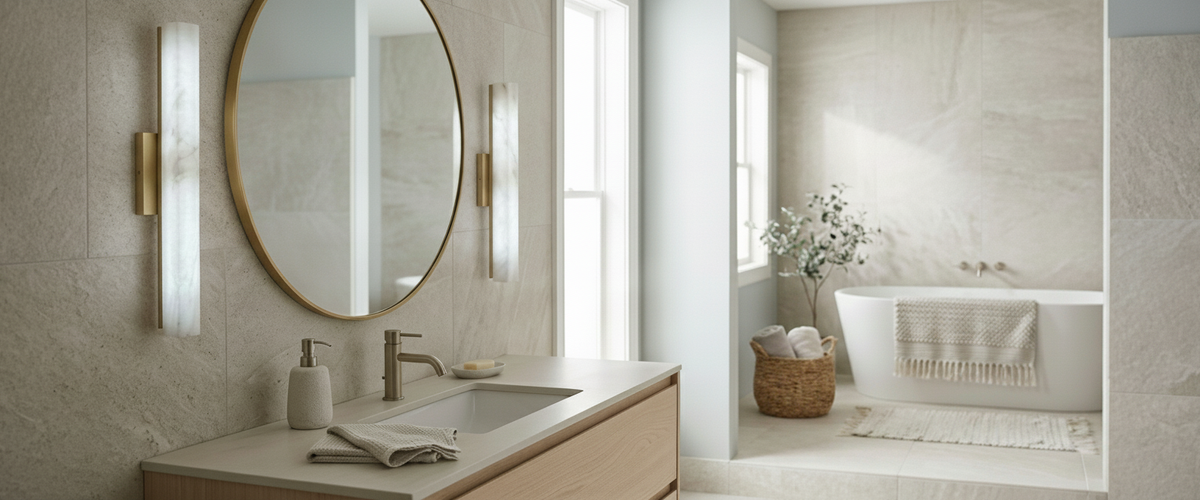

Stand under a single ceiling light and look in the mirror. The shadows pool under your eyes, your jaw goes hollow, and shaving or applying makeup turns into guesswork. That one overhead fitting is the most common mistake in British bathrooms, and most of the good bathroom lighting ideas worth knowing exist to correct it. The fix is rarely a brighter bulb. It is light coming from the right direction, at the right height, in layers you can control.
At Niori we make alabaster and natural-stone lighting, and the bathroom is one of the rooms where that warm, diffused glow earns its place. Stone softens light in a way few other materials manage. Before we get to where it belongs, here is the quick version of the bathroom lighting ideas that matter most.
Wall lights at eye level either side of the mirror remove the undereye shadows a single ceiling fitting creates.

Key Takeaways
A single ceiling light casts downward shadows on the face. Add light beside the mirror to fix it.
Flank the mirror at roughly eye level, around 60 to 66 inches (1.5 to 1.7 metres) from the floor, for the most flattering vanity light.
IP ratings matter. Bathrooms are divided into zones, and the fitting must be rated for the zone it sits in.
Small and windowless rooms benefit from reflected light, generous mirrors, and pale finishes.
Layer ceiling, mirror, and accent light so you can dial the mood up or down. The best bathroom lighting ideas all start here.
Alabaster and natural-stone wall lights suit the softer, away-from-water zones beautifully.

Why One Ceiling Light Gives Everyone Undereye Shadows
Light falls down from a ceiling fitting. When it hits your face from directly above, your brow casts a shadow over your eyes, your nose throws a line down toward your mouth, and the whole effect ages and tires you. No amount of wattage changes the angle. This is the single biggest reason people sense their bathroom lighting is wrong without being able to say why, and it is where most bathroom lighting ideas should begin.
A ceiling light still has a job. It gives the room its base layer of brightness, the light you flick on first. Recessed downlights or a flush stone ceiling fixture handle that well. The error is asking that one source to do everything, including the close work at the mirror that needs light from the side.
Flanking the Mirror: The Trick That Fixes Vanity Light
The most reliable of all bathroom vanity lighting ideas is to put light on either side of the mirror rather than above it. A pair of wall lights at roughly eye level lights both sides of the face evenly, fills in the shadows the ceiling created, and gives you a true picture for shaving and makeup. Aim for around 60 to 66 inches (1.5 to 1.7 metres) off the floor, and space them so they bracket the mirror rather than crowd it.
If the mirror is too wide to flank, or you only have room for one fitting, a light placed above and angled to wash down the face is the next best option. Opal or frosted glass diffusers matter here; a bare bulb at eye level glares. Where you want the light spread softly across the face rather than spotlit, a ribbed or opal-glass fitting such as the Cora 1 Light Bathroom Wall Light diffuses the source in exactly the way vanity work needs. It is one of the more practical bathroom light fixtures ideas for an everyday family bathroom.
Colour temperature is part of the trick too. Around 2700K to 3000K keeps skin tones warm and the room relaxing. Push past 4000K and the light reads clinical, which suits a utility space more than a bathroom you actually want to linger in. You can browse our broader range of lighting to see how warmer tones change the feel of a fitting before you commit. Among warm-toned bathroom lighting ideas, this one does the most quiet work.
IP Zones in Plain English, So You Buy Fittings That Are Safe
Water and mains electricity do not mix, so bathrooms are split into zones, and every fitting carries an IP rating telling you how protected it is. Get this right and the room is safe. Get it wrong and you have a fitting that should never have gone where it did. Safety underpins every one of these bathroom lighting ideas.
Zone 0: inside the bath or shower tray itself. Anything here must be low voltage and rated IP67, fully submersible.
Zone 1: above the bath or in the shower, up to about 7 feet 6 inches (2.25 metres). A minimum of IP44, often IP65 for showers.
Zone 2: the area extending roughly 24 inches (0.6 metres) beyond zones 0 and 1, and around the basin. IP44 is the usual minimum.
Outside the zones: the drier parts of the room. Standard fittings are generally fine, though splash protection is sensible near a basin.
The IP code itself is a recognised international standard; the IET's wiring regulations and the Electrical Safety First guidance set out how it applies to bathrooms in British homes. For a fitting going near the basin in Zone 2, an IP44-rated option such as the Shelly 1 Light Bathroom Wall Light meets the minimum without compromise. The short version for buyers: check the IP rating against the zone before you fall for a fitting, not after. And the wiring is always a job for a qualified electrician, not a weekend project.
Small and Windowless Bathrooms: Scale, Mirrors, and Reflected Light
Cramped and windowless rooms are where lighting decisions count most, because there is no daylight to fall back on. The instinct is to flood the space with downlights, but a grid of hard spots in a tiny room just throws shadows into every corner. Better small bathroom lighting ideas lean on reflected, indirect light.
In a compact, windowless room a generous mirror and pale finishes bounce light back and lift the perceived ceiling height.
Start with the mirror. A larger mirror does double duty, bouncing whatever light you have back into the room and visually doubling the floor space. Position your mirror lights so they reflect off pale tiles and the mirror surface rather than glaring straight at the user. Where space is tight and you want the mirror itself to carry the task light rather than crowding the wall with fittings, a slim dedicated mirror light like the Glintis LED Bathroom Mirror Light sits close to the glass and lifts the perceived ceiling height in a low or boxy room. Reflected light is the cleverest of small-room bathroom lighting ideas.
Finish choices feed into this. Pale walls, a glossy or honed stone, and a soft blue scheme all reflect rather than absorb. Light blue bathroom ideas read cool and airy, so balance them with warm 2700K bulbs to stop the room feeling cold. The same logic applies to a light green bathroom: keep the lighting warm and let the colour stay fresh rather than tipping clinical.
Layering Ceiling, Mirror, and Accent Light for a Calmer Scheme
A good bathroom has at least two or three light layers you can switch independently. The base layer is your ceiling lighting, the everyday brightness. The task layer is the mirror lighting that does the close work. The accent layer is the soft, low light you want for a bath at the end of a long day. Layering is the spine of nearly all bathroom lighting ideas.
Among bathroom ceiling lighting ideas, the choice comes down to recessed downlights for a clean look, or a flush stone ceiling fixture when you want the ceiling itself to carry some character. Ceiling bathroom lighting ideas need not be elaborate: in a period property with higher ceilings, a small pendant in alabaster can sit well outside the wet zones, casting a warm pool that downlights never quite achieve. Whichever of these bathroom ceiling lights ideas you favour, keep them on their own switch.
Dimming ties it all together. Put the mirror and accent layers on a dimmer and the same room serves a brisk morning and a slow evening without rewiring. Check that your bulbs and driver are dimmable before you buy; not every LED bathroom fitting is, and a non-dimmable LED on a dimmer flickers and fails early. Dimming is one of the cheapest bathroom lighting ideas with the biggest payoff.
Where Stone and Alabaster Wall Lights Belong in a Softer Bathroom
Alabaster is translucent, so light passes through the stone and emerges warm and diffused, with the natural veining glowing faintly from within. That quality is wasted under a harsh ceiling spot, and it comes alive in a wall light beside a mirror or flanking a freestanding bath. The light feels closer to candlelight than to a bulb, which is exactly the mood most people want from their bathroom lighting ideas at night.
Placement is about respecting the zones. Keep alabaster and natural-stone fittings in the drier areas, outside the immediate splash zones, where their IP rating and the room layout allow. They suit the basin wall, the run beside a long mirror, or the dressing corner of a larger bathroom. For the wet zones, choose purpose-made, higher-rated bathroom fittings in chrome, glass, or anthracite, and let the stone pieces do the atmospheric work where they are safe and sensible.
If you are drawn to that softer, stone-diffused glow, our alabaster lighting collection shows how the material behaves across wall lights, pendants, and table lamps. Flank a mirror wall with two carved stone fittings and it starts to feel like part of a bedroom suite rather than a separate utilitarian room, and the overhead downlights often go barely used in the evening. These are the bathroom lighting ideas that change how a room feels after dark.
A Quick Buyer's Checklist
Have you added light beside or around the mirror, not just overhead?
Is every fitting rated for the IP zone it sits in?
Are your bulbs 2700K to 3000K for flattering, relaxing light?
Can you dim the mirror and accent layers independently?
In a small or windowless room, is the mirror large enough to reflect light back?
Are stone and alabaster fittings placed in the drier zones where they belong?
Is the wiring booked with a qualified electrician?
Get those right and the room works in the morning and at night, flatters the face, and feels calm rather than clinical. That is the whole point of treating bathroom lighting ideas as layers rather than a single switch.