

A desk lamp that looks the part and then dazzles you off your screen has failed at its one job. The best desk lamp is the one that lays an even, controlled pool of light over the page or keyboard, holds that position without sagging, and shifts its mood from sharp daytime focus to softer evening email. Brightness on a box rarely tells you any of that. So before you read another lumen count, work backwards from the task.
At Niori we make alabaster and natural-stone lighting, and a desk is one of the more honest tests of a lamp. You sit close to it for hours. Glare, flicker, a wobbling arm, a base that creeps across the desk; all of it becomes obvious fast, and it is what separates the best desk lamp from a pretty paperweight.
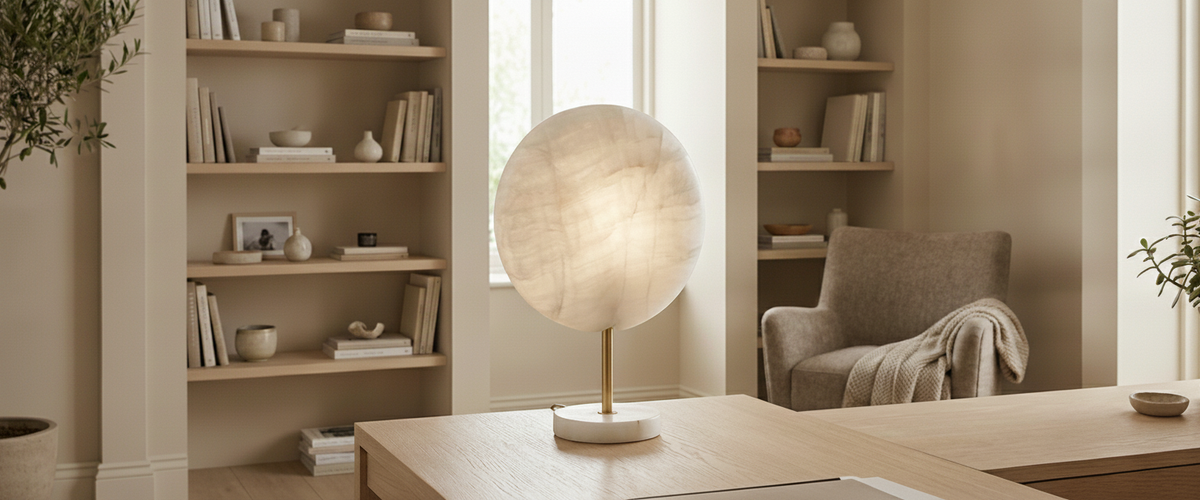
An alabaster lamp diffuses light through the stone, softening the contrast between screen and surroundings.

Key Takeaways
Judge by the task. Even, glare-free light on your work surface beats raw output every time when you pick the best desk lamp.
Beam control matters more than peak brightness. A tight, soft pool reduces eye strain and screen reflections.
Adjustability should feel firm. Joints that hold their angle after years of use are worth more than ten swivel points that sag by month two.
Dimming and warm-to-neutral colour let one lamp serve focused daytime work and relaxed evening sessions.
Weight keeps a lamp planted. A stone or alabaster base resists the nudges that tip lighter fixtures.

Define the Best Desk Lamp by the Task, Not the Spec Sheet
The best desk lamp for a graphic designer reviewing colour proofs is not the right choice for someone answering email beside a sleeping baby monitor. Start with what you actually do at that desk. Detailed paperwork, sketching and reading want a crisp, neutral light. Screen-heavy work wants gentle ambient fill so your pupils are not fighting a bright fixture against a dark room. Note your desk depth, whether you face a wall or a window, and how close your eyes sit to the bulb. Those four facts decide more than any wattage figure.
It helps to separate two roles. A task lamp throws light at a specific spot. An accent or ambient lamp lifts the whole desk so the contrast between your screen and the surroundings is comfortable. A carved alabaster table lamp does the second job beautifully, because the stone diffuses light through its body and softens the edges of the room. You can see how that translucent glow behaves across our alabaster lighting range.
Beam Control: Why a Tight, Even Pool Beats Raw Brightness
Two lamps can claim the same lumens and feel completely different on a desk. One scatters light everywhere, including straight into your eyes. The other shapes it into a defined, even circle on the page. That shaping is beam control, and it is the single most underrated quality in a workspace light. It is also the first thing the best desk lamp gets right.
You want a pool with no hotspot in the middle and no harsh fall-off at the edge. Hotspots tire your eyes; sharp edges make you keep nudging the lamp. A shade that hides the bulb from your eyeline at normal sitting height is doing real work here. Natural stone and alabaster help because the material itself diffuses light rather than firing a point source at you. The result is closer to daylight bouncing off a wall than a torch in the face. Where the work is purely screen-based and you simply want a focused task pool over a keyboard, a compact directional fixture such as the LYYT 12 LED USB Desk Lamp is closer to the right design language than a softly diffusing stone piece. The Chartered Institution of Building Services Engineers notes that controlling glare and contrast, not just raising light levels, is what makes a workspace comfortable to use for long stretches (see cibse.org).
Good beam control gives an even pool with no harsh hotspot and no abrupt edge.
Adjustability That Survives Daily Handling
Adjustability sells lamps in the showroom and disappoints at home. The question for the best desk lamp is not how many ways an arm can bend, but whether those joints still hold a position after a year of daily nudging. Cheap friction hinges loosen. Spring-balanced arms can lose tension and start to droop, so the head slowly creeps down while you type.
Look for joints with a confident, slightly resistant feel rather than a loose flop. Test the full reach if you can: a good arm should stay exactly where you leave it when you take your hand away. For a fixed alabaster or marble lamp, adjustability comes from placement instead of mechanics, which is often the more durable choice. You set it once and it never sags, because there is nothing to sag. On a desk where you sit in the same chair every day, a well-placed fixed lamp can outlast three articulated ones.
Dimming and Colour Shift for Focus and Evening Email
One desk serves several moods. Morning admin wants brighter, slightly cooler light. The 9pm catch-up wants something gentler so you are not wired before bed. A dimmable lamp covers both, which is why dimming is closer to essential than optional on a desk you use into the evening. The best desk lamp handles both ends of the day on one switch.
Check that the lamp dims smoothly and low without flicker or buzz, and confirm the dimming method before you buy, since not every LED plays nicely with every dimmer. For colour, a warm to neutral white, roughly 2700K to 3000K, suits most home offices; it reads as clean without feeling clinical. Some lamps shift colour temperature as you dim, going warmer at lower output, which mimics the way daylight softens toward evening. Alabaster naturally warms and diffuses whatever bulb sits behind it, so a stone fixture tends to feel kind to the eye even at full brightness. If you want to compare warm-glow fixtures across pendants, wall lights and lamps, browse the full lighting collection.
Materials and Weight: What Keeps a Lamp Planted
A desk lamp lives in a crowded, busy space. Cables get tugged, elbows knock it, the cat investigates. Weight is what keeps the best desk lamp where you put it. Lightweight plastic and thin metal lamps skate across the desk and tip when you adjust the arm; a dense base holds firm.
This is where natural stone earns its keep. A solid alabaster, marble or onyx base is genuinely heavy, sitting low and central, so the fixture stays planted no matter how you reach for it. Each piece also carries its own veining, which means no two are quite alike. Alabaster is a softer stone than granite, so it wants a little respect: dust with a dry or barely damp soft cloth, avoid acidic or abrasive cleaners, and lift rather than drag it across a surface. The Natural Stone Institute publishes sensible guidance on caring for softer calcite-based stones (see naturalstoneinstitute.org). Looked after, a stone base outlives the trends entirely.
Where a Desk Lamp Earns Its Place on Cramped or Shared Desks
Placement decides whether a lamp helps or hinders, and even the best desk lamp can underperform in the wrong spot. The classic rule still holds: put the light source to the side of your writing hand so the lamp does not cast a shadow over what you are doing. For a right-handed person, that usually means the lamp sits front-left.
On a cramped desk, footprint matters as much as light. A compact stone base with a tall, slim profile lights the surface without stealing working space. We once helped a client fitting out a narrow home office in a converted loft; the desk was barely deep enough for a monitor, so a wide-armed task lamp was out. A slender alabaster fixture set in the back corner gave a soft ambient wash that cut the screen glare without crowding the keyboard.
For dual-monitor setups, a single task lamp rarely covers the whole span. Better to combine ambient fill from a stone lamp with a small targeted light where you handle paper. On shared desks, where two people swap positions, the best desk lamp tends to be a fixed one with a generous, even pool, since it annoys fewer people than fussy articulated arms that the last user left pointing the wrong way. And if your desk doubles as a console or hallway table by evening, a lamp that looks like a considered object, not a piece of office kit, is the one you will keep out on display.
A Quick Buyer's Checklist
Beam: Even pool, no harsh hotspot, bulb hidden from your eyeline.
Adjustability: Joints hold position when you let go; or choose a fixed lamp and place it well.
Dimming: Smooth and flicker-free, with a dimming method that matches your setup.
Colour: Warm to neutral white for most home offices.
Weight: Dense, low base that resists nudges; stone is ideal.
Footprint: Compact enough for your desk depth, especially with monitors.
Care: Soft cloth, no harsh cleaners on natural stone.
Budget is the last question, not the first. Cost for a quality stone lamp depends on the material, the scale, the complexity of the piece and the finishing, so the sensible move is to settle on the task and the look you want, then request a tailored quote. Get the brief right and choosing the best desk lamp becomes a simple price conversation. Match the task to the material and the best desk lamp for your space tends to pick itself.