
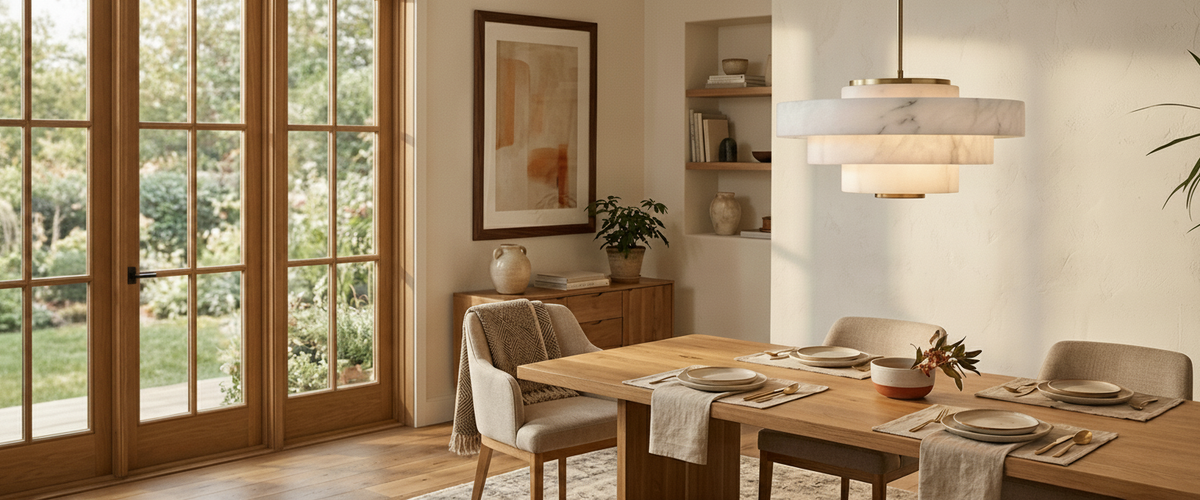

Most rooms sold as "Deco" are wearing the costume and missing the bones. A real art deco light fixture is built on geometry first: stepped tiers, fan shapes, sunbursts, and a symmetry so deliberate it almost feels engineered. Get the geometry right and even a plain brass arm reads as period. Get it wrong and no amount of gold finish will save it. Before you spend on art deco lighting for a hallway, dining room, or hotel lobby, learn what the era actually looked like, because the market is full of approximations that fall apart on close inspection. For the full range of forms, start with our deco lighting collection.

Key Takeaways Before You Buy
Geometry is the tell. Stepped forms, fans, and bold symmetry signal a genuine art deco light fixture; soft curves and busy ornament usually do not.
Materials throw different light. Brass warms it, glass shapes it, alabaster and natural stone soften it into a glow.
Match the shape to the spot. Pendants own the dining table, sconces frame mirrors and corridors, ceiling fittings carry the room.
Warm and dimmable wins. Period rooms ran low and amber, not bright and cool.
Weight and joinery tell the price. Solid metal, tight seams, and hand-finished stone justify the spend; thin castings do not.

The Geometry Test for a Real Art Deco Light Fixture
Start by ignoring the finish and looking at the silhouette. Deco grew out of the 1920s and 1930s love of machine-age order, and an art deco light fixture carries that DNA: stepped "skyscraper" tiers, repeating fan blades, chevrons, and a mirror-image balance you can fold down the middle. The Victoria and Albert Museum traces the style's break from the flowing lines of Art Nouveau toward this harder, more geometric language. If a fitting is all soft scrolls and floral curves, it is leaning Nouveau or generic glam, not Deco.
Stepped tiers and mirror-image symmetry are the clearest signs of a genuine art deco light fixture.
Look for intent in the symmetry. A genuine piece treats the shade, the arms, and the base as one composed unit, often radiating from a strong central axis. A stepped alabaster shade that narrows in clean tiers, or a fan of frosted glass set in brass, reads as a true art deco light fixture instantly. Random asymmetry and bolted-on detail are the giveaways of a copy chasing a look it does not understand.
How Brass, Glass and Stone Each Throw a Different Period Light
The materials are not interchangeable, and the way each handles light is the whole point. Brass does not soften light so much as color it; the warm metal bounces a faintly golden cast off ceilings and walls, which is why polished or aged brass detailing reads so naturally with period schemes. Glass shapes the beam. Frosted, ribbed, or fluted Deco glass scatters output into a controlled bloom, and stepped glass shades layer that effect tier by tier. Where a table needs that warm-metal cast paired with disciplined geometry rather than a single bright bulb, a multi-light art deco light fixture such as the Ascot 4 Light Art Deco Table Lamp shows how brass and a stepped white shade work together to color the light rather than just emit it.
Stone is where the light turns into atmosphere. Alabaster is mineral translucent, so a carved shade does not just sit in front of the bulb, it carries the glow through the material itself, releasing a warm, even light with the veining faintly lit from within. That diffused quality is exactly what Deco interiors wanted and what most reproductions miss. At Niori we work almost entirely in alabaster and natural stone for this reason; you can see the range of forms across our alabaster lighting collection, where the material does the diffusing that a plain glass globe never quite manages. Onyx and marble add a denser, more dramatic version of the same effect, with stronger banding when lit.
Alabaster carries the glow through the stone itself, giving the warm diffusion period rooms wanted.
Pendant, Sconce or Ceiling Fitting: Where Each Deco Shape Belongs
Choosing the right body matters as much as the style. Each art deco light fixture has a job to do depending on its form.
Mounting height is where most pendant installs go wrong. Too high and the bulb glares straight into eyeline; too low and it blocks the conversation across a table. For a stepped alabaster pendant over a dining surface, leave roughly 30 to 36 inches (76 to 91 cm) of clear air between the tabletop and the bottom of the shade, and the stone diffuses a soft pool downward while the faces around it stay flattered. Run a row over an island and the spacing should echo the geometry of the fitting itself; even gaps let the Deco rhythm read as deliberate rather than scattered.
Art deco light sconces do the quiet work. Mount a pair flanking a mirror, a bed, or a fireplace, and they frame the feature with symmetrical wall light. Fan-shaped or shell-stepped alabaster sconces are the classic move; set at around 60 to 66 inches (152 to 168 cm) from the floor, they wash light upward and sit at a flattering height. In a long corridor, evenly spaced sconces give that rhythmic, hotel-lobby cadence Deco loved.
An art deco ceiling light anchors a whole room. A flush or semi-flush stepped fitting suits lower ceilings and entrance halls, while a tiered chandelier carries a double-height stairwell. If you want a single statement, a layered alabaster ceiling light gives ambient glow without the visual clutter of a busy multi-arm piece. You can compare pendants, sconces, and ceiling fittings side by side across the full lighting range to see how the same Deco language scales up and down.
The Line Between Authentic Homage and Theme-Park Pastiche
There is honest homage, and there is fancy-dress. The difference is restraint. Real Deco used bold geometry but disciplined ornament; it knew when to stop. Pastiche piles on every cliche at once: gold everything, a sunburst, fringing, mirrored facets, and a zigzag, all on one piece. The result looks like a film set, not a room people live in. A good art deco light fixture never tries every trick at once.
A useful test: would the design still read as Deco in a matte finish, with the geometry alone carrying it? If yes, the bones are good and the materials are doing real work. If the whole effect collapses the moment you remove the shine, you are looking at decoration pretending to be design. We have shipped to clients restoring 1930s apartments who wanted exactly this distinction; the brief is almost always "period, not parody," and stone shades tend to win because they bring authority without shouting. The right art deco light fixture should hold up under that scrutiny.
Warm, Dimmed Glow: The Colour Temperature Period Rooms Actually Had
Original Deco interiors ran on early incandescent bulbs, which means low output and a warm amber cast, the look people once called a deco red light when the filament burned low. To honor that, choose LED lamps in the 2200K to 2700K range and put them on a dimmer. Cool white above 3000K will flatten brass to a gray and drain the warmth from an alabaster shade, killing the very effect you paid for.
For an art deco light fixture in alabaster, go warmer rather than cooler; the stone reads richest under low-Kelvin light, and the veining glows instead of bleaching out. Use dimmable drivers and check the bulb is rated for an enclosed fitting if the shade fully surrounds it. A high color-rendering bulb (CRI 90 or above) keeps the stone's natural tones honest. For wiring and dimmer pairing, use a qualified electrician; correct dimmer-to-driver matching prevents the flicker that ruins a slow evening dim.
Weight, Joinery and Finish: The Tells of a Fixture Worth Its Price
Quality announces itself before you switch the light on. Pick the art deco light fixture up, or read the spec honestly, and look for these signs.
Weight. Solid brass and real stone have heft. A suspiciously light "brass" arm is usually thin plated steel or resin.
Joinery. Tight, flush seams where tiers meet; no visible glue lines or gaps. Stepped forms should align cleanly, not approximately.
Finish. An even, hand-applied finish on metal and a polished, consistent surface on stone. Each piece of alabaster is unique, so expect natural veining to vary; that is the material being genuine, not a flaw.
Hardware. Quality canopies, ceiling roses, and switches. Cheap fittings cut corners here first.
Stone integrity. Hairline fractures and uneven thickness in a translucent shade show up the moment it is lit, so even diffusion is a good sign of careful carving.
On budget: the cost of an art deco light fixture tracks the material, the scale, the complexity of the geometry, the engineering behind the fitting, and the hand-finishing of the stone. A small sconce and a tiered chandelier are not the same conversation. Rather than chase a headline number, ask for a tailored quote against your room and your chosen piece, and weigh it against how long it will last. Natural stone, looked after, outlives trends.
A Quick Buyer's Checklist
Does the silhouette pass the geometry test (stepped, symmetrical, deliberate)?
Are the materials authentic, with real weight and tight joinery?
Is the shade alabaster or natural stone for a true diffused glow, or just plain glass?
Have you matched the form to the spot: pendant over a table, sconces flanking a mirror, ceiling fitting anchoring the room?
Are your bulbs warm (2200K to 2700K), high CRI, and dimmable?
Is the wiring and dimmer work going to a qualified electrician?
Tick those and you will end up with an art deco light fixture that reads as the real thing across a lifetime of evenings, not a costume that fades the first time someone looks closely. Start from the geometry, trust the stone to carry the light, and let restraint do the rest. Browse the full collections on the Niori homepage when you want to see how the same period language plays out across pendants, sconces, and ceiling fittings.