

Most rooms that claim an Art Deco scheme give themselves away within ten seconds. The fixtures are too busy, the chrome is too cold, and the symmetry has gone missing somewhere between the showroom and the ceiling. Good art deco lighting is disciplined. It rewards restraint, repetition and a confident sense of proportion, and it falls apart the moment you treat it as decoration for its own sake. Get the geometry right and you can read the period across the room; get it wrong and you have a film-set version of the 1930s that nobody quite believes.
This is where alabaster and natural stone earn their place. The Deco era loved materials that diffused light rather than threw it, and a carved stone shade does that better than almost anything modern. The best art deco lighting starts with the material, not the motif.
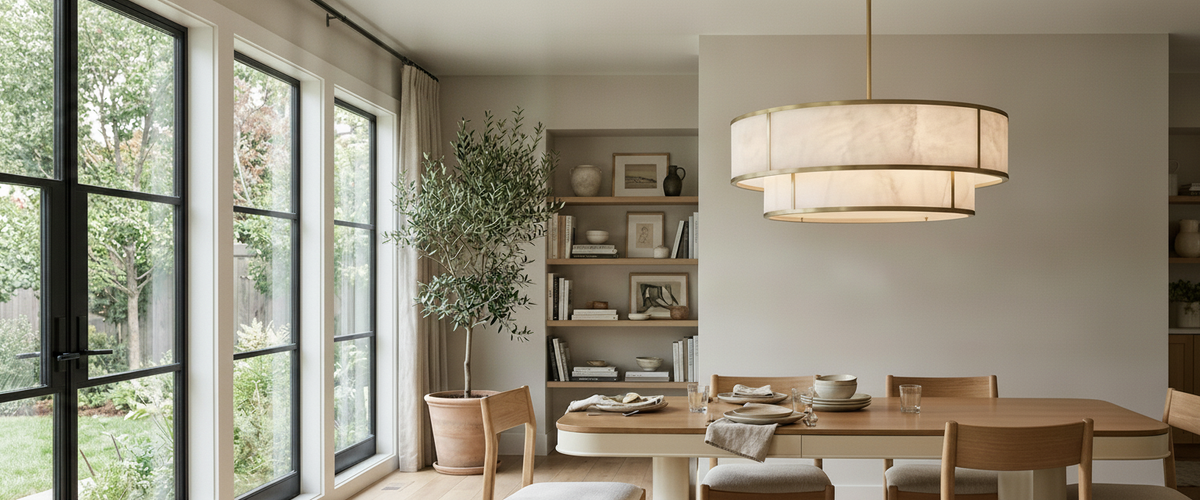
A stepped alabaster pendant shows the warm, diffused glow that defines the period.

Key Takeaways
Deco is defined by stepped form and symmetry, not by chrome or fan motifs alone.
Alabaster and natural stone carry the warm Deco palette better than polished metal, which can read cold and harsh.
Decide early whether one fixture anchors the room or a matched set builds the scheme.
Match form to room: stepped pendants suit dining and entry, sconces frame mirrors and corridors.
Scale and symmetry rules keep the look elegant rather than theatrical.
Budget depends on material, scale and finishing, so request a tailored quote rather than guessing.

The Geometry Test: Stepped Form and Real Symmetry
Before you judge an art deco lighting fixture on its finish, look at its silhouette. Authentic period design draws on stepped, ziggurat-like forms, clean repeated lines, and a strong vertical or radial symmetry. The Victoria and Albert Museum's account of the style shows how much it leaned on architecture and machine-age confidence rather than fussy ornament (vam.ac.uk). A genuine piece looks engineered. A pastiche piece looks costumed.
Run a simple test. Cover the finish with your hand, mentally, and ask whether the shape still says Deco. If the form only works because someone bolted on a sunburst or a zigzag, it is decoration pretending to be design. The best art deco lighting holds its geometry whether the pieces are made in brass, glass or carved stone.
Why Alabaster and Stone Carry the Deco Palette
Chrome and polished nickel get all the attention in revival shoots, but they have a problem: they reflect rather than glow. Point a warm bulb at a chrome bowl and you get hotspots and glare. Alabaster does the opposite. Light enters the stone, scatters through its crystalline structure, and leaves as a soft amber wash that suits the period's warm, lamp-lit interiors. This is the heart of why stone-based art deco lighting outlasts the metal versions.
Natural stone also brings the colour story Deco wanted. The era prized honeyed marbles, smoky onyx and creamy alabaster against gold and bronze. Those are warm, mineral tones, not the icy blue-white of a modern chrome scheme. We have shipped alabaster wall lights into a 1930s mansion-flat restoration where the owner had started with chrome sconces and found the rooms felt clinical after dark; swapping to carved stone art deco lighting with brass detailing brought the warmth back without losing the geometry. You can see the same logic across the alabaster lighting range, where stone does the diffusing and brass handles the structure.
Matched stone-and-brass sconces give the symmetry the period depends on.
Anchor or Ensemble: One Statement or a Whole Scheme
Decide this before you buy anything. Art deco lighting can work two ways, and mixing the approaches by accident is how rooms end up cluttered.
The anchor approach uses a single commanding fixture, usually an art deco ceiling light or a stepped pendant, as the room's focal point. Everything else stays quiet. This suits open-plan spaces and entrance halls where one strong piece reads cleanly from a distance.
The ensemble approach builds the period across several matched or complementary fixtures: a central pendant, a pair of wall sconces, and a table lamp that echoes the same stepped form. The discipline here is repetition. Pick one geometric motif and let it recur at different scales. When the shapes rhyme, the room reads as a considered scheme rather than a collection of art deco lights that happened to arrive together.
Matching Form to Room
The same Deco vocabulary plays out differently from room to room, and the form should follow the function. Good art deco lighting respects that.
Dining Rooms and Entry Halls
A stepped or tiered pendant earns its place over a dining table or in a double-height hall. The vertical layering gives the eye something to climb, and a carved alabaster body throws warm light down onto faces and tabletops without glare. This is where art deco pendant lights do their best work; they want a room with enough ceiling height to show the silhouette.
Living Rooms and Bedrooms
Here you usually want a softer hand. A pair of fan-shaped or stepped art deco light sconces flanking a fireplace or bed gives symmetry and a gentle wash up the wall. Add a stone-based table lamp for reading height and you have layered art deco lighting without a single harsh source. Where a console or sideboard needs a fixture that holds the Deco geometry honestly while keeping the light low and warm, a piece such as the Ascot 4 Light Art Deco Table Lamp in White & Gold sits more comfortably than a tall, single-source lamp.
Corridors and Stairwells
Sconces win in transitional spaces. A stepped pendant in a narrow corridor reads as theatre; a run of matched wall sconces, evenly spaced, reads as architecture. Symmetry along the wall does more for a hallway than any single statement piece.
Scale and Symmetry Rules That Keep It Elegant
Art deco lighting tips into theatre when the proportions slip. A few working rules keep it on the right side.
Pendant diameter: over a dining table, aim for a fixture roughly half to two-thirds the width of the table. Wider feels overbearing; narrower looks stranded.
Hanging height: leave around 30 to 36 inches (76 to 91 cm) between the tabletop and the base of a dining pendant. In a hall, hang for clearance and sightlines, not for drama.
Sconce placement: mount wall lights at roughly eye level when seated nearby, usually 60 to 66 inches (152 to 168 cm) from the floor, and keep pairs perfectly level with each other.
One dominant motif: let a single geometric idea lead. Stepped, radial or chevron; pick one and repeat it rather than crowding three together.
Symmetry is the quiet engine of the style. Deco interiors balance left against right, and the art deco lighting should reinforce that. A lone sconce on one side of a chimney breast undoes the whole effect. If you cannot run a matched pair, choose a different fixture type for that wall.
Finish and Warm-Light Pairings That Age Well
The finish is where revival schemes date fastest. Bright polished chrome under a cool LED reads as a recent shopfit. Warm brass, aged bronze and honed stone read as the period. The materials the 1930s actually used, glass, alabaster and brass, hold up because they were never trying to look new in the first place. That is the quiet rule behind lasting art deco lighting.
For the light source, stay warm. A colour temperature around 2400K to 2700K flatters alabaster and brass and matches the incandescent glow the era was built around. Choose dimmable LEDs and check the dimming module is rated for the lamp, because cheap drivers flicker and cool the colour as they dim. The CIBSE Society of Light and Lighting offers sound guidance on getting colour temperature and dimming right for residential interiors (cibse.org). Avoid anything that calls itself "daylight" white; it strips the warmth straight out of the stone.
A note on the red question that comes up in trend searches: a deco red light, or warm amber accent, can work as a single statement in a bar or snug, but it is an accent, not a scheme. Keep the main light warm and neutral, and let colour appear in one controlled place.
A Quick Buyer's Checklist
Does the silhouette pass the geometry test with the finish ignored?
Are you anchoring with one piece or building an ensemble? Commit before buying.
Is the stone genuinely translucent, so it glows rather than just sits there dark?
Does the metal detailing use warm brass or bronze rather than cold chrome?
Have you confirmed dimmable, warm-white bulbs and a compatible dimmer?
For wall sconces, can you install a matched, level pair?
Art deco lighting done well looks effortless because the hard decisions, scale, symmetry, material and light temperature, were settled before the first fixture went up. If you want to compare stepped pendants, sconces and stone table lamps in one place, the wider lighting collection is a sensible starting point. As an alabaster and natural-stone lighting brand, Niori builds its art deco lighting around the warm, diffused glow that made the period feel so considered in the first place. Budget will depend on material, scale, engineering and finishing, so request a tailored quote rather than working from a guessed figure.