

Spend a few thousand pounds on an alabaster pendant, then run it at full brightness off a plain on/off switch, and you have wasted the best thing about the stone. A dimmer light switch is the quiet control that decides whether a translucent shade glows like a lit candle or glares like an office strip. It is the cheapest piece of kit in the whole scheme, and it does more for atmosphere than any other single decision.
Alabaster and onyx earn their keep at low light levels. Push the output down and the veining inside the stone starts to read; warm light pools through the material instead of bouncing off it. Get the dimmer light switch wrong and you lose all of that, along with a fair bit of bulb life. So before you book the electrician, it is worth knowing what to ask for.
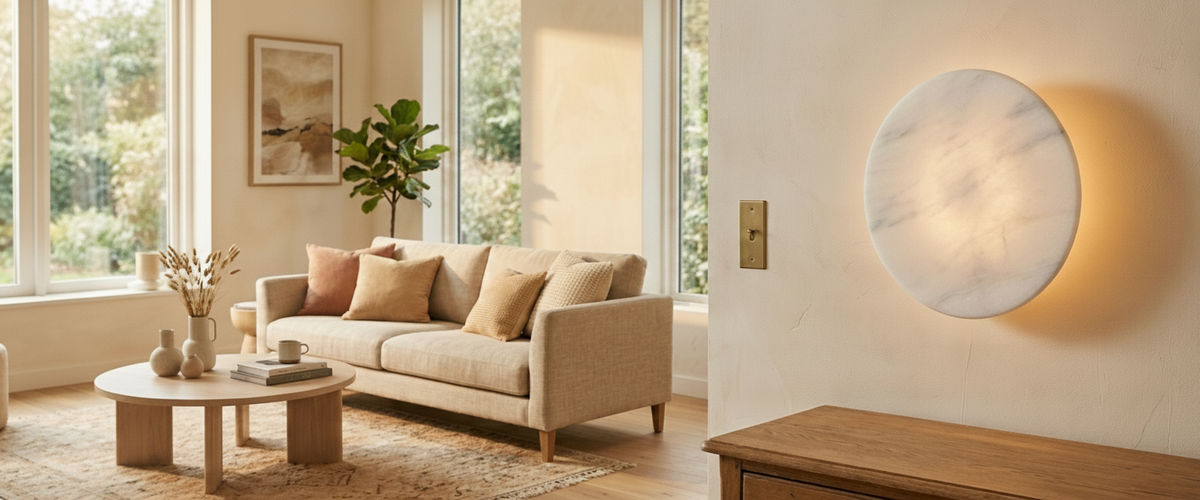
At low output, an alabaster pendant reveals its internal veining.

Quick Answer: What a Dimmer Light Switch Does for Stone Fixtures
It controls glow, not just brightness. A dimmer light switch reveals the internal veining and warms the colour temperature of compatible bulbs.
Match the control to the bulb. A trailing-edge LED dimmer light switch suits modern alabaster fixtures; the old leading-edge type can buzz and flicker.
One circuit, one logic. Decide which fixtures belong on which switch before first fix, not after the plaster is on.
Leave wiring to a qualified electrician. In the UK this is notifiable work under Part P; the switch is simple, the regulations are not.
Test the whole chain. Bulb, driver and dimmer all have to agree before you sign anything off.

What a Dimmer Light Switch Looks Like in Different Rooms
The same control behaves very differently depending on what it is feeding. A single rotary dimmer light switch driving one alabaster wall light in a hallway is a precise, surgical thing. The same module behind a cluster of stone pendants over a kitchen island is doing heavier lifting, balancing several fixtures at once so they dim evenly rather than one lagging behind the others.
In period homes we often see a plate dimmer that needs to suit brass switchgear and visible cabling. In a pared-back new build, a flat screwless plate or a smart keypad disappears into the wall and lets the light do the talking. The fixture sets the brief. A heavy onyx chandelier wants smooth, generous dimming with no visible steps; a small alabaster reading lamp can run off a simpler in-line control. Browse the full range of alabaster lighting and you will notice the pieces that benefit most from a dimmer light switch are the ones with the thickest, most translucent shades.
Scale, Mounting Height and Sightlines
Where you mount the switch matters almost as much as where you hang the light. A control at the wrong height interrupts the wall you spent money styling. Standard practice in the UK puts switches around 900mm to 1200mm from finished floor level, but in a project with a run of stone wall lights you want the plate set so it does not clash with a fixture or a piece of art at eye line.
Think about sightlines from the doorway. The first thing a guest sees should be the glow of the alabaster, not a bank of plates. Group dimmers onto a single multi-gang plate where you can, so one tidy control runs three or four circuits rather than scattering switches along the wall. Where a single switch already feeds the room and you only want a cleaner two-way arrangement rather than dimming, something like the 10AX 1 Gang 2-Way Switch in metal clad keeps the plate restrained against a darker wall. If you are dimming a large statement pendant, position the dimmer light switch where someone can adjust it on the way into the room, not buried behind a sofa.
A multi-gang plate lets each circuit move independently for layered light.
Room-by-Room Placement
Living room. This is where a dimmer light switch earns its keep. Put your alabaster floor lamp and any stone wall lights on separate dimmers from the ceiling fixture so you can drop the main light and lift the corners. The result is layered, lived-in light rather than one flat wash.
Kitchen and island. Task areas need to run bright, but the pendants over an island should dim independently so the room shifts from cooking to dining. A two-gang dimmer plate handles this cleanly: one gang for the worktop downlights, one for the stone pendants. Where two circuits sit side by side and only one needs dimming, a multi-gang plate such as the 10AX 2 Gang 2 Way Switch in metal clad keeps the on/off side tidy alongside the dimmed run.
Dining room. A single dimmer light switch on a marble or alabaster chandelier is the whole game here. Wire it so the lowest setting still reads the veining; nobody wants to eat under a fixture run at full output.
Bedroom. Two-way switching with a dimmer at both the door and the bedside is worth the extra cabling. Alabaster table lamps either side of the bed give a warm base level; the control lets you take the ceiling fixture right down without killing it. For more on building those levels, our guide to layering light in the bedroom walks through which fixtures to put on which circuit.
Hallway and stairs. Wall lights on a dimmer light switch make a long corridor feel calmer at night. If you compare options across the wider lighting collection, the carved stone wall lights are the ones that hold up best at low levels because the material itself is the diffuser.
Bulb Choice, Dimming and Contrast
The bulb decides everything. For alabaster and onyx you want a warm white LED, somewhere around 2700K, with a high colour rendering index so the stone's colour stays honest. A dim-to-warm bulb, which shifts towards amber as you lower it, is the closest thing to candlelight and flatters natural stone better than a fixed-temperature lamp.
Match the bulb to a compatible trailing-edge dimmer light switch. Older leading-edge controls were built for incandescent loads and tend to hum, flicker or refuse to dim low with modern LEDs. The Chartered Institution of Building Services Engineers publishes guidance on lighting quality and flicker that is worth a read if you are speccing a whole house (cibse.org). The short version: cheap bulb plus cheap dimmer equals visible flicker, and flicker is the one fault people feel before they can name it.
Contrast is the other half. An alabaster pendant glows hardest against a darker backdrop. Run it at 40 to 60 per cent over a deep wall colour and the stone looks lit from within. Against bright white walls at full output the effect flattens. The right dimmer light switch gives you that contrast on demand.
Common Placement Mistakes We See
We shipped a pair of onyx wall lights to a client in a converted Victorian terrace who had wired both fixtures and the ceiling light to a single switch. Everything came on together at one level, which defeated the point of having three light sources. The fix was a multi-gang dimmer plate so each circuit moved independently. It is the mistake we see most: too many fixtures bonded to one control.
One switch for the whole room. Split fixtures across separate gangs so you can layer the light.
Forgetting the minimum load. Some dimmers will not run a single low-wattage LED smoothly. Check the minimum load against your bulb wattage.
Leading-edge controls on LED fixtures. A frequent cause of buzz and flicker. Specify a trailing-edge dimmer light switch.
Switch height clashing with a wall light. Set heights against the fixtures, not just the wall.
Running stone at full brightness by default. The whole reason to buy alabaster is the glow you get below maximum.
How to Wire and Fit a Dimmer Switch Safely
The mechanics are simple, the safety is not. A standard one-gang dimmer light switch replaces a single switch: live, switched live and earth into the module, fixed to the back box, plate screwed on. Two-way dimming adds a second control point and an extra conductor. None of that is hard to describe, and none of it should be done live or by an unqualified person.
In the UK, replacing or adding switching is notifiable work under Part P of the Building Regulations in many situations. Use a registered electrician, and ask them to test the full chain (bulb, driver and dimmer) on site before they leave. Electrical Safety First publishes clear homeowner guidance on what counts as competent work and why DIY mains alterations are a false economy (electricalsafetyfirst.org.uk). Treat the switch as the easy bit and the regulations as the part that protects you.
Care and Long-Term Performance
A good dimmer light switch protects your investment. Running alabaster and onyx below full output keeps heat down inside the shade, which is gentler on both the bulb and the stone over years of use. Wipe switch plates with a dry cloth, never a wet one, and keep solvents away from brass and bronze finishes. If a dimmed fixture starts to flicker after a bulb change, the new bulb is almost always the culprit, not the dimmer.