
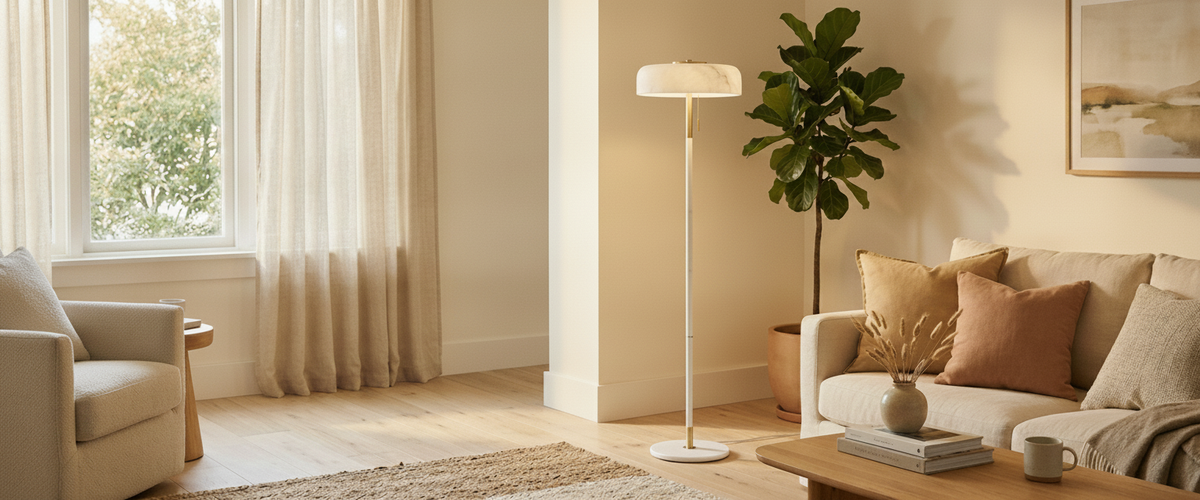

One harsh ceiling pendant, switched on full, is what kills most living rooms. The space looks flat by day and clinical by night, and no amount of new cushions fixes it. The honest answer is that good living room light fixtures work as a set, not a single hero piece. You want light at three or four heights, on more than one switch, with at least one source giving the soft, warm glow you get when light passes through stone rather than bouncing off a bare bulb.
That last point is where alabaster and natural stone earn their place. Backlit, a thin slab of alabaster glows from within and scatters light gently across a room, which is why it has been used in windows and lamps for centuries. The best living room light fixtures lean on exactly this trick.
A layered scheme reads as one family rather than a set of unrelated buys.

Key Takeaways
Layer your scheme: ceiling, wall, table and floor lights on separate circuits, never one fixture doing everything.
Alabaster and onyx diffuse light softly and warm the colour, which flatters skin tones and furniture.
Scale the main fixture to the room, not the table; undersized pendants are the most common buying mistake.
Put everything on dimmers and match bulb colour temperature across the room.
Budget tracks material, size, engineering and finishing, so request a tailored quote rather than guessing.

What Living Room Light Fixtures Means and Who It Is Best For
When people search for living room light fixtures they usually mean the visible, decorative pieces that shape a room: the ceiling pendant or chandelier, wall lights either side of a fireplace or sofa, plus table and floor lamps. These living room light fixtures sit apart from recessed downlights, which are useful but rarely beautiful on their own.
This guide suits anyone furnishing or reworking a sitting room, whether that is a Victorian terrace with high ceilings, a new-build with a flat 2.4 metre (8 foot) ceiling, or a hospitality space that needs to feel calm in the evening. Interior designers and architects specifying for clients will recognise the layering logic; first-time buyers will find it stops them over-spending on the wrong single piece.
How to Compare Living Room Light Fixtures Before Buying
Start with what the room is missing rather than what looks nice in isolation. A bright open-plan room with big windows wants ambient softening in the evening; a dark snug wants gentle pools of light, not a flood. Run through these decision points before you commit any living room light fixtures:
Function: Is the fitting providing general fill, a focal glow, reading light, or wall wash? Each job suits a different type.
Light quality: Bare LED bulbs read cold and clinical. A diffusing material like alabaster softens the source and warms the colour, which matters more in a living room than anywhere else.
Switching: Can it sit on its own dimmer circuit? A scheme on one switch can only ever be all-on or all-off.
Scale: Measure the room, not just the coffee table. More on sizing below.
Maintenance: Natural stone needs a gentle touch; cheap acrylic shades yellow. Know what you are signing up to.
If you want to see how these types differ in person, browsing a focused range helps. The alabaster lighting collection shows the same material worked into pendants, wall lights and lamps, which makes the layering idea easier to picture.
Key Materials, Finishes and Scale Decisions
Material is the single biggest factor in how a living room feels after dark. Alabaster is a fine-grained gypsum stone, slightly translucent, with soft cloudy veining. Lit from behind it gives a warm honeyed glow that no frosted glass quite matches. Onyx is denser and more dramatic, with bolder banding that comes alive when backlit. Marble tends to be used for bases and solid elements rather than shades, since it is largely opaque. Brass detailing pairs naturally with all three and warms up as it ages, which is why stone-and-brass living room light fixtures hold their look for years.
Backlit veining turns each piece into a quiet focal point.
Each slab of natural stone is unique, so two lamps from the same design will never be identical. The Natural Stone Institute has good background on how gypsum and calcite stones behave and why they need careful handling (see naturalstoneinstitute.org). For a living room, that uniqueness is a feature; the veining becomes a quiet focal point when the light is on.
Getting the Scale Right
The most common mistake we see is a pendant chosen to suit a coffee table and then drowned by the room around it. A rough working method: add the room's length and width in feet, and that figure in inches is a sensible diameter for a central fixture. A 14 by 16 foot room (about 4.3 by 4.9 metres) suggests a piece around 30 inches (76 cm) across. Adjust down for a busy room, up for a minimal one.
Hanging height matters just as much. Over a coffee table or console, keep the bottom of a pendant high enough to clear sightlines across the room, usually well above head height when standing. In a room with a low ceiling, a flush or semi-flush alabaster ceiling light gives you the glow without stealing headroom.
Where to Place Living Room Light Fixtures for the Strongest Visual Impact
Think of the room in zones and give each one its own light. Spread your living room light fixtures across these layers:
Ceiling: Your main living room ceiling light or chandelier sets the tone. Alabaster pendants soften the overhead glare that plain fittings throw down. Centre it on the seating area, not always the geometric middle of the room.
Walls: A pair of alabaster wall lights either side of a fireplace, artwork or the sofa adds height and symmetry. Wall washers carry light up and out, which makes a low room feel taller.
Table: A table lamp on a side table or console gives the warm, eye-level pool that makes a room feel lived-in. This is the layer people forget and then wonder why the room feels stark.
Floor: A stand light in the living room, set behind a reading chair or in a dim corner, fills the gaps the other layers miss. An alabaster floor lamp doubles as a sculptural object by day.
One client in a double-height sitting room had relied on recessed spots for years and found the room cold every evening. We layered a large alabaster pendant over the seating, wall lights flanking the chimney breast and a single floor lamp in the far corner, all dimmable. The recessed downlights now rarely go above half; the stone does the heavy lifting and the room finally feels warm after dark.
For browsing across types rather than one material, the full lighting range lets you compare pendants, wall lights and lamps side by side before you settle a scheme. If you want the layering logic applied room by room across the house, our lighting guides walk through the same approach in more detail and cover plenty of living room lighting ideas.
Bulbs and Dimming
Get the bulbs right or the best fitting will still disappoint. For living rooms, choose a warm white in the region of 2700K; anything cooler reads like an office. Keep colour temperature consistent across every living room light fixture in the room, or your careful layering will fight itself. Use dimmable LEDs and dimmer switches rated for them, since an underrated dimmer causes flicker and buzz. The Chartered Institution of Building Services Engineers offers solid technical guidance on lighting levels and quality for those who want the detail (cibse.org).
Budget, Quality and Delivery Considerations
Price for natural-stone lighting tracks several things at once: the material and its rarity, the size and weight of the piece, the engineering inside it, the finishing of the metalwork, and any installation. A hand-carved onyx chandelier is a different proposition from a small alabaster table lamp, so a single price band across living room light fixtures would be misleading. We would always rather give you a tailored quote against your actual room and shortlist than quote a vague range that helps no one.
On quality, look for stone that is properly sealed and mounted, brass that is solid rather than plated where it takes wear, and wiring that meets the standards for your market. Real alabaster carries faint colour variation and natural inclusions; a perfectly uniform "stone" shade is usually resin. Shipping heavy stone pieces worldwide needs proper crating, and for anything hard-wired we would always recommend a qualified electrician handles the final connection.
How Niori Can Help With Lighting Projects
Niori specialises in alabaster and natural-stone lighting: pendants, chandeliers, wall lights, table lamps and floor lamps designed around the warm, diffused glow that stone gives. For a single room or a whole-house scheme, we can help you balance the layers, match scale to your ceiling height, and pull together living room light fixtures that read as one family rather than a set of unrelated buys. The same set of living room light fixtures, planned this way, lifts both a quiet snug and a double-height space. Start from the Niori homepage to see the range, then send through your room dimensions and a rough brief for a considered recommendation.
Good living room lighting is quiet work, and the right living room light fixtures do it without showing off. When it is right, nobody points at the fittings; they just notice the room feels better to be in. That is the standard worth aiming for.