
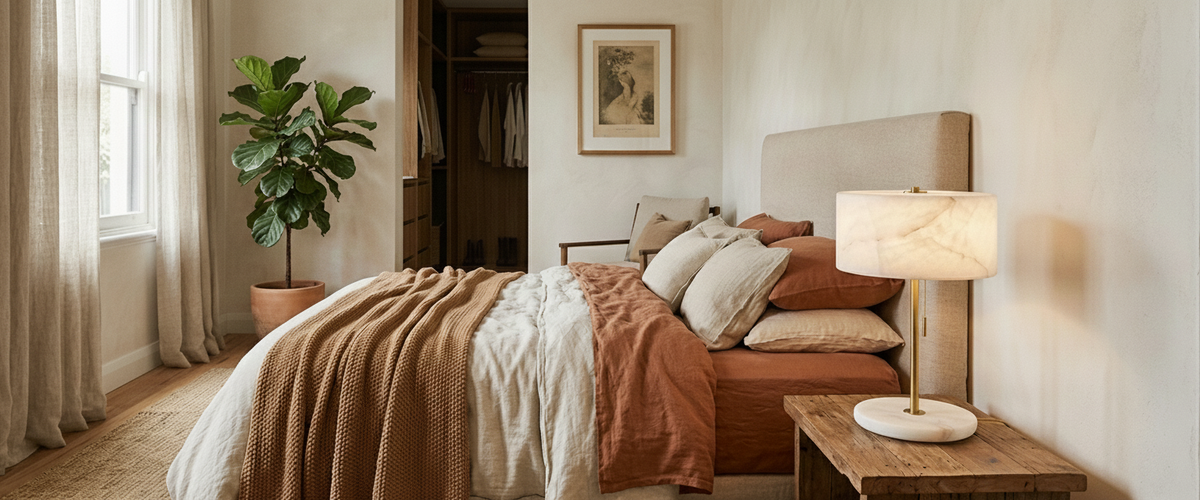

The best led lights for bedroom calm should warm a room rather than flood it with the kind of clinical glare you feel before you can name it. The light is technically bright, the room is technically lit, and yet it feels like a waiting room. This guide shows how to choose led lights for bedroom spaces that hold onto warmth, covering color temperature, CRI, layering, and where soft natural materials do the quiet work. The most common mistake we see is shoppers chasing lumens and forgetting that a bedroom is the one room where light should help you slow down, not snap to attention. Get it right and the gain is less about spending more, more about three numbers and a few smart fixture choices.
Alabaster is unusually good at this, which is why so much of what we make at Niori starts there. The best led lights for bedroom use hide their source and show only the glow.
A warm alabaster lamp turns raw LED output into soft, even light.

Key Takeaways
Aim for warm color temperatures around 2700K, not the 4000K to 5000K of an office.
Look for a CRI of 90 or higher so skin and stone keep their natural depth.
Layer ceiling, bedside and wall sources rather than relying on one fixture.
Put dimming within reach of the bed; a single bright ceiling switch is no use at 11pm.
Alabaster and natural-stone shades turn raw LED output into a soft, even glow.

The Clinical-Glow Trap
Cool white LEDs are everywhere because they are cheap to make and look punchy in a showroom. As led lights for bedroom use they backfire. Light in the 4000K to 5000K range carries a blue-leaning quality that the body reads as daytime, which is the opposite of what you want as you settle for sleep. Cooler, brighter light in the evening can suppress melatonin and delay the wind-down your bedroom is supposed to support.
The fix is not complicated. Warm color temperatures, lower output, and several softer sources beat one cold ceiling fixture every time. The trouble is that most bedroom lights and bedroom light fixtures are sold on brightness alone, so it pays to read the spec sheet rather than the marketing.
The Numbers That Flatter, Not Flatten
Two figures matter most. Color temperature, measured in Kelvin, tells you how warm or cool the light looks. When you choose led lights for bedroom calm, 2700K is the comfortable default; 3000K works if you want a slightly crisper feel near a dressing area. Anything above 3500K starts to feel office-like.
The second is CRI, the color rendering index, a score out of 100 that measures how truthfully a light shows color. Cheap LEDs often sit around 80, which quietly grays skin tones and flattens the veining in marble or onyx. Look for CRI 90 or higher. It is the difference between alabaster glowing like warm honey and looking like a dull plastic shade. High color rendering genuinely changes how a space feels, and a bedroom is where that shows most. This is one number where good led lights for bedroom use quietly justify their price.
If you want flexibility, CCT (color-changing temperature) fixtures let you shift from a warmer evening tone to a cooler morning one. Useful near a wardrobe or vanity; less essential over the bed, where warm and dimmable is usually all you need.
Layering: Stop Asking One Light to Do Everything
The single biggest upgrade to any bedroom is splitting the lighting into layers so no fixture has to carry the whole room. Good bedroom lighting works in three roles.
Ambient: a gentle overall wash, often a ceiling light. This sets the base level.
Task: reading light at the bedside, focused enough to read by without waking your partner.
Accent: wall lights, a low lamp, or hidden strips that add depth and shadow.
For the ceiling layer, a dimmable LED semi-flush or flush fitting suits standard ceiling heights without dominating the room. Where you want the warm wash without a hard downlight effect, a piece like the Nur Dimmable LED Semi-Flush Ceiling Light at 3000K sits closer to the right design language for an ambient base. Many buyers reach for bedroom ceiling lights in polished or aged brass because the warm metal sits well against soft white walls and reads calmer than chrome; the compact, low-profile Welland LED Flush Ceiling Light in aged brass is a good example of keeping the output modest rather than treating the ceiling like a kitchen island. When you compare lights ceiling bedroom options against ceiling lights for bedroom schemes, the test is the same: warm, dimmable, and never doing the whole job alone. If you have a higher ceiling, a small chandelier or a single statement pendant can replace the flush fitting, but keep the mood low. Layered well, these led lights for bedroom use never compete with each other.
Layering ceiling, bedside and accent sources keeps any one fixture from doing all the work.
You can browse the full spread of pendants, wall lights and ceiling fittings across the niori lighting collection to see how the layers work together before committing to any one piece.
Dimming From the Bed: The Detail Everyone Forgets
A beautiful warm fixture is wasted if the only switch is by the door. The most common complaint we hear after install is exactly this: the lighting is lovely, but you have to cross a cold floor to turn it down. Plan dimming and switching from where you actually lie. The best led lights for bedroom use are the ones you can soften without getting up.
Practical options that work well:
Dimmable bedside lamps with an inline or touch dimmer, so each side controls its own light.
A two-way dimmer on the ceiling circuit, with one switch at the door and one at the bed.
Smart bulbs or a smart dimmer module if you want app and voice control, set to a warm scene for evening.
One caution worth repeating: LED dimming only works if the bulb, the fixture and the dimmer are compatible. Trailing-edge dimmers suit most modern LEDs; older rotary dimmers can cause flicker or buzz. If you are changing wiring or adding circuits, use a qualified electrician rather than guessing. Electrical Safety First has clear guidance on when work needs a professional.
Where Alabaster Bedside Lamps Earn Their Place
This is where natural stone quietly outperforms everything else. A bare LED is a hard point of light. Push that same diode through a carved alabaster shade and the stone scatters it into a soft, even glow with no harsh hotspot. The faint veining picks up the warmth and gives the light a depth that frosted glass never quite manages. Few led lights for bedroom calm do this as well.
For a bedside table, an alabaster table lamp on a brass base does two jobs at once. Low and warm, it works as ambient light for the room; positioned beside the headboard, it gives enough to read by without glare bouncing off the page. We shipped a pair to a client in Surrey converting a loft into a main bedroom, and the brief was simply "nothing that feels like a hotel corridor". Two alabaster lamps and a single dimmable brass flush fitting did the entire room; no downlights at all.
If you want to compare carved shades, bases and finishes, the alabaster lighting collection is the clearest place to see how stone handles your led lights for bedroom use. Marble and travertine pieces behave similarly, reading a touch more opaque and architectural, which suits a wall fitting better than a shade.
Wall Lights and Sconces: Free Up the Bedside Table
If your nightstand is small, or you simply dislike clutter, a sconce light fixture bedroom mounting by the bed is the elegant answer. Wall-mounted reading lights at roughly shoulder height when seated keep the surface clear and throw light exactly where you read. These are some of the most space-efficient led lights for bedroom use you can fit. Where you want soft diffusion rather than a hard beam beside the headboard, a round stone fitting such as the Torello LED Round Travertine Wall Light gives the same gentle glow as an alabaster shade, with the bonus of a sculptural daytime presence.
For symmetry, wall lights for bedroom schemes usually work best in pairs flanking the headboard. Allow space so the light falls onto the page rather than into your eyes, and put each on its own switch or dimmer where you can.
Hidden LED Strips: Luxe Versus Budget
Concealed strips can look genuinely refined or distinctly cheap, and the difference comes down to where the light source hides. The rule is simple: you should see the glow, never the diode. As accent led lights for bedroom calm, strips tucked behind a headboard, above a wardrobe pelmet, or under a floating bedside shelf wash the wall with soft indirect light and read luxe. Strips stuck along an exposed edge where you can count the dots read budget every time.
Choose a warm 2700K strip with high CRI, run it on the same dimmer logic as the rest of the room, and use a diffuser channel to smooth the output. Treat strips as accent only; they support the alabaster lamps and ceiling fitting, they do not replace them.
A Quick Buyer's Checklist
Color temperature 2700K to 3000K for the main bedroom layers.
CRI 90+ so skin and stone keep their warmth.
At least two layers: ceiling plus bedside, ideally with accent.
Dimming reachable from the bed.
LED, fixture and dimmer confirmed compatible.
Alabaster or stone shades to soften any direct LED.
Hidden strips concealed so the source never shows.
What It Costs
Pricing for natural-stone lighting depends on the material, the size of the carved piece, the complexity of the fitting, and the metalwork and finishing involved. When you cost out led lights for bedroom calm, a small marble wall light and a large carved alabaster pendant sit at very different points for good reason. Rather than quote a band that would mislead, we suggest requesting a tailored quote for the specific pieces and room you have in mind.
Get the color temperature, the layers and the dimming right, and your led lights for bedroom use stop feeling lit and start feeling restful. That is the whole job. Everything else is detail.