
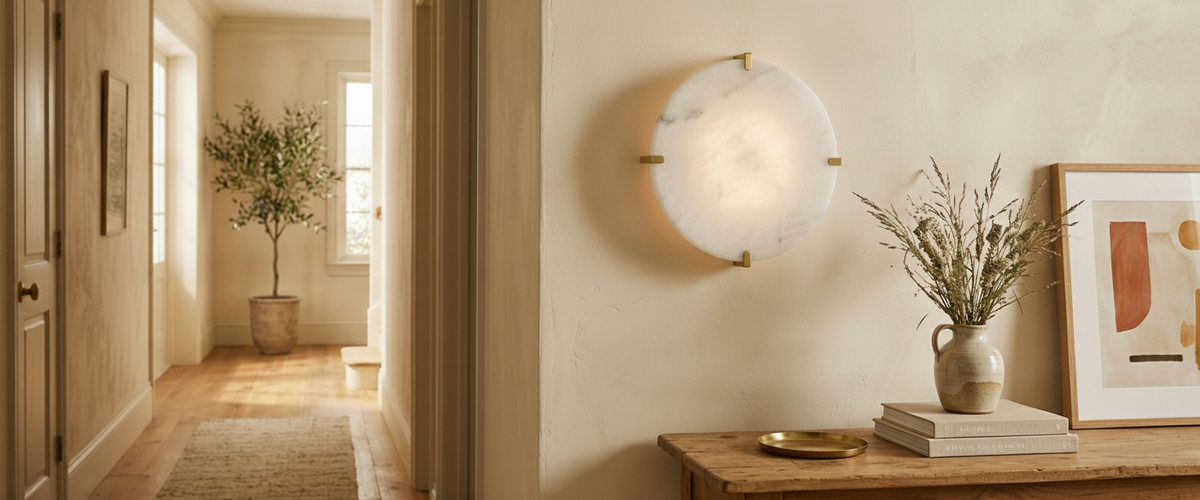

Drop a single pendant in the middle of a hall and you've built a tunnel. The light pools under the fitting and falls off fast, so you walk from a bright patch into gloom at each end, then back again. It looks worse the longer the run is. Good hallway lighting is really a problem of distribution, not of finding one handsome fixture and hoping it carries the whole space.
That's where the material does quiet work in your hallway lighting. Alabaster and natural stone diffuse light from the inside, so a hall lit with them feels filled rather than spotlit. Before we get to fittings, here's the short version.

Key Takeaways
- A hall needs even light along its length, so plan for two or more light sources, not one central fitting.
- Map where light has to land (front door, stair, doorways, art) before you choose how it looks.
- Flush or semi-flush ceiling fittings suit standard ceilings; a rhythm of wall sconces suits long, narrow runs.
- Alabaster softens the glare a glossy hall throws back, which matters on painted walls and polished floors.
- Light the turn, the landing and the stair change, not just the floor underfoot.
- Dark halls with no natural light want layered, warm sources and reflective surfaces, not one brighter bulb.

Reading the Run Before You Choose the Fixture
Walk your hall slowly and notice where you actually need to see. The threshold by the front door, where keys and post land. The foot of the stairs. Each doorway you pass. A console or a piece of art. These are the points your hallway lighting should reach; the fitting is just the delivery method.
A short, square entrance hall behaves differently from a long landing corridor. We shipped a pair of alabaster wall lights to a Georgian terrace in Bath where the owner had one pendant fighting a four-metre (roughly 13-foot) run. Adding sconces at the two-thirds points killed the dark ends completely, and the original pendant went from working alone to being purely decorative. That's the usual fix: stop asking one fitting to do three fittings' work.
Measure the length and the ceiling height before you spend anything on hallway lighting. Under about eight feet (2.4 metres), pendants intrude and you'll knock taller guests' eyeline. Above that, you have room to hang something with presence. You can browse fixture types by form across the full lighting collection once you know whether you're working in width or height.
Hallway Ceiling Lights Versus a Rhythm of Wall Sconces
Two honest routes exist for most halls, and they suit different shapes. Both are sound hallway lighting ideas once you've read the run.
Flush and Semi-Flush Ceiling Fittings
For standard ceilings, hallway ceiling lights that sit close to the plaster keep the headroom clear and throw light down the run. A flush alabaster fitting reads as a soft glowing disc rather than a hard downlight, which is the point. On a longer hall you'll want two or three spaced evenly, not one in the geometric centre. The spacing is what removes the tunnel effect; a rule of thumb is to keep gaps roughly equal to or a little less than the ceiling height so the pools of light overlap.
Recessed can lights in the hallway work too, and plenty of clients ask about them. They're tidy and unobtrusive, but bare LED cans can feel clinical and they cast hard shadows on faces. If you go that way, pair them with at least one stone or alabaster fitting so your hallway lighting has a warm anchor and isn't all flat downlight.
A Run of Wall Lights
For a long, narrow hall, hallway wall sconce lighting often beats anything overhead. Mounted at roughly five and a half feet (around 1.7 metres) to the centre of the fitting, sconces wash light up and down the wall and lead the eye along the corridor. The rhythm itself does the decorating. Alabaster sconces are kind here because the stone glows rather than glares, so you don't get hotspots bouncing off a glossy painted wall as you pass.
You can run sconces alone or alongside a single restrained ceiling fitting. This layered approach to hallway lighting gives you a low, ambient layer plus an accent layer, which is what stops a hall feeling like a service corridor.
How Alabaster Kills the Glare a Glossy Hall Throws Back
Halls are often the most reflective rooms in a house: eggshell or gloss paint, a mirror by the door, a polished or tiled floor. Put a bright, clear bulb into that and the surfaces throw it straight back at you. Alabaster solves this at the source, which is why it makes such forgiving hallway lighting. Light passes through the stone and scatters across its internal structure, so what reaches the room is already soft and even.
The effect is the same warmth that drew people to translucent stone centuries ago. Alabaster has been carved into windows and lamps since antiquity precisely because it passes a gentle, honeyed light; the mineral properties of alabaster make it soft enough to work finely and translucent enough to glow. Each piece carries its own veining, so no two fittings light a wall in quite the same way. You can see how that translucency reads across pendants, sconces and flush fittings in the alabaster lighting range.
Natural stone and marble behave similarly but with more body; thicker pieces hold more shadow and give a slightly moodier wash, which can suit a darker, more formal hall.
Stairwells and Turns: Light the Change of Direction
Stairs and turns are where bad hallway lighting becomes a safety issue, not just an aesthetic one. The eye needs to read each tread and each change of level, and a single light at the top or bottom leaves the middle in shadow. Light the change of direction itself.
For a turning stair, a pendant dropped into the void of a double-height stairwell lights the whole vertical run and gives you one piece of presence to look up at. An alabaster pendant or a small stone chandelier works well because the glow is visible from above and below without a hard bulb glaring into anyone's eyes on the landing. Where there's no void, stagger wall sconces so your stairwell hallway lighting gives each turn and the landing its own pool of light.
Keep brightness consistent between the hall and the stair. A sharp jump from bright corridor to dim stairwell makes the steps harder to read, not easier. Aim for an even, warm level throughout, with the pendant or sconces as accents rather than the only working light.
Three Habits That Keep a Hall Feeling Like a Corridor
These are the hallway lighting mistakes we see most often when buyers send us photos of a hall that isn't working.
- One central fitting, nothing else. It guarantees bright middle, dark ends. Split the light into two or more sources spaced down the run.
- Cold, glary bulbs. A hall is a transition space and wants warmth. Aim for a warm colour temperature around 2700K and put the fittings on a dimmer so you can drop the level at night without changing bulbs.
- Ignoring the walls. Overhead light alone flattens a hall. A sconce or a low table lamp on a console gives the vertical surfaces something to catch, which is what makes the space feel furnished rather than purely functional.
Lighting a Dark Hall With No Natural Light
Windowless halls are common in flats and terraces, and the instinct to fit one very bright light usually backfires; it creates a hard, shadowed box. Layer your hallway lighting instead. Combine a soft ceiling fitting with sconces or a console lamp so light comes from several heights. Keep wall colours light and use a mirror to bounce what light you have. Warm alabaster sources read as inviting in a way a single cool downlight never will, because the glow fills the space rather than spotlighting one patch of floor.
A Quick Buying Checklist
- Measure first: length, width and ceiling height decide pendant versus flush versus sconce.
- Count your light points: aim for even coverage end to end, not one centred fitting.
- Pick warm and dimmable: around 2700K on a dimmer suits a transition space.
- Choose stone for glare control: alabaster and marble diffuse rather than reflect.
- Light the stair and turns: treat changes of level as their own zones.
- Use a qualified electrician for any new fixed wiring or added circuits.
Niori works only in alabaster and natural stone, so every fitting we make is designed to give the soft, even, glare-free hallway lighting a hall needs from end to end. Budget depends on material, scale, fixture type and finishing, so for a hall with specific dimensions or an awkward run, request a tailored quote and we'll talk it through.