
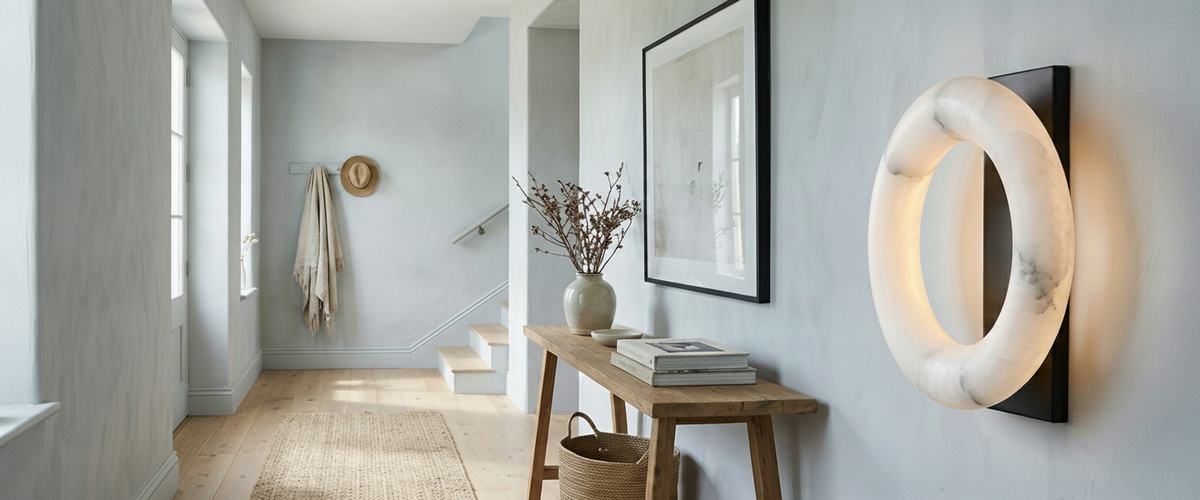

Most halls are lit by a single fitting hung halfway along the ceiling, and then the homeowner wonders why the far end sits in shadow. A corridor is the one space in the house where light has to travel, and a lone pendant simply cannot reach both ends with any grace. Getting your hallway lighting right is less about one hero piece and more about how you space hallway light fixtures for warmth and finish across the whole run.
That is where alabaster earns its place. The stone diffuses light from the inside out, so a fitting reads as a soft glowing object rather than a hard point of glare you walk straight into. In a tight hall, that difference is felt every single day, and it is why so many hallway light fixtures in stone outperform a cheap glass shade.
Two spaced fittings light a long hall far more evenly than a single central pendant.

Key Takeaways for Hallway Lighting
One central ceiling fitting almost always leaves dark patches. Plan for two or more light sources along the run.
Read the shape of your hall first. Low, double-height, and long-narrow halls each want a different fixture type.
Wall sconces often beat a line of downlights for halls under about 4 feet (1.2 metres) wide.
Warm bulbs (2700K) on a dimmer set the welcoming tone an entrance needs.
Match metal and stone tones to your skirting, door furniture, and floor so the hallway light fixtures feel built in, not added on.

Why a Single Ceiling Fitting Leaves Dark Patches
Light falls off quickly with distance. A pendant centred in a 16-foot (5-metre) hall pushes plenty of light to the middle and very little to either end, so the doors at each end sit in gloom while the centre glares. Add a few coats and a console table and the shadows deepen further.
The fix is rhythm. Two or three modest fittings spaced down the run give you even pools of light with no harsh fall-off between them. Alabaster ceiling lights help here because their stone bodies spread a wider, gentler wash than a bare downlight, so you can use fewer of them and still avoid scalloped shadows on the walls. When you plan hallway light fixtures this way, the whole corridor reads evenly. Browse the full range of alabaster pieces in our alabaster lighting collection to see how the stone handles that diffusion.
Read Your Hall First: Low, Double-Height, or Long and Narrow
Before you choose anything, look at the volume you are working with. The right hallway light fixtures depend on it.
Low ceilings. If your ceiling sits below about 8 feet (2.4 metres), avoid anything that hangs. Flush or semi-flush alabaster ceiling lights keep headroom clear and still throw a warm glow. A slim carved disc or a low-profile dome in alabaster reads as architecture rather than an obstacle.
Double-height entrances. A stairwell or galleried landing can carry a longer pendant or a small chandelier. This is the one place in a hall where scale pays off; a piece dropping into the void anchors the space and lights the stairs below. Keep the lowest point well clear of any walking line.
Long and narrow. The classic terraced-house corridor. Here a row of ceiling fittings can feel like an airport jetway. Wall sconces, or a mix of one ceiling light plus sconces, usually feel warmer and more human. Spacing two sconces down the wall lights the run evenly without lowering the visual ceiling, which a single overhead fitting rarely manages in a tight Victorian hall.
Alabaster sconces wash the walls upward, lifting a narrow hall without crowding the ceiling.
Where Wall Sconces Beat a Row of Downlights
Downlights along a wall can graze it nicely, but in a genuinely narrow hall they often light the floor in tight circles and leave faces and pictures dim. Hallway wall sconce lighting throws light outward and upward, washing the wall and lifting the whole corridor. As hallway light fixtures go, sconces are often the quietest win in a tight space.
Reach for sconces when:
The hall is under roughly 4 feet (1.2 metres) wide, where ceiling fittings feel cramped.
You want light on artwork, a mirror, or a console rather than on the floor.
You are working around beams, hatches, or sloped ceilings that make ceiling positions awkward.
Alabaster sconces are particularly forgiving because the stone glows softly rather than producing a hard bright edge, so two facing each other across a hall will not dazzle anyone passing through. For a wider mix of ceiling and wall hallway light fixtures across rooms, our main lighting collection is a good place to compare forms side by side.
Mounting Height and Spacing That Keep Sightlines Clean
Get the geometry right and the fittings disappear into the room in the best way. Even the best hallway light fixtures fail if they sit at the wrong height.
Sconce height: mount the centre of the light around 60 to 66 inches (1.5 to 1.7 metres) from the floor. That keeps the source near eye level without shining into anyone's face.
Sconce spacing: 8 to 10 feet (2.4 to 3 metres) apart along the run gives even pools without dark gaps. Two sconces suit most standard halls; three for a longer hall.
Ceiling fittings: if you must use several, space them so their pools of light just overlap. Centre them on the walking line, not tight to one wall.
Pendants in a stairwell: keep the lowest point at least 7 feet (2.1 metres) above the highest tread you can stand on.
One practical tip from the studio: mark proposed positions in painter's tape before drilling, then walk the hall morning and evening. You will spot a clash with a door swing or a picture frame far cheaper on tape than on plaster.
Bulb Warmth and Dimming for an Entrance That Says Welcome
A hall is the first and last thing you see each day, so the light should feel hospitable rather than clinical. Choose lamps around 2700K. That warm-white tone flatters skin, woodwork, and the natural cream of alabaster, and it keeps the stone's veining looking soft rather than blue.
Put your hallway lighting on a dimmer wherever you can. Bright for arriving with shopping or showing guests in; low and amber for the last trip upstairs at night. Pair LED lamps with a trailing-edge dimmer rated for LED loads to avoid flicker, and ask for high-CRI lamps (90 or above) so colours stay true. Any new wiring or fixed fitting should be installed by a qualified electrician; the guidance from Electrical Safety First is worth a read before you start.
Tying Finishes to Skirting, Door Furniture, and Floor Tone
Hallway lighting ideas often fail at the last step: the fitting is lovely but its metal fights everything else in the hall. Tie the finish to what is already there.
Match the metal on your sconces or ceiling lights to your door handles, hinges, and switch plates. Brass against brass, brushed nickel against chrome. If your skirting and architraves are painted a soft white, a cream alabaster body sits quietly against them; against darker panelling, the glowing stone stands out beautifully. Read the floor too. Warm oak boards and a warm bulb sing together; cool grey stone floors can take a slightly crisper light, though I would still stay on the warm side of neutral in an entrance. Coordinated this way, your hallway light fixtures look chosen rather than left over from the previous owner.
Alabaster is a natural stone, so expect gentle variation in colour and veining from piece to piece. That is part of its character rather than a flaw, and it is exactly why a stone fitting feels grounded in a period hall in a way a moulded glass shade rarely does.
A Quick Buyer's Checklist
Count your light sources: one fitting per long hall is rarely enough.
Decide ceiling, wall, or a mix based on width and ceiling height.
Confirm headroom: flush fittings for low ceilings, hanging pieces only in double-height space.
Set sconce centres around 60 to 66 inches (1.5 to 1.7 metres) high, 8 to 10 feet (2.4 to 3 metres) apart.
Specify 2700K, high-CRI, dimmable LED lamps on an LED-rated dimmer.
Match metal finish to door furniture and switch plates.
Book a qualified electrician for any fixed installation.
Cost depends on material, scale, fixture complexity, engineering, and installation, so the most useful next step is to request a tailored quote rather than work from a guessed figure. Tell us the length, width, and ceiling height of your hall and we can point you to hallway light fixtures that will light it evenly, end to end. The right hallway light fixtures pay you back every time you walk through.