
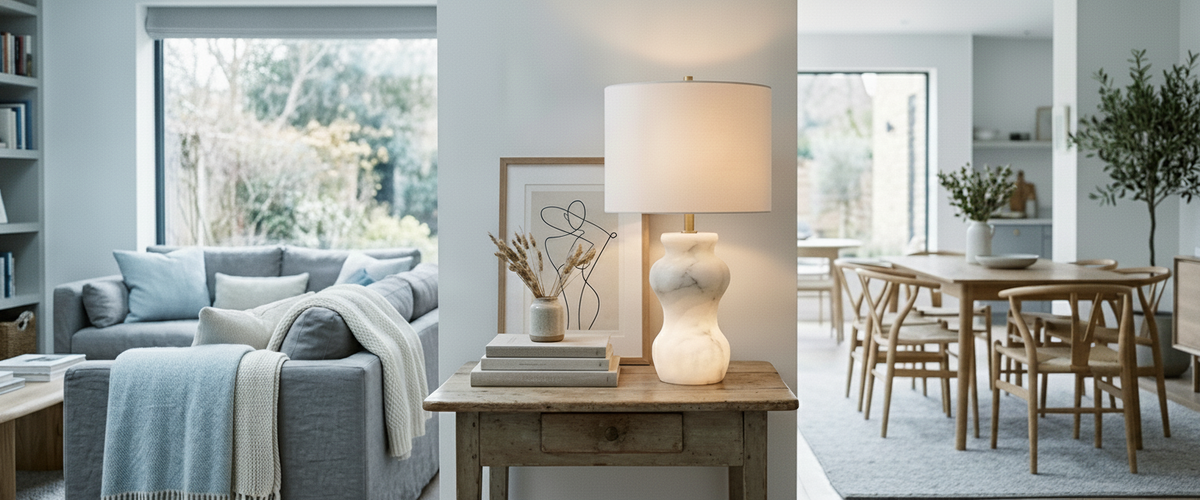

The word 'designer' does a lot of work on a price tag, and most of it goes unchecked. Designer table lamps should buy you considered proportion, honest materials, and a light quality that flatters a room rather than spotlighting it. Too often the word just buys you a name and a markup. The difference between honest designer table lamps and dressed-up ones shows up over years, not in the first week, which is exactly why it pays to know what you are looking at before you commit.
At Niori we make alabaster and natural-stone lighting, so we spend a lot of time with the part of a lamp most shoppers skip: the way stone diffuses light and the way a base feels in the hand. That perspective shapes the advice below. Whether you are specifying designer table lamps for a client or buying one good lamp for your own console, the criteria are the same.
An alabaster base becomes part of the light source rather than just a stand for it.

Quick Answer: What a Designer Table Lamp Should Buy You
Material that ages well: solid stone, kiln-fired ceramic, or properly finished metal that gains character instead of looking tired.
Proportion that holds: a base-to-shade ratio that suits the surface it sits on, not a generic pairing.
Light you want to sit under: a shade that softens output rather than throwing glare.
Build you can feel: weight, balance, clean seams, and a switch that operates without wobble.
A reason for the price: engineering, finishing, and material, not just a label.

The Word 'Designer' Decoded
Designer should describe a process, not a sticker. A genuine piece starts with intent: someone decided how light leaves the shade, how the base anchors the form, and how the two relate at the height people actually see them. That intent is what you pay for in real designer table lamps. A lamp that simply borrows a fashionable silhouette and bolts on a cheap socket is wearing the word like a costume.
Here is the honest test. Ask what changes if you remove the brand name. If the answer is 'the price', be skeptical. If the answer is 'the casting, the finish, the dimming behavior, and the way the stone was selected', you are looking at real table lamps design. Browse our wider lighting range and you will notice the designer table lamps that read as designed share a quiet consistency between base and shade rather than a loud gesture.
Material Honesty: How Bases Hold Value Over Years
Material is where these lamps quietly succeed or fail. The base does two jobs: it grounds the lamp visually and it carries weight so the thing does not tip. Three families dominate the better end of the market, and each behaves differently with time.
Stone, including alabaster, marble, and onyx. Solid stone has mass, so the lamp sits with confidence and resists knocks. Alabaster has an extra trick that ceramic and metal cannot copy: it is mildly translucent, so a lit base glows softly rather than going dark. That warm, internal light is the reason designers reach for it, and it is the defining quality of an alabaster table lamp like the Axis 1 Light Alabaster Table Lamp, where the stone itself becomes part of the light source rather than just a stand for it. Each block carries its own veining, which means no two designer table lamps are identical. The Natural Stone Institute notes that alabaster is a relatively soft stone, so it wants gentle handling and protection from standing water, but treated sensibly it lasts for generations (naturalstoneinstitute.org).
Ceramic. Kiln-fired ceramic holds glaze color beautifully and resists fading. The risk is hollow, lightweight castings dressed up to look solid. Lift before you trust.
Metal. Brass and bronze develop a patina that many buyers prize; lacquered finishes stay bright but can chip. The question to ask is whether the metal is solid or plated over something softer, because plating wears at the points your hand touches most.
If you want the glow as well as the mass, our alabaster lighting collection is built around exactly that quality of stone, including circular and column designer table lamps with brass detailing.
Base-to-Shade Proportion, and Why Getting It Wrong Sinks a Lamp
Proportion is the fastest way to spot a lamp that was costed rather than designed. A heavy stone base under a mean little shade looks top-light and unfinished. An oversized shade on a slim stem looks like a hat two sizes too big. Get this wrong and even an expensive lamp reads as a mistake.
On a column base, a taller, narrower shade flatters the vertical line.
A practical starting point: the shade width should sit close to the height of the base it tops, and the shade should hide the bulb and socket completely when you stand at normal eye height. On a column lamp, a taller, narrower shade usually flatters the vertical line, which is part of why the Caldrin Stone Column Table Lamp pairs its upright base with a restrained shade rather than a wide drum. On a rounded alabaster table lamp, a fuller drum shade tends to balance the curve. These are guides, not laws, but they save you from the worst pairings.
One studio lesson worth passing on. We had a client in a Surrey conversion who loved a marble base but kept defaulting to a shade that was too tall, which left a dark gap of stem and made the lamp look severe. Dropping the shade by a couple of inches (around 5 cm) closed the gap, let the marble read as the hero, and the lamp suddenly looked twice its price. Proportion did that, not money. Good table designer lamps live and die on this detail.
Console, Bedside, or Desk: Where a Designer Lamp Earns Its Footprint
A lamp like this should suit its surface, not just the room. The footprint and light spread change what works, and the best designer table lamps are chosen for a spot, not bought on impulse.
Console and entryway. This is the showcase spot. A sculptural alabaster or marble base does real work here because it is seen up close and from across the hall. A striped marble base such as the Arvella Striped Marble Table Lamp suits this position, since its veining gives the eye something to read even when the lamp is switched off, which a console light often is for much of the day.
Bedside. Function leads. The shade needs to throw light downward for reading without glaring at your partner, and the switch must be easy to find in the dark. Matched pairs read as deliberate; a single bedside lamp can look like the budget ran out. Keep the base footprint modest so you still have room for a glass of water and a book.
Desk and study. Here you may want directional light, so an adjustable arm or a focused shade beats a soft glow. A weighted stone base stops a working lamp drifting as you reach past it. If the desk doubles as a video-call backdrop, a warm alabaster table lamp behind you reads far better on camera than overhead light.
Light Quality Over Looks: Shade Translucency and the Right Bulb
A lamp can look perfect and still light a room badly. The shade and the bulb decide what you actually live with at night, and this is where designer table lamps separate from their cheaper imitators.
Translucency is the variable most people ignore. A dense shade pushes light up and down in two pools. A translucent shade, or a lit alabaster base, releases a soft ambient wash that fills the space without harsh edges. For relaxed rooms, that diffuse glow is the goal; for a working desk, you may want the more contained pools instead.
For the bulb, choose warm white around 2700K for living spaces and bedrooms, where comfort matters more than crispness. Aim for a color rendering index (CRI) of 90 or above so skin tones and timber finishes look true; the Lighting Research Center has long made the case that high CRI is worth prioritizing for spaces people inhabit (lrc.rpi.edu). If you want to dim, confirm the lamp and bulb are both dimmable and pair them with a compatible LED dimmer, because a mismatch causes the flicker and buzz that ruins an otherwise lovely lamp. Where any rewiring is involved, use a qualified electrician.
Tells of Real Craft You Can Check by Hand
Before you buy, the lamp will tell you the truth if you handle it. Run through this quick checklist on any designer table lamps you are weighing up:
Weight and balance: lift it. Quality stone and metal feel reassuringly heavy, and the lamp should not feel keen to tip when you press the top edge.
Seams and joins: look where parts meet. Clean, flush joins say care; visible glue lines or rough transitions say corner-cutting.
The switch: operate it several times. A good switch is firm and quiet, with no wobble in the socket.
Cable and finish: braided or well-dressed cable and a neatly finished base feel considered. A thin, kinked flex undermines the whole piece.
Stone surface: on alabaster or marble, the veining should run as a feature, and the surface should feel smooth and sealed, not chalky or dusty.
Underside: turn it over. The base of a lamp is where shortcuts hide. Felt pads, a tidy cable exit, and a stable foot all signal a maker who cares.
You will not always get to do all of this when buying online, which is where clear photography of the underside, the join, and the switch matters. Many designer lamp tables sold by name skip those shots entirely. Ask the retailer for those images if they are missing. A specialist will have them, and a good table lamp designer is proud to show the underside.
How to Choose the Best Designer Table Lamp
Pull it together with a simple decision order. First, fix the surface and the job: ambient glow for a console, readable light for a bedside, focused light for a desk. Second, choose the material that suits both the look and the wear it will take. Third, settle proportion using the base-to-shade guide above. Fourth, lock in the bulb temperature and dimming. Do it in that order and you rarely end up with a handsome lamp that fights its room. This is the same checklist we would use whether the candidates are our own pieces or ballard designs table lamps.
The best designer table lamps reward patience. The good ones are quiet about why they cost what they do, and the reasons sit in the material, the engineering, and the light, where you can find them if you look. Start from the homepage at Niori if you want to see how alabaster and stone shape that warm, diffused light in practice, and how our designer table lamps put the glow inside the base.