
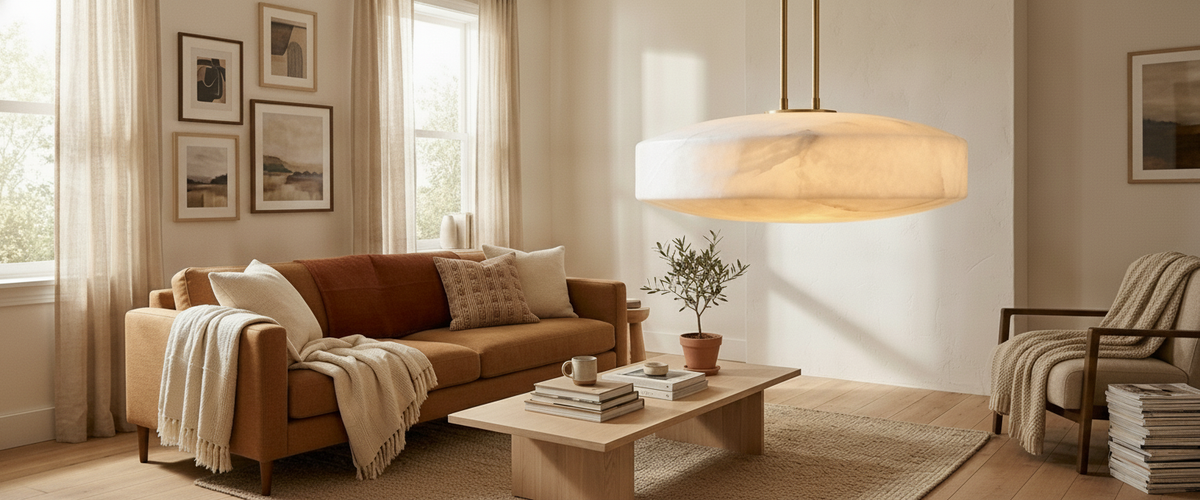

A statement fixture that looks faultless in a showroom can sulk in a real room. Most problems with designer lighting in the UK come down to fit, not taste. Drop a broad alabaster pendant into a low-ceilinged Victorian kitchen and it skims your guests' heads; hang a delicate single wall light on a wide plaster wall and it disappears. These are scale, height and backdrop problems, and they are fixable before you spend a penny.
Niori works in alabaster and natural stone, so the advice below leans on materials that glow rather than glare. A carved alabaster shade softens and spreads light through the stone itself, which changes how a piece of designer lighting reads at every mounting height. That matters more in British rooms than people expect.

Designer Lighting UK: Key Takeaways
Scale to the room, not the ceiling height alone. A wide pendant needs floor space below it, not just headroom.
Period terraces and new builds read fixtures differently. Backdrop and ceiling type change the same piece of designer lighting completely.
Mounting height makes or breaks comfort. Too high looks mean; too low blocks sightlines and faces.
Warm, dimmable light fixes the British winter problem. Alabaster handles this well because the stone diffuses the source.
Backdrop matters as much as the fixture. A busy wall flattens a carved piece; a calm one lets the veining show.

How a Designer Piece Reads in a Period Terrace Versus a New Build
The same alabaster pendant tells two different stories depending on the bones of the house. In a period terrace with cornicing, picture rails and a deeper ceiling rose, a designer fixture has competition. The architecture is already speaking, so a quieter, sculptural piece of designer lighting in stone tends to sit better than a busy multi-arm chandelier that argues with the plasterwork. The translucence of alabaster reads as period-friendly without pretending to be antique.
A new build gives you a blank, flat ceiling and usually a lower, more uniform height. Here a designer fixture has to do the work the architecture is not doing. A bolder form, a cluster of pendants, or a wide ceiling light earns its place because there is nothing else to look at. Browse the range across the alabaster lighting collection and you can see how the same material shifts from understated in an older room to commanding in a plainer one.
The honest test: stand in the doorway and ask what the eye lands on first. In a period room you want the designer lighting to complement the existing detail. In a new build you often want it to become the detail.
Scale and Mounting Height for Low UK Ceilings and Tight Rooms
British ceilings are frequently lower than the heights designer lighting in the UK is photographed in, and tight rooms are the norm rather than the exception. Get the maths roughly right before you fall for a piece.
For a dining pendant, aim to hang the bottom of the fixture around 30 to 36 inches (76 to 91 cm) above the table surface. Over a kitchen island, leave clear sightlines across the room. In a hallway or stairwell, the lowest point of the fixture should sit well above head height; nobody should ever have to duck. Our guide to choosing the right pendant light walks through these measurements in more detail if you want to plan before you buy. The Chartered Institution of Building Services Engineers publishes lighting guidance worth a look if you want to think about light levels rather than just clearance (cibse.org).
On width, a rough guide for a pendant or chandelier in inches: add the room's two dimensions in feet, then treat that number as a sensible diameter in inches. A 12 by 14 foot room suggests a piece of designer lighting around 26 inches wide. Adjust down for low ceilings. A piece that is correct in diameter but hung too low will still feel oppressive, so width and height work together.
Alabaster has real weight, so always confirm the fixing and the ceiling can carry the load, and use a qualified electrician for the installation. Stone pendants are heavier than they look.
Room by Room: Where a Statement Fixture Belongs and Where It Overwhelms
Not every room wants a hero piece, and stacking statements in adjoining spaces cancels them out.
Living Rooms
This is where a designer fixture earns its keep. A sculptural alabaster pendant or a pair of designer wall lights in the UK flanking a fireplace gives the room a focal point. Resist the urge to centre everything; designer lighting placed over the seating zone rather than the geometric centre of the room reads more intentional.
Dining Rooms
The one place where a bold pendant or small chandelier is almost always right, because there is a table to anchor it. The fixture has a clear job and a clear position. This is the safest room to spend on a centrepiece.
Kitchens
Designer pendants over an island work, but keep them in scale and let the diffused stone light do the softening. A good designer light shade in the UK matters here, since the right material pulls the glare off task light. The best designer light shades in the UK do this without dimming the room into gloom. Avoid hanging a delicate decorative piece directly over a hob or sink where heat, steam and splashback make life hard.
Bedrooms and Hallways
Bedside table lamps in alabaster give a warm, low glow that suits winding down. In a hallway, a single well-chosen ceiling light or a run of wall lights guides you through without crowding a narrow space. A hallway is usually too tight for anything wide.
Bathrooms
Here you need the right IP-rated fittings and a careful approach to zones. A wall light beside a mirror is lovely, but specification and electrical safety come first, so involve a qualified electrician early.
Daylight, Dimming and the British Winter Problem of Warmth
British winters are long, grey and short on daylight, which is exactly why warmth matters so much in UK homes. Cold, bright light in a December living room feels clinical. The fix is two-fold: choose warm designer light bulbs in the UK and put nearly everything on a dimmer.
For warmth, look at colour temperature. Around 2700K is the friendly, golden range most homes want for living and dining spaces. Alabaster is your ally here because the stone diffuses the source and pulls the edge off the light, so even a modest bulb reads soft. Pair that with a dimmer and your designer lighting drops the room into evening mode without swapping fittings.
Check dimmer compatibility before you buy. Not every LED plays nicely with every switch, and a mismatched pairing causes flicker or buzz. Designer light switches in the UK should be matched to the driver from the start. If you are specifying smart switches or a scene-based system, confirm the driver and switch are designed to work together. The Energy Saving Trust has sensible, independent guidance on LED choices and efficiency (energysavingtrust.org.uk).
Backdrops That Flatter a Designer Fixture and Ones That Flatten It
A carved stone fixture needs a backdrop that lets its veining and translucence show. A calm, mid-tone wall, a plain plaster finish, or a quiet painted ceiling all give the eye somewhere to rest so the designer lighting reads clearly. Soft contrast is your friend; the piece should sit slightly proud of its surroundings.
Busy wallpaper, a gallery wall directly behind a wall light, or a heavily patterned ceiling will flatten even a fine alabaster piece. The detail of the carving competes with the pattern and loses. The same goes for over-lighting a room from every direction; if the whole space is bright, nothing glows. Let the fixture be the warmest point in the room and let the surfaces around it stay relatively plain.
Placement Misfires We See in UK Client Projects
A few patterns come up again and again. We once advised a client in a converted London terrace who had fallen for a wide pendant intended for a double-height space; in their standard-height dining room it would have hung at forehead level. We steered them to a more compact carved piece, and the room finally felt finished rather than crowded.
Other common misfires:
Centring on the room, not the furniture. Designer lighting centred on the ceiling but off-centre from the table looks like a mistake.
Buying the photo, not the dimensions. The fixture looked huge in the lifestyle image because the room was huge.
One dimmer for everything. Separate your statement fixture from task lighting so you can dim the mood without losing the worktop.
Forgetting the daytime view. A fixture is on display when it is switched off too, so the unlit form should still earn its place.
Underestimating weight. Stone and marble fixtures need proper fixings and professional installation.
If you want to compare forms across pendants, chandeliers, wall lights and table lamps before committing, the full lighting range is a useful place to see how scale and material change a piece in context. For more on matching fittings to a specific room, our alabaster pendant lights collection shows how scale and placement play out across different forms. Confident lighting design in the UK rests as much on planning as on the fittings, and a good lighting designer in the UK will start with measurements, not mood boards. Specialist lighting design software in the UK can model levels and shadows before anything is bought, which takes the guesswork out of placing your designer lighting.
How to Choose: A Quick Buyer's Checklist
Measure first. Note ceiling height, room dimensions and any table or island the fixture sits over.
Match the form to the room. Quieter and sculptural for period detail; bolder for plain new-build ceilings.
Confirm weight and fixing. Stone is heavy; plan the installation with a qualified electrician.
Specify warm, dimmable bulbs. Around 2700K for living and dining, on a compatible dimmer.
Plan the backdrop. Keep the wall or ceiling behind the designer lighting calm.
Request a tailored quote. Budget depends on material, scale, complexity, engineering, installation and finishing rather than a flat figure.
Designer lighting in the UK works best when the piece, the room and the light all agree. Alabaster and natural stone make that easier than most materials because the glow is built into the shade, not bolted on. Get the scale and height right, keep the backdrop quiet, and a single piece of designer lighting will carry a room.