
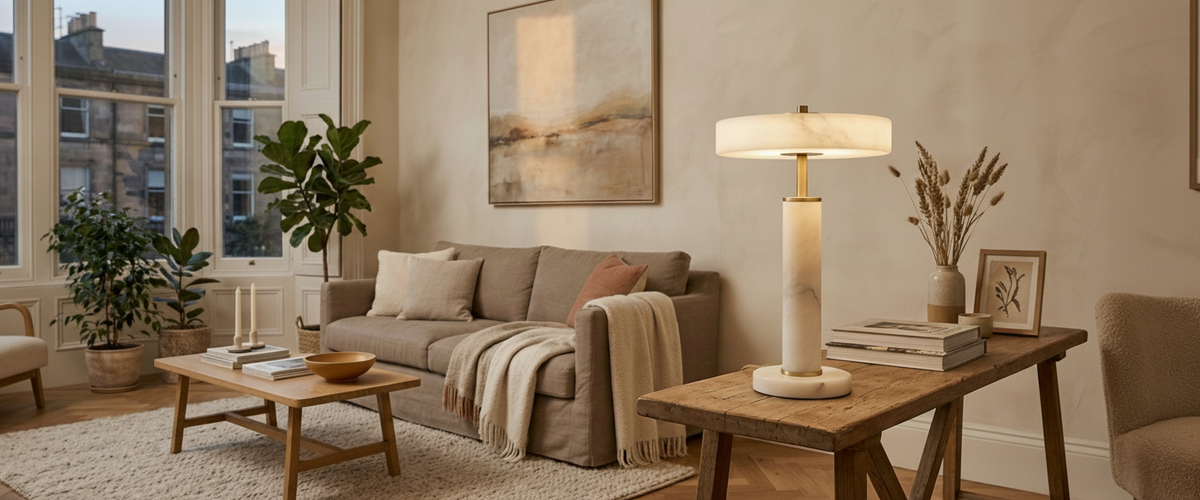

Shopping for designer light bulbs in the UK usually starts with the wrong question. Buyers fixate on the look of the filament, when three numbers most listings bury decide everything: colour temperature, colour rendering (CRI) and how cleanly the bulb dims. Pick warm 2700K, high CRI and confirmed dimming, and an alabaster or stone fixture glows; ignore those specs and it greys. A decorative filament lamp behind clear glass photographs brilliantly and tells you almost nothing about how a room will feel at night. We learned this in the studio: a client in a converted Edinburgh townhouse loved the coil of a vintage-style bulb, fitted it inside an alabaster pendant, and rang us a week later asking why the stone looked flat and grey. The bulb was the problem.
Stone is unforgiving. Alabaster and onyx only earn their keep when the light source flatters the veining and warms the surface. Get the spec wrong and an expensive fixture sulks.

Key Takeaways
Aim for 2700K warm white for alabaster and marble; cooler temperatures grey the stone.
Choose high CRI (90 or above) so veining and undertones read true.
Match the bulb to the fixture: exposed bulbs are decorative, shaded bulbs are felt not seen.
Confirm dimming compatibility before you buy; flicker on UK circuits is a real risk with cheap drivers.
Lumens are not quality. Brighter rarely means better in a stone fixture.

Filament Theatre Versus the Specs That Actually Matter
Decorative filament bulbs sell on looks, and there is nothing wrong with that when the bulb is meant to be seen. A clear glass A60 with a soft amber filament can be the whole point of an open-shade pendant. The trouble starts when buyers treat that decorative glow as a quality signal for every fixture, including ones where the bulb hides inside carved stone.
Inside an alabaster shade, the filament pattern is irrelevant. What reaches your eye is light pushed through translucent mineral, and the stone edits that light heavily. So the real questions become: what colour is the light, how accurately does it render the surface it passes through, and does it hold steady when you dim it? Those are spec-sheet answers, not styling ones. The best designer lighting in the UK pairs a considered fixture with a bulb chosen for physics rather than for its photograph, and that is true of every set of designer light bulbs in the UK we recommend.
Why 2700K and High CRI Decide Whether Stone Glows or Greys
Colour temperature, measured in kelvin, sets the warmth of the light. Lower numbers run warm and amber; higher numbers run cool and blue. For alabaster, marble and onyx, 2700K is the sweet spot. It brings out the honey and cream tones that make natural stone feel alive. Push to 3000K and you keep most of the warmth with a slightly crisper read; cross 3500K or 4000K and the stone starts to look clinical, the warm minerals fade, and the surface drifts towards grey. This is the first thing to check on any designer light bulbs in the UK listing.
Colour Rendering Index, or CRI, is the quieter hero. It measures how faithfully a light source shows colour against natural daylight, on a scale to 100. A bulb at CRI 80 will look fine on a wall but can mute the subtle pinks, golds and rusts that give onyx its character. Aim for CRI 90 or higher so the veining reads true. The Victoria and Albert Museum's guidance on lighting sensitive materials underlines how much colour rendering and intensity change the way a surface is perceived (vam.ac.uk). Stone is not light-sensitive in the conservation sense, but the principle holds: the source defines the surface.
If you are comparing designer light fixtures in the UK and the bulb spec is missing or vague, treat that as a warning. A serious supplier states kelvin and CRI without being asked, and good designer light bulbs in the UK always carry both numbers on the box.
Exposed Bulbs You See Versus Shaded Bulbs You Only Feel
There are two jobs a bulb can do, and they call for different choices.
Exposed bulbs are part of the design. Think of a brass pendant where the bulb hangs in open air, or a wall sconce with the lamp on show. Here you want a handsome envelope: a clear or opal globe, a filament-style LED, a shape that suits the fitting. Where the lamp itself is on display, a clear filament such as the 8W E27 LED Filament Bulb in clear glass A60 carries the look while still behaving like a modern LED.
Shaded bulbs live inside alabaster, glass or fabric and are only ever felt. Nobody admires them; they admire what the shade does with their light. For these, ignore decoration entirely and buy on colour temperature, CRI and dimming. An opal or frosted bulb is usually the better partner inside stone because it diffuses evenly and avoids a hot spot burning through a thin patch of alabaster. For a translucent shade that needs an even wash rather than a visible filament, an opal globe such as the 8W LED Globe Bulb E27 Opal in 3000K is closer to the right design language. You can see the range of fixtures these decisions apply to across our lighting collection.
The same split governs designer light shades in the UK. A shade in heavy linen wants more output behind it than a thin alabaster disc, which will glow happily on a modest lumen count. Matching designer light bulbs in the UK to the shade material is half the battle.
Dimming and Flicker on UK Circuits: the Honest Version
This is where good projects go quietly wrong. Many LED bulbs sold as dimmable behave badly on UK circuits, especially older trailing-edge or leading-edge dimmers never designed for low-wattage LED loads. You get flicker, buzz, a narrow dimming range, or bulbs that snap off long before the dial reaches the bottom. Not all designer light bulbs in the UK are tested against the dimmers people actually own.
The honest version: a dimmable LED bulb, a compatible dimmer and a sensible minimum load all have to agree. If you are running a single 8W bulb on a dimmer rated for far higher loads, it may flicker simply because the load is too small. Reputable manufacturers publish dimmer compatibility lists; check the bulb against the switch before you commit. For anything beyond swapping a like-for-like bulb, bring in a qualified electrician, and follow current UK wiring guidance rather than guesswork (electricalsafetyfirst.org.uk). The best designer light bulbs in the UK publish that compatibility up front.
Flicker matters more than people think. Visible flicker is obvious, but low-level flicker you cannot consciously see still causes headaches and eye strain over an evening. Inside a still alabaster shade, smooth dimming is one of the genuine pleasures of the material, so it is worth getting right. While we are on switches, do not let a beautiful fixture end at an ugly plate.
Lumens Against Warmth, and Why Brighter Is Rarely Better
Lumens measure total light output. The instinct to buy the brightest bulb available is almost always wrong for stone fixtures. Alabaster works by glowing softly; flood it with output and you either get glare through thin sections or a harsh, washed-out surface that loses its depth.
For a bedside alabaster table lamp, a modest output of roughly 400 to 600 lumens is plenty. In a small fitting with an E14 cap, a low-output warm bulb such as the XLED 4.5W E14 Candle Bulb in warm white gives that gentle glow without overpowering a thin stone shade. For a pendant over a large dining table you want more presence, but you also want a dimmer so you can pull it back for dinner. Think in terms of layers. A warm, lower-output bulb in a stone fixture rarely needs to be the only light in the room; pair it with discreet downlights or a floor lamp and let the stone be the warm centre rather than the workhorse. The lighting profession's principles on layered illumination are a useful sanity check here (ies.org).
A practical rule from the studio: choose warmth and CRI first, then the lowest lumen count that lights the room comfortably. You can always add a fixture. You cannot make over-bright stone feel calm, and the best designer light bulbs in the UK respect that limit.
Questions Worth Asking a UK Supplier Before You Commit
Use this as a quick checklist when you are comparing designer wall lights in the UK, pendants or lamps and the bulbs that go in them. The same questions sort good designer light bulbs in the UK from filler.
What colour temperature is supplied or recommended? You want 2700K for stone, 3000K at most.
What is the CRI? 90+ for anything lighting alabaster, marble or onyx.
Is it dimmable, and on which dimmer types? Ask for a compatibility list, not a yes.
Opal or clear? Opal for shaded fixtures to avoid hot spots; clear only where the bulb is on show.
What cap fitting? E27, E14, B22 and so on; confirm before ordering spares.
What is the expected life and warranty? Cheap LEDs fail early and drift in colour as they age.
Does the fixture suit a warm, dimmable source? Browse the alabaster lighting range to see how stone and warm light read together.
A specialist supplier will answer all of these without flinching. If the bulb spec is an afterthought, the fixture probably is too. Trustworthy sellers of designer light bulbs in the UK treat the numbers as the headline, and that is how you separate real designer light bulbs in the UK from the filler.
A Note on Lighting Design Tools and Specialists
For larger projects, the bulb is one decision inside a wider scheme. A lighting designer in the UK often models rooms before a single fixture is hung, using lighting design software in the UK to predict output, glare and colour across a space. Good lighting design in the UK treats decorative stone fixtures as accents within a layered plan rather than the only source. If you are fitting out a hospitality space or a large home, it is worth involving a specialist early. The numbers we have covered here, kelvin, CRI, lumens and dimming, are exactly the inputs that professional will want from you.
Get the bulb right and an alabaster fixture does something a photograph cannot capture: it warms a room from the inside. That is the whole point of the material, and it lives or dies on the small print of the designer light bulbs in the UK you choose.