
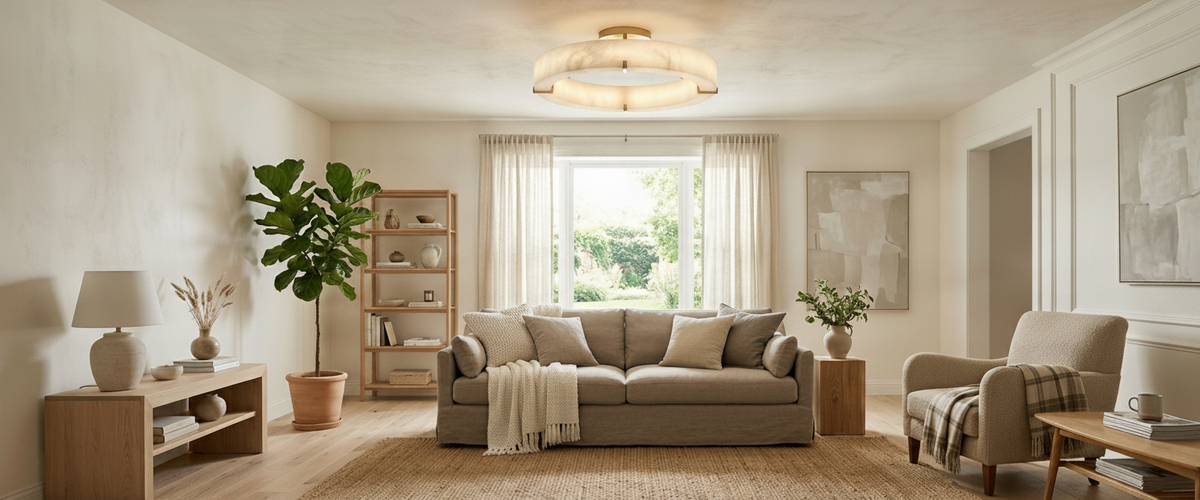

The cheapest part of good living room ceiling lights shoppers obsess over is usually the bulb. Everything that makes a piece worth living under sits upstream of that: the block of stone chosen, the way it was carved, the wiring hidden inside, and the hand that finished the surface. Buyers tend to pick living room light fixtures on a photograph and a price, then wonder six months later why the light feels flat or the fixture looks cheaper in the flesh. The answer is almost always in the making, and it shapes how ceiling lights living room buyers choose actually perform.
At Niori we work in alabaster and natural stone, so this is the side of the trade we know best. Below is what actually happens before a stone fitting reaches your ceiling, and what to listen for when a maker talks you through their living room ceiling lights.

Key Takeaways
Stone selection and veining decide how the light glows long before the bulb does.
Carving thickness, finishing and wiring quality drive both the look and the cost of ceiling lights living room shoppers compare.
Flush and semi-flush fittings suit low ceilings; pendants and chandeliers want height.
Ask about stone origin, wall thickness, dimming compatibility and how the piece is fixed to the ceiling.
Price depends on material, scale, complexity and installation, so request a tailored quote rather than trusting a flat figure on ceiling lights living room buyers see online.

What Makers Think About Before Crafting Living Room Lighting
The first decision is never style. It is light behaviour. Alabaster is translucent, so a fixture made from it does not simply hold a bulb; it becomes the light source. A maker has to picture how the stone will read when lit and when dark, because a living room with lighting sees both states every day. A pale, fine-grained block glows like a lantern. A more heavily veined piece throws shadow and warmth in a way that suits older rooms and softer schemes. This is the groundwork behind ceiling lights living room owners keep for years.
Ceiling height comes next. A flush or semi-flush stone fitting is the honest answer for a standard UK living room around 2.4 metres (8 feet) high, where a hanging piece would crowd the room. Where headroom is tight and the room needs an even ambient wash rather than a low-hanging focal point, a low-profile fitting such as the Brompton Flush Ceiling Light sits closer to the right design language. Higher ceilings, the kind you find in a converted warehouse or a double-height extension, can carry a pendant or a small chandelier without it dominating. Get this wrong and even the best ceiling lights living room schemes can offer look awkward. We have re-specced more than one project where a client fell for a low-hanging pendant that would have sat at forehead height over a sofa.
Then there is the rest of the lighting plan. A single ceiling fitting rarely carries a room on its own. Makers and designers treat it as the ambient layer, the soft wash you switch on first, with table lamps and wall lights filling in the corners. If you want to see how that layering works across fixture types, our full lighting range shows the same warm vocabulary applied to pendants, wall lights and lamps. These are the living room lighting ideas that quietly do the heavy lifting around your ceiling lights living room layout.
Craft Decisions That Change the Result and the Price
A few choices made early on quietly set the quality ceiling for the whole piece.
Wall thickness. Carve the stone too thick and the light cannot pass through; the fixture goes dull and lifeless. Too thin and it becomes fragile and prone to hot spots where the bulb sits close to the surface. The sweet spot is found by hand, and it is one of the clearest tells between a considered piece and a mass-produced one. It is also where ceiling lights living room buyers choose either glow or disappoint.
Metalwork. Brass detailing, whether brushed, aged or polished, does more than decorate. It carries the weight, hides the wiring and frames the stone. Solid brass ages gracefully; thin plated steel does not. On flush fittings especially, the backplate and trim are where you see whether a maker cut corners. A piece like the Welland LED Flush Ceiling Light in aged brass shows how a warm metal finish can carry a flush fitting without looking like an afterthought, which is exactly what good ceiling lights for the living room ask of their metalwork.
Light source and dimming. Warm LED, ideally around 2700K, flatters alabaster's natural cream and honey tones. Cooler bulbs make stone look grey and clinical. Good dimming matters more than most buyers expect, because the magic of stone living room lights is the low evening setting, where the whole piece glows rather than glares. The Chartered Institution of Building Services Engineers notes that layered, dimmable living room lighting supports both comfort and the way a room is actually used through the day (cibse.org).
None of these are free. Thicker brass, hand-finished stone and proper drivers all add cost, which is why a flat price across very different ceiling lights living room options should make you suspicious. Material, scale, complexity, engineering and finishing all move the number, so a tailored quote tells you far more than a headline figure.
Why Stone Selection and Veining Make or Break the Glow
This is the part buyers underestimate most. Two alabaster fittings of identical shape can look like different products entirely, purely because of the stone inside them. Veining is natural and never repeats, so a maker is partly an editor: choosing which block becomes a calm, milky disc and which one keeps its dramatic amber streaks. It is the same choice that separates ordinary ceiling lights living room shoppers settle for from the ones people remember.
For your room, the question is how much character you want overhead. A quieter stone reads as a soft, even glow and sits back politely in a busy room. A boldly veined block becomes a feature in its own right and asks the rest of the scheme to keep calm around it. Neither is better; they suit different rooms. What matters is that the maker chose the block on purpose rather than using whatever offcut was nearest, because that choice carries straight through to how living room ceiling lights behave once lit.
Alabaster has been prized for exactly this translucency for centuries, used in windows and lamps long before electric light existed, as collections at the Victoria and Albert Museum show (vam.ac.uk). That history is also a clue for buyers: the stone has always been about the light passing through it, not just the surface you can touch. If you want to compare how different blocks read when lit, the pieces in our alabaster lighting collection are a useful place to see veining in context, and a good starting point for ceiling lights for the living room.
From Block to Ceiling: How the Piece Is Actually Made
The workshop sequence behind good ceiling lights living room buyers trust is more deliberate than most people imagine.
Stone selection. Blocks are assessed for colour, translucency and structural soundness. Cracks and weak seams are rejected; a flaw that survives carving can fail under heat over time.
Carving and shaping. The form is roughed out, then refined toward that critical wall thickness. This is slow work, and stone removed cannot be put back.
Finishing. The surface is smoothed and sealed. Finish changes the feel completely, from a soft matte to a gentle sheen, and affects how light scatters across the stone.
Wiring and assembly. The fixture is wired with a suitable warm light source and driver, the brass components are fitted, and the whole piece is tested lit before it leaves.
Installation. Stone is heavy, so the ceiling fixing has to be specified properly. This step belongs to a qualified electrician, both for the load and for the connection.
That last point is not negotiable. A stone fitting can carry real weight, and the mounting has to suit your ceiling type. Always have ceiling lights for the living room installed by a qualified electrician rather than treating it as a weekend job; UK electrical safety guidance is clear that fixed lighting work should be done competently and tested (electricalsafetyfirst.org.uk).
Honest Red Flags to Ask About Before You Commit
A confident maker will answer all of these without flinching, and the way they talk about their ceiling lights living room range tells you a lot.
"Where does the stone come from, and is each piece individually selected?" Vague answers usually mean uniform, machine-cut stone with little regard for veining.
"What is the wall thickness, and how does it handle heat?" This separates pieces built to glow from pieces built to photograph.
"Is the metalwork solid brass or plated?" Plated trim tarnishes and chips; solid brass earns a patina.
"What bulb and dimming setup is recommended?" If the answer is a cold white bulb with no dimming, the stone will never look its best on ceiling lights for the living room.
"How is it fixed, and what does the ceiling need to support?" A maker who has shipped real living room ceiling lights will talk weight and fixings comfortably.
"Why this price?" A good seller can break it down by material, scale and finishing rather than quoting a round number with nothing behind it.
One more, often forgotten: ask how the piece is cleaned. Alabaster does not like harsh chemicals or soaking. A soft dry cloth, and an occasional barely-damp wipe, is the safe routine. A maker who cares about the longevity of their living room ceiling lights will tell you this unprompted.
Choosing the Right Fixture for Your Room
If your ceiling is standard height, a flush or semi-flush alabaster fitting gives you the warm ambient layer without stealing headroom, and it is where most ceiling lights living room buyers want earn their place. If you have height to play with, a pendant or compact chandelier can anchor a seating area beautifully, ideally on a dimmer so it earns its keep from afternoon reading to late evening. A floor lamp in the corner fills the gap the overhead fixture leaves, which is why most well-lit rooms run at least two or three light sources rather than relying on the centre fitting alone. A stand light a living room corner often needs is rarely an afterthought; it is part of the same plan as your ceiling lights for the living room.
The thread through all of it is the same: choose the stone deliberately, light it warm, dim it well, and have it fitted properly. Do that, and ceiling lights living room owners live with stop being a thing you switch on and become part of how the room feels after dark. Browse the range from the Niori homepage if you want to see how the alabaster ceiling lights for the living room sit alongside the wider collection.