
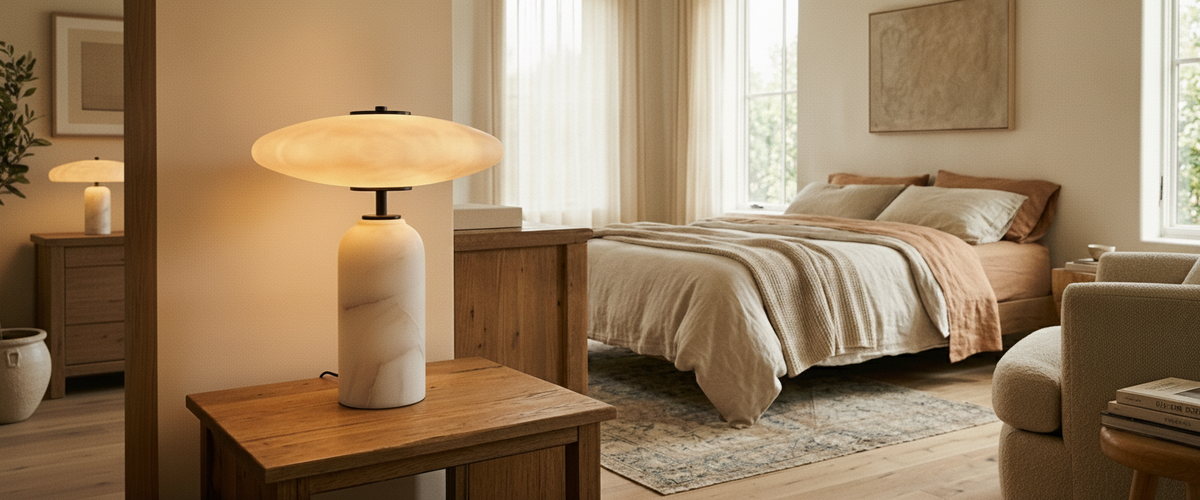

A single overhead fitting blasting straight down is the fastest way to make a bedroom feel like a place you work rather than sleep. It flattens faces, throws hard shadows under the eyes, and gives you exactly one mood: on. Good bedroom lights fixtures do the opposite. They work in layers, lean warm, and let you drop the room into something restful without crossing the floor in the dark. The best bedroom light fixtures rely on alabaster and natural stone, because the material itself softens light before it ever reaches you.
This is a buyer's guide for getting that right, whether you are fitting out a main bedroom in a period home or specifying bedroom light fixtures for a guest suite on a hospitality project.

Key Takeaways
Never rely on one ceiling light. Layer overhead, bedside and accent so the glow overlaps gently.
Warm colour temperature (roughly 2200K to 2700K) tells the body it is nearly time to sleep.
Alabaster and stone shades diffuse light internally, so you get glow rather than glare.
Two-way switching at the door and the bed is worth more than any single fixture.
Dimmable LED bulbs give you flexibility without the heat or the buzz.

Why One Overhead Fixture Makes a Bedroom Feel Like an Office
Most bedrooms inherit a builder-grade ceiling fitting placed dead centre, wired to a single switch by the door. It lights the room, technically. What it does not do is flatter anyone, support reading, or shift mood as the evening winds down. You end up with a bright box that is either fully on or fully off. That is why one fitting rarely counts as proper bedroom light fixtures.
The fix is not a bigger fitting. It is more sources, each doing less. When you spread light across a ceiling piece, two bedside points and perhaps a wall light or two, no single source has to work hard. The effect reads calmer, and the room finally feels like somewhere you would choose to rest.
Layering Ceiling, Bedside and Accent So They Overlap Softly
Think in three layers. The ceiling layer gives ambient fill. Bedside lighting handles task work like reading and late-night water. Accent lighting picks out a wall, a headboard, or a piece of art and adds depth. Good bedroom light fixtures cover all three.
For the ceiling layer, a flush or semi-flush alabaster fitting suits standard ceiling heights of around 8 feet (2.4 m), while a pendant or compact chandelier earns its place in rooms with height to spare. Alabaster ceiling lights for bedroom schemes have a real advantage here: the stone diffuses the source inside the shade, so you look up and see a warm pool of light rather than a bright bulb. You can browse the range of stone and alabaster pieces across the alabaster lighting collection to see how the material handles overhead light.
Bedside is where most schemes are won or lost. Matched table lamps frame the bed and give symmetry, but in a smaller room, a pair of wall lights for bedroom use frees up the surface entirely. A sconce light fixture bedroom setup is my go-to when nightstands are shallow or doubling as charging stations. These are the bedroom light fixtures buyers underrate most.
Stone and Alabaster Shades for an Overhead Glow That Flatters
Alabaster is a translucent stone, so light passes through it and scatters. That scattering is what softens shadows on a face and takes the edge off a bright bulb. Each piece carries its own veining, which means the glow is never flat; you get subtle variation in tone across the surface as the light moves through the stone. The Metropolitan Museum of Art holds carved alabaster objects that show how long the material has been valued for exactly this quality of translucency.
Marble and onyx behave differently again. Denser stone reads more as reflected surface light, with veining catching the eye, while alabaster glows from within. For a bedroom, where you want softness above all, alabaster usually wins for shades and overhead diffusers, with marble or brass detailing adding weight at the base or stem. It is one reason stone bedroom light fixtures suit a sleep space so well.
One studio observation worth passing on: we shipped a pair of alabaster table lamps to a client redoing a coastal bedroom in California, and they came back surprised that the lamps gave enough light to read by while still feeling dim. That is the stone doing its job. It spreads the output instead of concentrating it, so the room feels gentle even at a usable brightness.
Two-Way Switching So You Never Cross the Room in the Dark
A bedroom needs two control points: one at the door, one at the bed. Two-way switching lets you walk in, light the room, get into bed, and switch everything off without a cold trip back across the floor. It sounds obvious. It is also the single upgrade people thank me for most after the fact, no matter which bedroom light fixtures they chose.
Pair that with dimming on the ceiling and bedside circuits and you have genuine control. Bright while you tidy or dress, low and warm while you read, off from under the covers. Always have switching and dimming installed by a qualified electrician; the controls and bulbs need to be matched correctly to avoid flicker or buzz.
Warm Temperatures That Signal Sleep Instead of Activity
Colour temperature matters more in a bedroom than anywhere else in the house. Cool, blue-white light keeps the body alert, which is useful in a kitchen and counterproductive next to a pillow. Warm light, in the 2200K to 2700K range, mimics the tone of low evening sun and candlelight, and helps the room signal rest. Bedroom light fixtures should always lean warm.
There is good reason to take this seriously. Guidance from the Sleep Foundation notes that bright and blue-toned light in the evening can interfere with the body's natural wind-down. Choosing warm led lighting for bedroom use is a small decision with an outsized effect on how the room feels at night.
What Wattage and Bulb to Choose
Forget old wattage habits; with LED you should read lumens, not watts. As a rough guide, a bedside reading bulb of around 400 to 500 lumens is plenty, while a ceiling layer might sit closer to 800 lumens on a dimmer. For a relaxed bedroom, aim for warm output that you can dim, rather than maximum brightness. A bedside fitting wants a soft, low-output bulb for reading, while a ceiling layer can carry a little more so the room never feels gloomy when you need it bright. Choose dimmable LED bulbs rated for the colour temperature you want, and check the fitting's recommended maximum so the stone shade never runs hot.
The Bedroom Lighting Mistakes I See Most, and the Quick Fixes
A few patterns come up again and again when buyers describe a bedroom that does not feel right, usually traceable to the bedroom light fixtures themselves.
One central fixture doing everything. Add bedside and a wall light or two so the load spreads.
Cool white bulbs. Swap to 2700K or warmer and the whole mood changes overnight.
No dimming. Retrofit dimmable bulbs and a compatible dimmer with an electrician.
Bedside lamps too tall or too short. Aim for the shade base to sit roughly at shoulder height (around 24 to 28 inches, or 60 to 70 cm, from the mattress) when you are propped up in bed, so light falls on the page, not in your eyes.
Bedroom ceiling lights hung too low over the centre of the bed. Keep at least 7 feet (2.1 m) of clearance from the floor, or move a pendant off-centre over a dressing area instead.
Forgetting wall lights for bedroom corners. A single sconce on a dark wall adds depth that no central fitting can.
A Quick Buyer's Checklist
Plan three layers: ceiling, bedside, accent.
Pick warm, dimmable bulbs across all of them.
Specify two-way switching at door and bed.
Match fixture scale to ceiling height and bed width.
Choose alabaster or stone shades where you want glow without glare.
Confirm fitting weight and fixing with your installer before buying.
Bringing It Together
The best bedroom light fixtures form a system, not a single purchase. Get the layers and the warmth right, give yourself two-way control, and let alabaster or natural stone soften the output, and the room stops feeling lit and starts feeling restful. If you are weighing up ceiling, wall and table options together, it helps to see these bedroom light fixtures side by side across the wider lighting collection so the materials and scale read as one scheme rather than separate buys.
Budget depends on material, scale, complexity, engineering, installation and finishing, so for a tailored set of bedroom light fixtures the most useful next step is to request a quote with your room dimensions and ceiling height to hand.