
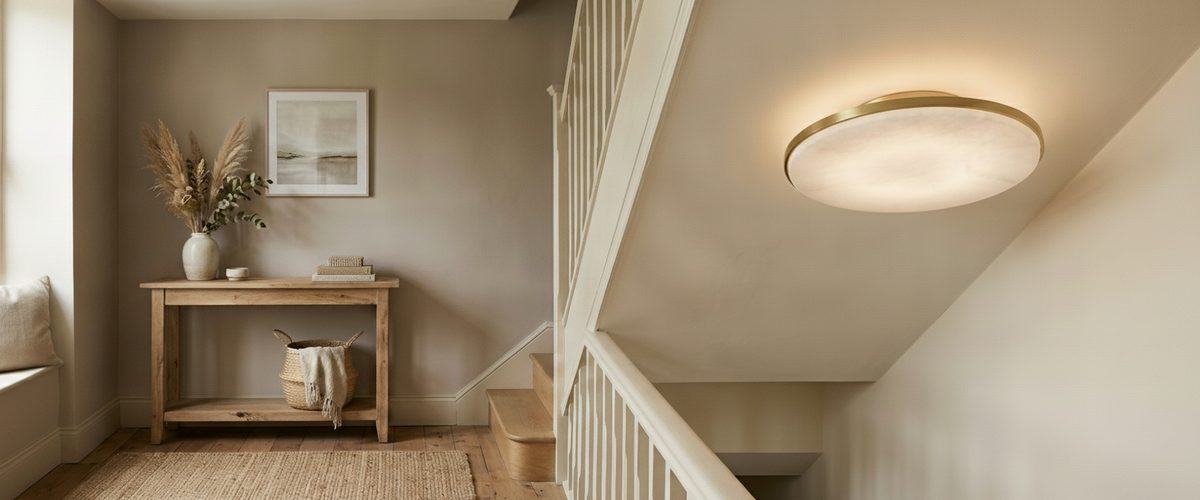

There is a precise moment when an alabaster semi flush beats both a pendant and a flat ceiling mount, and most people only notice it after they have installed the wrong one. The room has a ceiling around eight to nine feet (2.4 to 2.7 metres). A pendant would drop into eye line or feel theatrical for the space. A pure flush mount would press the light against the plaster and flatten the whole ceiling. An alabaster semi flush threads that gap: it hangs a few inches clear, holds a carved shade, and lets warm light spill upward as well as down.
That upward spill is the trick. It is the difference between a ceiling that feels heavy and one that breathes.
An alabaster semi-flush lifts a tight ceiling with a soft upward wash.

Quick Answer: When an Alabaster Semi-Flush Earns Its Place
Ceiling height: best between roughly 8 and 9.5 feet (2.4 to 2.9 metres), where a pendant intrudes and a flush mount feels mean.
The job it does: an alabaster semi flush gives ambient wash, not a focal sculpture; soft general light over a clear, even room.
Why alabaster: the stone diffuses the bulb so you read warm glow, not a glaring filament.
Drop it adds: usually a few inches below the canopy, enough to lift the ceiling without stealing headroom.
Where it lands: hallways, bedrooms, kitchens, dressing rooms, and landings with standard ceilings.

Why the Gap Above the Shade Lifts a Tight Ceiling
A flush mount has nowhere for light to go but down and sideways. The plaster directly above it stays in shadow, and a low ceiling reads even lower because your eye stops at a dark band. An alabaster semi flush opens a small gap between the stone shade and the canopy. Light escapes through that gap and washes the ceiling around the fixture, which visually pushes the plaster back.
With this stone the effect is gentler than with glass or metal. An alabaster ceiling lights glows in itself, so the shade is not a hard bright object floating under a dark ceiling; it is a warm body of light with a soft halo above it. In a narrow hallway or a bedroom with a standard ceiling, that halo is what stops the room feeling boxed in. We shipped a layered alabaster semi flush to a London flat with 2.5 metre ceilings last winter, and the owner's note afterwards was simple: the hall finally felt taller, not just brighter.
If you want to see how that warm, diffused quality reads across different fixture types before you commit, it helps to browse the wider alabaster lighting range and compare semi-flush forms against pendants and wall lights side by side.
The Drop It Adds and the Ceiling Heights That Suit It
An alabaster semi flush is defined by a short stem or spacer between canopy and shade. That gives you a small, deliberate drop, normally a few inches rather than the foot or more a pendant commits to. The point is presence without intrusion.
Heights to keep in mind:
Under 8 feet (2.4 metres): choose a shallow semi-flush or a true flush mount. Anything with real drop starts to feel close overhead.
8 to 9.5 feet (2.4 to 2.9 metres): the sweet spot. The fixture sits with intent and still leaves clear headroom under it.
Over 10 feet (3 metres): an alabaster semi flush can look stranded high on the plaster. This is pendant or chandelier territory.
Always measure the lowest point of the fixture against the tallest person who will walk under it, and against any door swing or wardrobe nearby. In a kitchen, check it clears wall-cabinet doors and the top of the fridge.
Stone Thickness and Diffusion: Killing the Centre Hotspot
The common failure with any stone ceiling light is a bright hotspot directly under the bulb, with the edges of the shade staying dimmer. Alabaster is naturally translucent, so light passes through it; but the thickness and the veining decide how evenly it does so. Thin, very pale stone lets a lot through fast, which can leave the centre glaring while the rim looks pale. Slightly thicker stone, or a layered alabaster light fixture for the ceiling, spreads the light more evenly across the whole shade. Where the priority is an even glow with no single bright point, a layered alabaster semi flush such as the Elara 10 Light Layered Alabaster Semi-Flush handles diffusion better than a single thin shade ever will.
Thicker or layered stone spreads light evenly and avoids a centre hotspot.
Alabaster is a soft form of gypsum, prized for centuries precisely because it transmits light, a quality conservators link to its fine, even crystalline structure (see the Getty Conservation Institute on gypsum and calcite alabaster). That same softness is why the stone is carved rather than moulded, and why no two shades read identically.
To avoid the hotspot:
Pick a fixture where the bulb sits set back from the shade wall, not pressed against it.
Favour layered or thicker shades for a more even glow.
Use frosted or opal bulbs rather than clear glass, so there is no hard point source.
For multi-light designs, the cluster of smaller bulbs already softens any single bright point.
Rooms Where a Transitional Alabaster Semi-Flush Lands Well
An alabaster transitional ceiling light, neither strictly modern nor period, suits more rooms than people expect because the stone reads as material rather than style. The form can be carried by a clean brass band or a more decorative collar, which is what tips it modern or traditional.
Hallways and landings. The classic case for an alabaster semi flush. Low traffic ceilings, frequent on-off use, and a real need for warmth. A single shade here sets the tone for the whole floor.
Bedrooms. An alabaster semi flush gives soft general light without a pendant hanging over the bed. The upward spill keeps the ceiling from pressing down when you are lying flat looking up.
Kitchens and utility spaces. Over a run of cabinets or a galley, the fixture keeps clear of cupboard doors while still giving even ambient light above your task lighting.
Dressing rooms and bathrooms. Warm, even stone light flatters skin and fabric far better than a cold downlight. For bathrooms, check the fixture carries an appropriate IP rating for the zone and have it installed by a qualified electrician.
For an antique alabaster ceiling light look, lean on softer brass tones and more carved detail; for an alabaster contemporary ceiling light, choose cleaner geometry and a tighter metal frame. An alabaster modern ceiling light pairs well with minimal interiors, while an alabaster traditional ceiling light suits period rooms with richer detailing. If you are weighing one of these against a pendant for the same spot, the full lighting collection makes the comparison easier.
Spacing and Bulb Choice for an Even, Warm Wash
One alabaster semi flush covers a modest room well. For longer hallways or open-plan runs, you may want two or more in line, and spacing matters as much as the fixtures themselves.
Practical guidance:
Spacing: in a hallway, position fixtures so their pools of light overlap slightly rather than leaving dark gaps; roughly even spacing along the run, with the end fixtures not jammed against the walls.
Colour temperature: stay in the warm band, around 2700K, which suits the honeyed tone of the stone. Cool white fights the material and makes it look grey.
Dimming: use dimmable LEDs and a compatible dimmer. An alabaster semi flush looks its best dimmed back in the evening, when the stone seems to hold the warmth.
Bulb shape: match the bulb to the shade opening so it sits centred and set back; a stray bulb visible at the rim spoils the glow.
A multi-light alabaster semi flush behaves differently from a single shade. The cluster spreads output across many small sources, so you get a broad, soft wash with almost no single hotspot. For wider hallways, generous bedrooms, or the centre of an open-plan space where one shade would not reach, a larger cluster such as the Elara 16 Light Alabaster Semi-Flush in Brass covers the floor area that a single shade simply cannot.
A Short Buyer's Checklist
Confirm your ceiling height sits in the 8 to 9.5 foot (2.4 to 2.9 metre) range before ruling out a pendant.
Measure the lowest point of the fixture against head height, door swings, and cabinet doors.
Choose thicker or layered stone, plus a frosted bulb, to avoid a centre hotspot.
Stay at 2700K and add a compatible dimmer.
For bathrooms or damp zones, check the IP rating and use a qualified electrician.
Ask for a tailored quote rather than assuming cost; price depends on the stone, scale, metalwork, and finishing.
Get those few decisions right and an alabaster semi flush does the quietest, most useful job in lighting: it makes an ordinary ceiling feel considered, and fills the room with a warmth that a flat downlight never manages.