
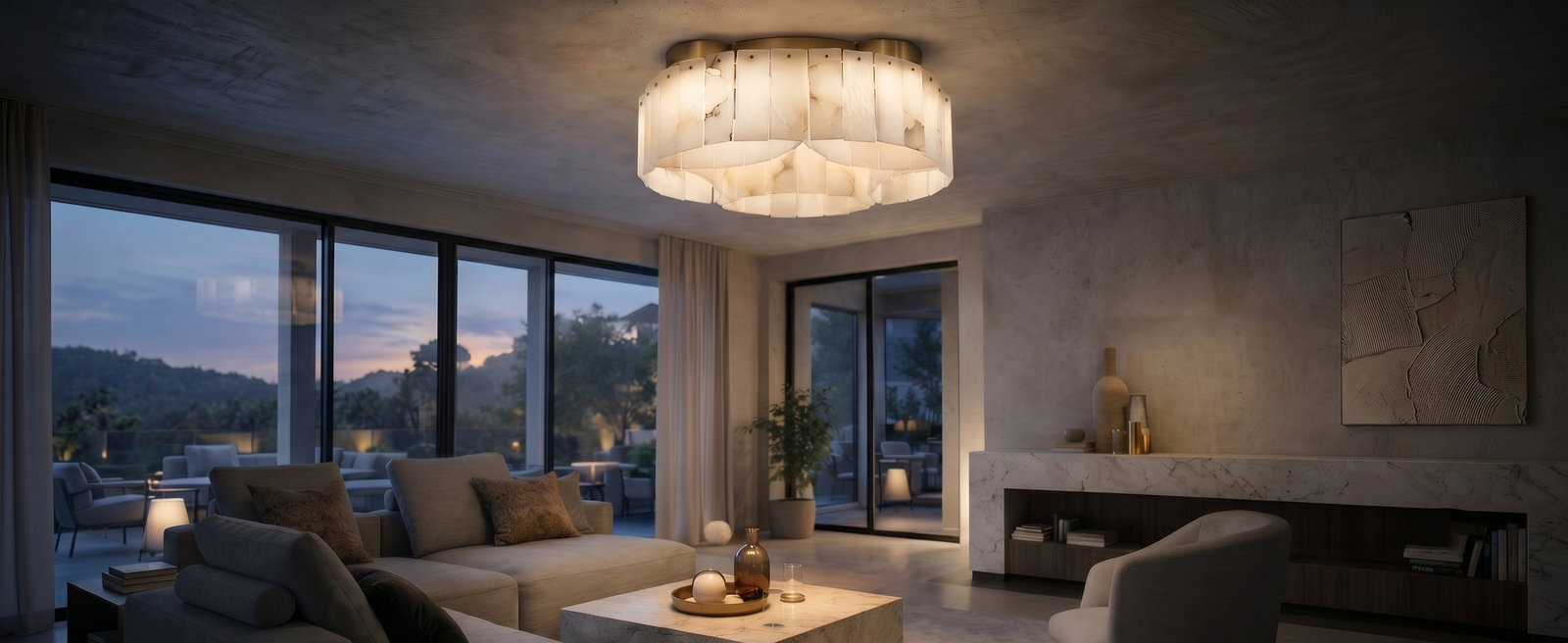

Hang a pendant under a 2.4 metre (8 foot) ceiling and you create a hazard with a cord on it. People duck, tall guests clip it, and the room reads cramped because your eye keeps catching the underside of the fitting. An alabaster flush mount solves the problem by refusing to drop at all. It sits tight to the plaster, glows from where it is fixed, and gives back the headroom a chandelier quietly steals. For low rooms, that is the whole argument.
Stone changes what that flat fitting can do. Where a frosted glass disc throws a uniform, slightly clinical wash, a slab of alabaster carries the light through its body and pushes it sideways, picking up veining as it goes. The result is warmer and softer, and it spreads rather than spotlights. That difference is why an alabaster ceiling lights earns its place in rooms where a plain builder's fitting would feel like an afterthought, and it is the same reason an alabaster flush mount outperforms a sealed disc overhead.
A flush alabaster fitting keeps the ceiling line clean in a low room.

Key Takeaways
Flush mounts protect headroom. Under roughly 2.4 metres (8 feet), an alabaster flush mount almost always reads better than a pendant.
Alabaster spreads light sideways. The stone diffuses the source so you get a soft pool, not a hotspot.
Best rooms: landings, halls, bedrooms, low-ceilinged kitchens and box rooms.
Check before fixing: diameter against the ceiling plane, heat dissipation, and bulb or LED access.
Go semi-flush when the ceiling climbs past about 2.6 metres (8.5 feet) and wants a little presence.

Why a Pendant Fights a Low Ceiling and a Flush Mount Makes Peace With It
A pendant is designed to occupy vertical space. Lower it into a room that has none to spare and the proportions collapse. The fitting hovers at eye level, the drop competes with door heads and picture rails, and the ceiling feels closer than it is. We have shipped to plenty of Victorian terraces and converted flats where the buyer started out wanting a small chandelier and ended up far happier with a flat alabaster light fixture ceiling once they measured the actual gap above their head.
An alabaster flush mount sidesteps all of that. By sitting tight against the ceiling, the fitting keeps the plane unbroken, so the eye travels across the room rather than stopping under it. You lose nothing in light output and gain a clean, calm ceiling line. In a low room, that calm is worth more than any amount of sparkle.
How a Stone Slab Spreads Light Sideways Instead of Dropping a Hotspot
Alabaster is a translucent stone. Cut thin enough, it transmits light through its surface, which is why it has been used in windows and lamps for centuries; the Victoria and Albert Museum's collection notes its long history as a carved decorative stone valued for exactly this glow (vam.ac.uk). In an alabaster flush mount, that translucency does practical work. The bulb sits behind the stone, the stone takes the edge off the source, and the light leaves the fitting already diffused.
Because the shade is broad and flat, the spread runs sideways across the ceiling and down the walls rather than punching a single bright circle onto the floor. You read fewer harsh shadows and softer transitions between light and dark. The veining matters here too: no two alabaster panels are identical, so each fitting carries its own faint map of grey and honey lines that only show when lit. That is the difference between an alabaster lighting fixture and a sealed acrylic dome doing the same job without any of the character.
Lit from behind, the stone's veining gives every flush fitting its own character.
Landings, Bedrooms and Halls: The Rooms Where Flush Fittings Quietly Win
Some rooms are made for an alabaster flush mount. Landings and upstairs halls are usually the lowest ceilings in a house, often with sloped sections nearby, and they are circulation spaces where you do not want anything to duck under. A flush alabaster ceiling light gives even, gentle light for moving between rooms at night without glare. An antique alabaster ceiling light suits an older landing especially well, where a softer, aged glow flatters period plasterwork.
Bedrooms reward the soft, sideways spread. You rarely want a bright downward beam over a bed; you want ambient fill that flatters the room and leaves task lighting to bedside lamps. Where the room needs that diffused fill rather than a hard downlight, a round alabaster flush mount such as the Bravion LED Round Alabaster Flush Ceiling Light sits flat enough to clear wardrobe doors and ceiling fans while still casting the stone's warmth across the room. Its clean disc reads as an alabaster modern ceiling light, equally at home in a pared-back scheme.
Entrance halls and box rooms are the third group. Halls are often narrow and low, and an alabaster flush mount keeps the threshold clean and welcoming. In small kitchens with limited ceiling height, a flat fitting also clears the swing of upper cabinet doors, which a pendant never will. An alabaster contemporary ceiling light keeps the look crisp in a new-build kitchen, while a softer carved shade gives a hall a more traditional feel. For a wider look across forms and finishes, the full lighting collection shows how flush and semi-flush pieces sit alongside pendants and wall lights.
Sizing to the Ceiling Plane: Diameter, Projection and the Room Below
Getting the size right is mostly arithmetic and a little judgement. For diameter, a common starting point is to add the room's two dimensions in feet and read the total in inches. A room that is 12 by 14 feet suggests an alabaster flush mount around 26 inches (66 cm) across; in a low room you can size down slightly so the ceiling does not feel weighed on. Where the ceiling line wants a crisp geometric anchor rather than a circle, the square Cadris LED Medium Square Alabaster Flush Ceiling Light comes in small, medium and large for exactly this reason, so you can match the fitting to the ceiling rather than the other way round.
Projection, meaning how far the fitting drops from the plaster, is the number people forget. A true alabaster flush mount projects very little, which is the point under a low ceiling. Measure the headroom you actually have, then leave generous clearance for anyone tall who walks beneath it. Think about the floor below too: a fitting centred over a landing reads differently from one over a bed, so plan from the position people stand and look up.
Measure twice: ceiling height, the fitting's projection, and the clearance left for the tallest person in the house.
Scale to the room: add the two room dimensions in feet, read in inches, then size down a touch in low spaces.
Centre on use, not the room: position over the path people walk or the bed they sleep in, not just the geometric middle.
Heat and Bulb Access: The Unglamorous Checks Before You Fix It Up There
Two practical things decide whether you love an alabaster flush mount or resent it. The first is heat. A fitting pressed against the ceiling has less air around it than a pendant, so the bulb or LED module needs to run cool and the housing needs to let warmth escape. Integrated LED fittings handle this well because they run at low temperatures and spread the source across a board rather than concentrating it in one hot bulb. If your fitting takes replaceable lamps, stay within the stated wattage and choose LED rather than halogen.
The second is access. Ask how you change the light source before you fix anything overhead. With an integrated LED fitting you are buying a long-life module, often rated for tens of thousands of hours, so replacement is rare; check whether the driver is serviceable when it eventually fails. For lamped fittings, make sure the shade comes away cleanly so you are not wrestling a stone panel at the top of a ladder. Any hard-wired alabaster flush mount should be installed by a qualified electrician, both for safety and to meet UK wiring regulations.
One more care note specific to stone. Alabaster is softer than marble and porous, so it dislikes water and harsh cleaners. Dust it with a dry, soft brush or cloth; the Natural Stone Institute's general guidance on softer stones is to avoid acidic or abrasive products entirely (naturalstoneinstitute.org). Treat it gently and an alabaster traditional ceiling light will look the same in twenty years as it does on the day it goes up.
When the Ceiling Is Tall Enough to Deserve a Semi-Flush Instead
Flush is the answer for genuinely low rooms, and an alabaster flush mount is the natural pick there. Once the ceiling climbs past roughly 2.6 metres (8.5 feet), you have a little air to play with, and a semi-flush fitting starts to make more sense. A semi-flush sits on a short stem, dropping a few inches below the plaster, which lets light escape above the fitting as well as below it. That uplight bounces off the ceiling and lifts the whole room.
Semi-flush forms also carry more visual weight, so they suit a hall with a bit of height or a bedroom with a period ceiling. Where a room can carry more presence without a full pendant drop, a layered piece such as the Elara 10 Light Layered Alabaster Semi-Flush Ceiling Light stacks alabaster panels into a fuller shape that reads as a small chandelier without the long drop. The decision is simple: measure your ceiling, leave proper clearance, and let the height decide. A low ceiling wants an alabaster flush mount; a medium one can carry semi-flush. Either way, an alabaster transitional ceiling light bridges old and new rooms more easily than most fittings, which is why it tends to be the safe choice when a house mixes period bones with modern furniture.