
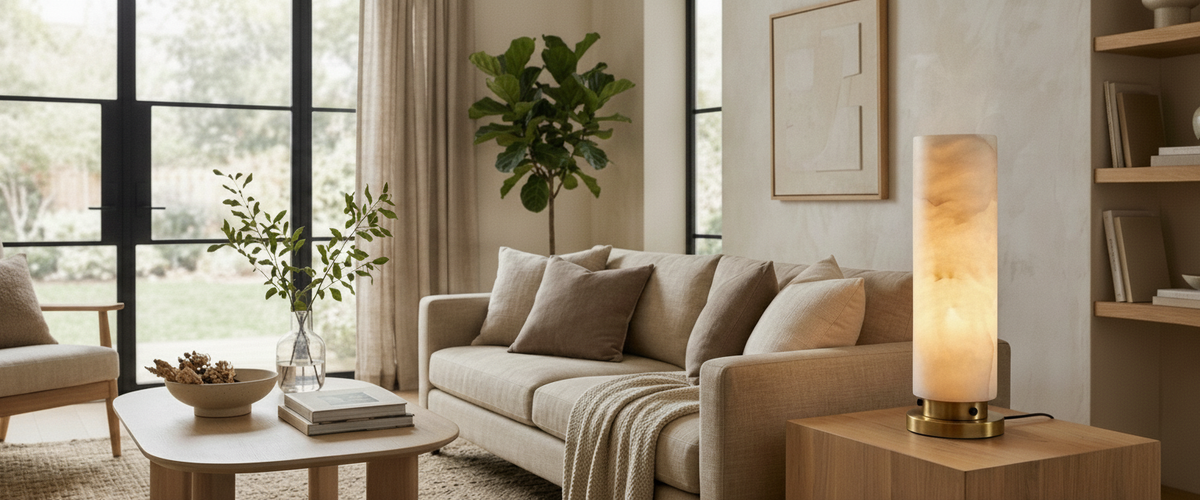

The fastest way to spot a cheap alabaster table lamps is to switch it on. Hold a warm bulb behind good stone and the surface comes alive with soft amber depth and slow-moving veins. Hold the same bulb behind thin, overworked stone and you get a flat grey-white panel that may as well be resin. The lamp lives or dies on the stone, the bulb behind it, and where it lands in the room. Everything else is detailing.
Good stone glows from within when lit with a warm bulb.
Alabaster has been carved for light and ornament for thousands of years precisely because it lets light through without going clear, a quality the British Museum documents across Egyptian and Mesopotamian pieces. That same translucency is why we build so much of the Niori range around it. But the word covers a wide quality range, and a buyer needs to know what separates a piece worth keeping for decades from one that disappoints within a year.

Key Takeaways Before You Buy
Stone quality beats everything. Translucency and veining decide whether the lamp glows or greys.
Bulb temperature is non-negotiable. Warm light (around 2700K) is what makes alabaster sing.
Match the base to its surface. A column lamp on a narrow nightstand reads very differently from the same lamp on a wide console.
Antique, vintage and modern read three ways from the same material; pick the era that suits the room, not the trend.
Cordless can be genuinely useful in the right spot, and pointless in the wrong one.
Care is light-touch but real. Alabaster is soft and reacts to water, so cleaning matters.

One Stone, Three Stories: Antique, Vintage and Modern
The same alabaster reads completely differently depending on how it has been cut and mounted. An antique alabaster table lamps tends to carry carved detail, fluted columns, urn shapes, sometimes a marble or gilt-bronze base. It signals age and ceremony, and it suits panelled rooms, libraries and traditional bedrooms. The trade-off is that older wiring and fittings often need replacing before the lamp is safe to run, so factor that into the real cost.
A vintage alabaster table lamp, roughly mid-century onward (think 1940s to 1970s), usually softens the carving. Think rounded urns, simpler turned bases, a warmer everyday feel. These pieces sit happily in a mixed interior where nothing is trying too hard. A modern alabaster table lamp strips the silhouette back to geometry: clean columns, discs, segmented blocks, paired with brass that is brushed rather than polished. The stone does the talking instead of the carving.
None of these is better. They are three different moods drawn from one material. If you are furnishing a calm, contemporary room, an alabaster modern table lamp gives you the glow without the period weight; a segmented base like the Alverin Segmented Alabaster Table Lamp shows how brass and stacked stone can read clean rather than ornate. If the room already leans classical, a vintage or antique piece will feel rooted rather than borrowed. You can browse the full spread of forms across our alabaster lighting range to see how the same stone shifts character from base to base.
One material, three moods: carved antique, softened vintage, and pared-back modern.
What a Warm Bulb Does Inside Carved Alabaster
Glass scatters light at the surface. Ceramic blocks it. Alabaster does something neither manages: it carries light about 2 to 4 millimetres into the stone, so the veining glows from within rather than catching the surface. That depth is the whole point, and it depends entirely on bulb choice.
Use a warm white LED in the 2700K range. Cooler bulbs (3500K and up) turn the amber tones grey and kill the effect; you have effectively paid for stone and lit it like a bathroom. We tell every customer the same thing: buy the lamp, then buy the right bulb, because the wrong one wastes the material. A dimmable warm bulb is better still, letting the lamp drop to a low evening ember.
The lighting industry guidance on colour temperature is worth a glance if you want the technical reasoning, but the short version is simple. Warmer is kinder to skin tones, to wood, and especially to natural stone. A few watts of LED behind good alabaster will out-perform a far brighter cold bulb for atmosphere every time.
Reading Veining and Translucency Before You Pay
This is where money is won or lost. Before you commit, look for a few specific things.
Translucency: ask to see the lamp lit, or request a lit photo. Good stone shows warmth and movement; poor stone stays opaque and flat.
Veining character: natural alabaster carries irregular, organic veins. Suspiciously uniform patterning can mean a synthetic or heavily reconstituted material.
Wall thickness: too thin and the stone looks bleached and fragile when lit; too thick and almost no light escapes. The makers who get this right are balancing both.
Natural marks: small inclusions and cloudy patches are normal and often beautiful. Cracks that run through a wall are not; those are structural.
Because every block of alabaster is unique, no two lamps light identically. The Natural Stone Institute notes that this variation is inherent to the material rather than a flaw. Treat the photo on screen as a guide to the form, and expect your piece to carry its own grain.
Base Proportion: Console, Sideboard or Nightstand
A beautiful lamp on the wrong surface looks like a mistake. Proportion is the quiet skill here.
On a nightstand, keep the lamp compact and tall enough that the light falls at reading height when you are sitting up in bed. Where the bedside surface is shallow and you need warmth without crowding a glass of water and a book, a small rounded piece such as the Marveta Small Rounded Alabaster Table Lamp sits more comfortably than a tall statement base. On a sideboard or console, you have room for a taller column or a segmented base, and a pair reads beautifully flanking a mirror or artwork. On a wide console in an entrance hall, scale up rather than down; a timid lamp on a generous surface looks lost, and a vertical column such as the Altessa Vertical Alabaster Table Lamp holds its own against the height.
A useful rule from the studio: the lamp should sit at roughly two-thirds the height of the piece behind it if there is one, and the shade or stone body should never overhang the front edge of the surface. We once helped a client in a tall Georgian hallway who had bought a lamp that looked perfect online and arrived dwarfed by a six-foot (about 1.8 m) console. The fix was a taller column lamp, and the room finally settled. If you want to compare heights and footprints across the wider catalogue, the full lighting collection lists dimensions for each piece.
Cordless and Rechargeable Alabaster: Useful or Gimmick?
A cordless alabaster table lamp is genuinely useful in places a flex cannot reach: a dining table centre, a deep windowsill, an outdoor terrace table on a summer evening, a bathroom shelf away from a socket. The soft alabaster glow works well at low rechargeable output, and you avoid drilling or trailing cables across a room.
It becomes a gimmick when you buy it for a spot that already has a socket two feet (about 60 cm) away. Rechargeable units add cost, hold a battery that will eventually need replacing, and usually run at lower brightness than a mains lamp. So the honest test is location. If the lamp needs to move, or sits where wiring is genuinely awkward, cordless earns its place. If it lives permanently on a bedside table beside a plug, a mains lamp gives you more light for less compromise.
Keeping the Stone Glowing Instead of Greying
Alabaster is a soft stone and slightly soluble in water, which is exactly why it must never be cleaned like glass. Greying over the years usually comes from one of three things: a build-up of dust and grease dulling the surface, water marks, or a cold bulb fooling you into thinking the stone has changed. The stone rarely has.
Keep it simple:
Dust regularly with a dry, soft cloth or a clean make-up brush for carved detail.
For marks, use a barely damp cloth and dry immediately; never soak it and never use household sprays, which can etch the surface.
Keep lamps off wet surfaces and away from steam where you can.
Lift from the base, not the stone body, especially on taller column lamps.
If the glow looks flat, change the bulb to a warm 2700K LED before you assume the stone is tired.
Looked after this way, a good alabaster table lamp ages slowly and gracefully. The stone was formed over geological time; a few decades on a console will not trouble it. The thing most likely to fail first is a cheap bulb or a cold one, and both are easily fixed.
How to Choose Yours
Start with the room and the surface, not the lamp. Decide whether you want the period weight of an antique or vintage piece or the quiet geometry of a modern base. Then judge the stone on translucency and veining, confirm it takes a warm dimmable bulb, and check the height against the surface it will live on. Pricing across alabaster lamps depends on the stone, the scale, the metalwork and the engineering, so the sensible move is to request a tailored quote rather than chase a headline figure. Get those decisions right and the lamp will glow for years instead of greying into the background.